The Science Behind Personal Color Analysis and Color Compatibility
A full technical explainer on visual neuroscience, color spaces, and evidence behind color compatibility.
Quick answer
The science behind personal color analysis comes from human color perception, opponent-process vision, and measurable color dimensions such as hue, value, and chroma.
What you will learn
- Human color perception is biologically grounded but context-dependent.
- Hue, value, and chroma are measurable dimensions behind palette logic.
- Personal color systems are useful frameworks with known limits and edge cases.
Human Color Perception: Physiology and Neuroscience
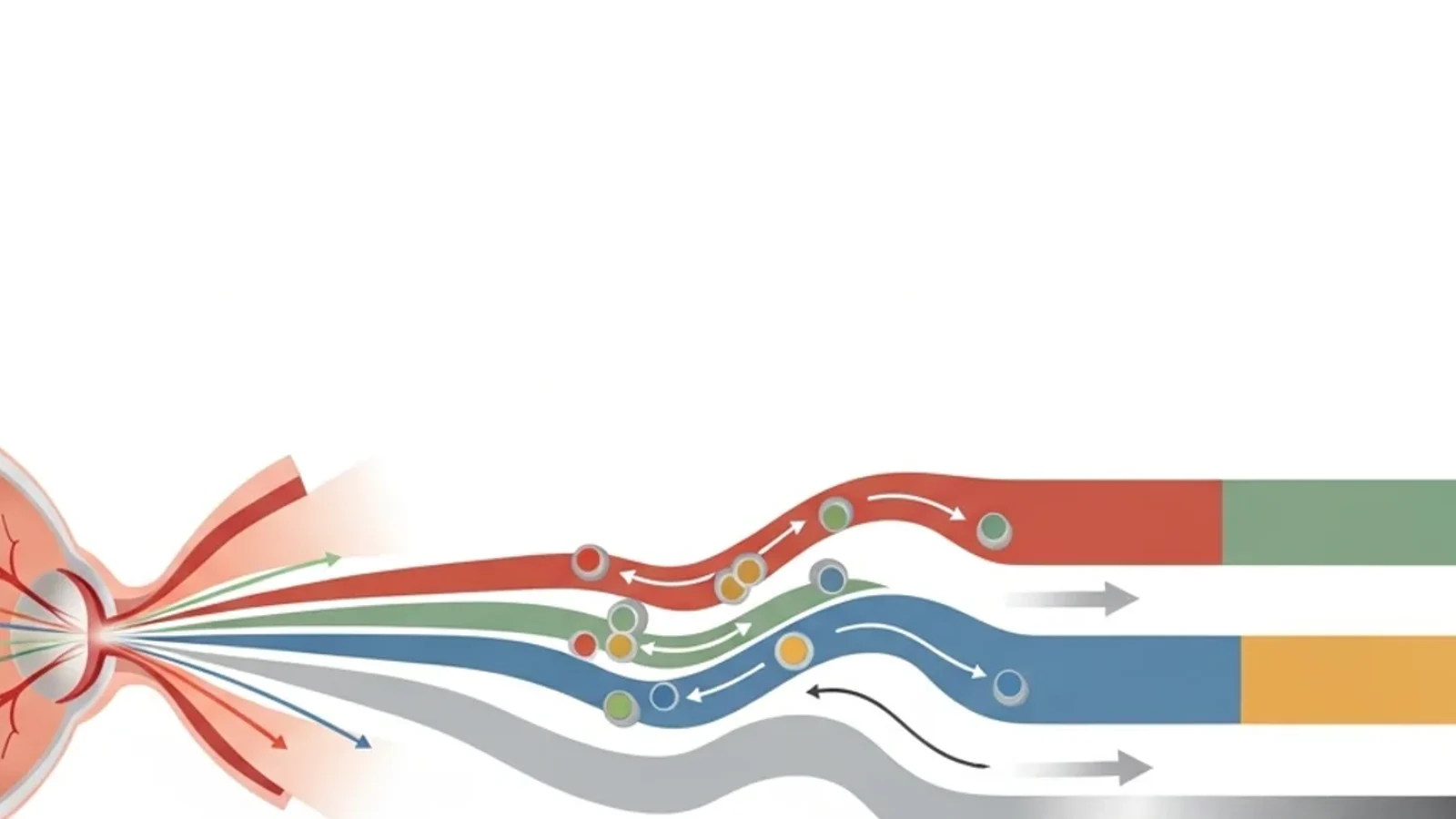
Human color perception begins with specialized cells in the retina and extends through complex neural pathways in the brain. Cone photoreceptors in the eye – traditionally three types in humans (L, M, and S cones sensitive to long, medium, and short wavelengths respectively) – are the foundation of trichromatic vision. These cones respond to different parts of the spectrum and their signals are combined and compared to produce the sensation of color1. For example, signals from L and M cones are compared in an opponent channel that roughly corresponds to a red–green axis, while signals from S cones are compared against a combination of L+M in a blue–yellow channel23. This is known as the opponent-process theory, originally proposed by Ewald Hering, which explains why we do not perceive “greenish red” or “yellowish blue” – certain cone signals physiologically cancel each other out, leading to mutually exclusive color perceptions (red vs. green, blue vs. yellow)24. Additionally, a luminance channel (light–dark) carries information about brightness contrasts2.
Once the retina encodes these opponent signals, they are relayed through the optic nerve to the brain. Neurons in the lateral geniculate nucleus (LGN) of the thalamus receive opponent-color input: for instance, some LGN cells are excited by signals from L-cones and inhibited by M-cones (creating a red–green differential response), while others are excited by S-cone input and inhibited by L+M input (blue–yellow response)3. These neural circuits enhance color differences and contribute to color contrast effects. In the primary visual cortex (V1), “double-opponent” cells integrate signals from multiple cones in their receptive fields to detect color contrast edges – essentially comparing color in one region of a visual scene to surrounding regions5. As visual information progresses to higher areas like V2 and V4, more complex processing occurs: cells begin to respond to specific hues and work to maintain color constancy (so that an object’s color looks stable under different lighting)67. This hierarchical processing allows the brain to differentiate millions of colors and maintain stable color perception in varied environments7.
The physiological basis of color vision thus combines trichromatic encoding at the photoreceptor level with opponent encoding at neural levels. This dual theory (trichromacy + opponent processes) aligns with our subjective experience: we can describe most colors by three primary dimensions, yet we intuitively sort those colors into “cool” versus “warm” or “light” versus “dark” categories that mirror the opponent and luminance channels. Notably, the terms “warm” and “cool” themselves stem from perceptual psychology: longer-wavelength light (reds, oranges, yellows) tends to evoke sensations described as warm or arousing, whereas shorter wavelengths (blues, blue-greens) feel cool or calming8. These associations likely arise from both physiological effects (e.g. red light can increase arousal) and cultural metaphors (fire is warm, water is cool). The neuroscience of color differentiation therefore provides a foundation for understanding how humans perceive and categorize colors – an essential context for personal color analysis systems, which implicitly rely on the fact that people discern subtle color differences in skin, eyes, and hair and respond to color combinations in patterned ways.
Objective Color Models and Perceptual Color Spaces
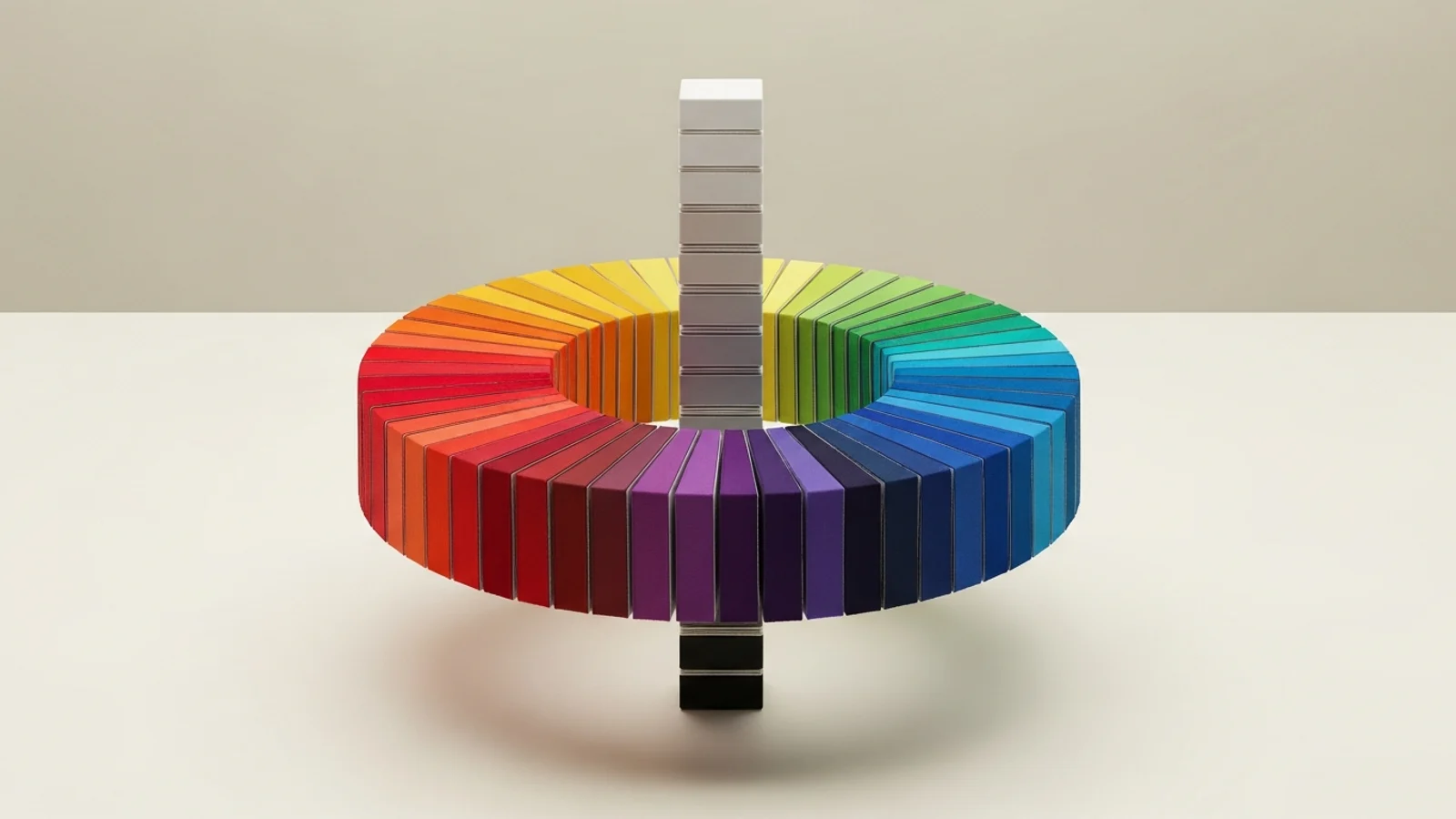
To bridge human perception with measurable color properties, scientists and artists have developed objective color models. These models provide a standardized, numeric description of colors and help relate them to perceived color harmony. One of the earliest and most influential systems was developed by Albert H. Munsell in the early 20th century. Munsell, an artist seeking an orderly way to teach and communicate color, devised a three-dimensional color model defined by Hue, Value, and Chroma9. Hue refers to what we normally think of as color family (red, yellow, green, etc.), Value refers to lightness (from black at the bottom to white at the top), and Chroma refers to color purity or saturation (intensity of the hue)1011. Munsell’s great innovation was to empirically calibrate these dimensions so that equal steps in any attribute were as uniform as possible in visual perception11. Through extensive testing of human visual response, he adjusted his system until a change of, say, one step in value or one step in chroma produced a roughly equal perceptual difference11. The outcome was the Munsell Color Order System, often visualized as an irregular color solid (sometimes depicted as a sphere or tree): hues arranged circularly, value running along a vertical axis, and chroma extending outward. Because different hues achieve different maximum chroma (for example, vivid yellows are much brighter than the most vivid blues), the solid is not a perfect sphere – Munsell eventually developed a lopsided “color tree” to accommodate this reality1213. Crucially, Munsell’s system allowed for a notation of color (e.g. 5R 6/10 to describe a specific red) that is objective and reproducible, and it laid the groundwork for understanding color relationships. Colors with similar value or chroma can be grouped, and harmonies could be explored by geometric relations in this 3D space (though Munsell himself did not rigidly define harmony formulas, later researchers and color analysts have experimented with concepts like conical spirals slicing through the Munsell solid to identify harmonious palettes)1415.
In parallel with artist-developed models like Munsell’s, scientists formalized color measurement with systems like the CIE XYZ model (defined in 1931 by the International Commission on Illumination). CIE XYZ is based on averaging human color matching data and provides a device-independent mathematical description of color. All visible colors are represented as combinations of three primaries (X, Y, Z), which correspond to hypothetical receptors and are linearly related to the cone responses of a “standard observer.” While XYZ is useful as a technical reference, its coordinate system is not perceptually uniform – the same numerical distance in XYZ space might not feel like the same degree of color difference to an observer16. To address this, the CIE later developed CIELAB (Lab), a color space from 1976 designed to be more perceptually uniform16. CIELAB uses three coordinates: L for lightness (corresponding to human brightness perception) and a and b for color axes roughly aligned with the opponent-color dimensions of vision1617. In fact, CIELAB explicitly encodes color in a way similar to our visual processing – with a red–green axis (a: negative values = green, positive = red) and a blue–yellow axis (b: negative = blue, positive = yellow)17. Because of this design, complementary hues in the perceptual sense tend to lie opposite each other in CIELAB space (e.g. a positive a red is opposite a negative a green)18. The intent was that a small change in any direction of L, a, or b* would correspond to a just-noticeable change to the human eye16. In practice CIELAB isn’t perfectly uniform (certain regions like the blue hues still have distortions19), but it became widely used in industry for quantifying color differences (the Delta-E metric) and communicating color standards.
Other advanced color spaces and color appearance models have been developed to refine perceptual uniformity or account for viewing conditions. One example is the IPT color space (introduced in 1998), which was designed for improved hue linearity over CIELAB. In IPT, the components (I, P, T) are transformations of XYZ intended to better align with how humans perceive hue differences (especially addressing the non-uniformity of blue hues in Lab)2021. Such models attempt to ensure that equal distances anywhere in the space correspond to equal perceived color differences. These uniform color spaces are invaluable for discussing color harmony objectively: many classical definitions of harmony involve some form of balance or complementarity that can be visualized in a color space. For instance, one idea of a harmonious palette is a set of colors of equal saturation and lightness (lying on a horizontal slice of a color solid), or direct complements (opposites on a hue circle) for high contrast. However, research shows that predicting aesthetic harmony is not as simple as picking opposites on a diagram. A study on complementary color harmony found that colors exactly opposite in CIELAB were not always perceived as optimal complements – there were systematic deviations, meaning our perception of what looks best together isn’t perfectly captured by geometric opposites in a uniform space2218. This indicates that while objective models provide a framework, human preference and perception add another layer of complexity to defining “harmony.”
In summary, objective color models like Munsell, CIE XYZ, CIELAB, and IPT provide the scientific structure that underlies color analysis. They quantify hue, lightness/value, and chroma/saturation in a way that correlates to human vision. Personal color analysis systems often borrow the terminology and logic of these models – especially Munsell’s hue/value/chroma system – to describe an individual’s coloring and palette in rigorous terms2324. The idea of finding flattering colors is frequently framed as finding colors that share certain measured attributes with one’s natural coloring, creating a visual harmony that can be explained both artistically and in terms of colorimetry.
Ready to apply this to your own wardrobe?
Use your personal palette as the fastest filter for what belongs near your face.
Hue, Value, and Chroma in Personal Color Analysis
At the heart of personal color analysis (PCA) is the idea that every individual’s natural coloring can be characterized along three primary dimensions – analogous to hue, value, and chroma – and that the colors which best flatter that individual will share those characteristics. In seasonal analysis systems (such as the popular 12-season or 12-tone systems), each season or color type is essentially a unique combination of hue temperature, value level, and chroma intensity25.
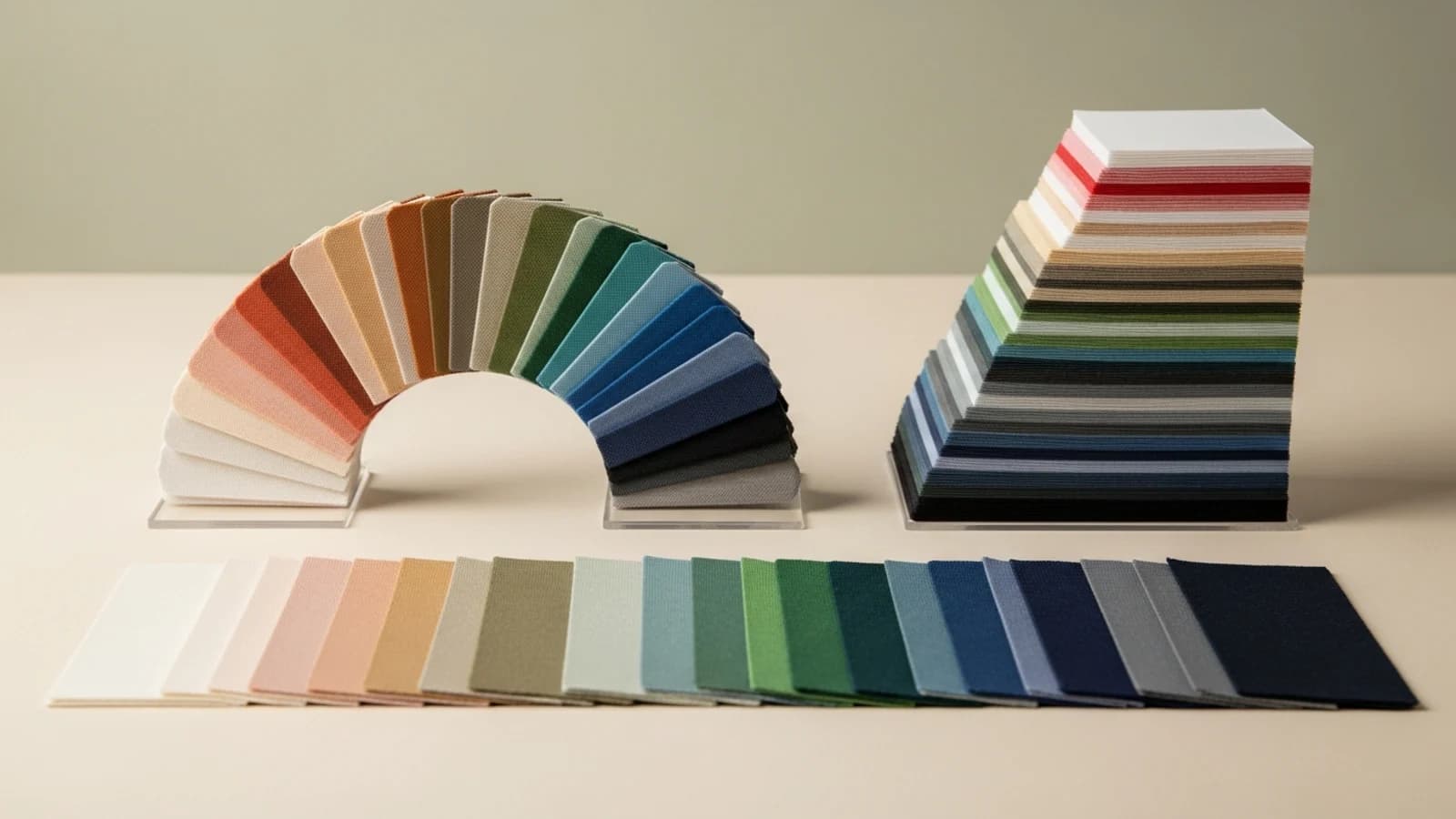
Not every system uses identical terminology, but all major personal color analysis approaches include these three factors in some form. The 12-season Sci/ART system explicitly notes that each of the 12 harmony groups (subseasons) is characterized by a unique combination of hue temperature, value range, and chroma level25. For instance, True Winter (also called Cool Winter) is defined as completely cool in hue, medium-to-dark in value, and relatively high in chroma (though not the absolute brightest)31. In contrast, Soft Autumn would be warm in hue, medium in value (not extremely dark or light), and low in chroma (muted). By assessing a client with test drapes, an analyst is essentially measuring which hue/value/chroma settings flatter the face – the drapes function as “fine mathematical tools” to gauge the face’s color dimensions23. This process is often described in pseudo-scientific terms by consultants: they might say “we measure the color dimensions of your face”23. In reality, it is a trained visual evaluation, but it’s grounded in the idea that your complexion and eyes reflect specific HVC coordinates that can be matched. When a person wears colors that share their skin’s undertone (hue), that fall in the same general lightness range, and have a similar softness or brightness, the overall effect is harmonious – the clothing looks like an extension of the person, and the viewer’s eye is drawn to the person’s face rather than to any single color disparity.
- Hue in PCA context usually refers to the temperature of the color – whether it is warm (yellow/golden undertones) or cool (blue/pink undertones). A person’s overall coloring can lean warm, neutral, or cool in hue. Palette colors are chosen to match that: e.g. a “True Summer” or “Cool Summer” type will have an absolutely cool hue bias, meaning their best colors are those with cool, bluish undertones, whereas a “Warm Spring” will have strictly warm, yellowish undertones in their palette25. In the language of color science, this roughly corresponds to the dominant wavelength range or balance of a color (more yellow/red versus more blue content). Interestingly, hue is often called the “emotional” dimension of color because different hues carry strong psychological associations26 (for example, green might feel refreshing, red exciting, blue calming, etc.). Personal color systems leverage this by noting that the wrong hue (too warm or cool for a person) can clash with their innate coloring – observers might describe the effect as the person looking “flushed” or “sallow” when wearing an out-of-sync hue.
- Value refers to the lightness or darkness of the color. This is perhaps the most visually apparent aspect of both a person’s coloring and any given outfit – our visual system is highly attuned to value contrasts27. In PCA, value is considered critical: some individuals have predominantly light coloring (e.g. light blonde hair, fair skin, light eyes), so very dark, heavy colors may overwhelm them. Others have deep coloring (dark hair, deeper skin tone or eyes), and they carry off dark colors well but may look washed out in pastels. Value is also tied to contrast level in one’s natural appearance: for instance, a person with very light skin and very dark hair has high contrast (a “Winter” trait in seasonal analysis), whereas someone with medium skin and medium brown hair has low contrast (often seen in “Summer” or “Autumn” types). PCA palettes aim to mirror these value levels. A “Light Summer” palette, for example, contains mostly lighter-value colors to harmonize with a light-featured person28. Value has been called the most “informational” color attribute for vision27 – our brains rely on light/dark differences to read shape and facial features – so wearing the right value contrast can even influence how vibrant or defined one appears. High-value contrast clothing on a low-contrast person can make their features recede, whereas matching the level of contrast tends to look balanced.
- Chroma (or saturation) indicates how pure/intense vs. muted/greyed a color is. In Munsell terms this is chroma; in everyday terms, a bright neon pink has high chroma, while a dusty rose is low chroma. Individuals also have an apparent chroma to their coloring: some have very bright, clear eye colors and a certain clarity to skin and hair – they tend to shine in brighter, saturated colors. Others have a softer, more muted coloring (perhaps “soft” gray-blue eyes, or hair that’s a blend of shades); such individuals often look best in softened, less saturated tones that echo that gentle quality. Thus, seasonal palettes are often distinguished by chroma: e.g. the difference between a Soft Summer (muted chroma) and a Bright Winter (high chroma) is the intensity of the colors they wear2825. Chroma is sometimes described as the “attracting” or attention-grabbing quality of color29. In PCA, over-saturated colors on a person with low-chroma coloring can steal the attention (the color wears them instead of complementing them), whereas the right level of chroma makes the person, not the garment, stand out. For example, a bright, jewel-toned fuchsia might overwhelm someone with delicate coloring, whereas a person with vivid natural coloring (clear eyes, sharp contrast) might sparkle in it.
The Enigma of “Warm” vs “Cool” Skin Undertones
One of the most prominent (and often misunderstood) concepts in personal color analysis is the skin undertone – commonly described as “warm” or “cool.” In PCA, determining whether someone has a warm (yellow/gold-based) undertone or a cool (blue/pink-based) undertone is a crucial step in narrowing down their best palette. However, from a scientific perspective, skin undertone is a nuanced and somewhat ambiguous phenomenon.
In dermatological and colorimetric terms, human skin color is influenced by a combination of pigments: primarily melanin (in two forms, eumelanin and pheomelanin) which can impart brown, black, or slightly reddish hues, and hemoglobin (blood under the skin) which adds pinkish-red tones, as well as carotene which can contribute a golden yellow cast. The balance of these factors, along with depth of skin tone (light to dark), creates a continuous spectrum of skin colors – not a binary warm/cool switch. When color analysts speak of a “cool” undertone, they usually mean skin that, compared to others, appears pinkish, rosy, or with hints of blue-red; a “warm” undertone appears more golden, peachy, or yellow-olive. In effect, they are talking about the subtle predominance of redness vs. yellowness in the skin’s coloration. Color scientists can actually measure these attributes: using color instruments, skin color can be quantified in a color space (often CIELAB) with coordinates for lightness (L), red-green (a), and blue-yellow (b). Undertone in that context would correspond to the a and b values – a higher a (more red) and lower b (less yellow) might indicate a “cool pink” undertone, whereas a higher b (more yellow) with slightly lower a might indicate a “warm” undertone. Notably, measured values for human skin almost always fall in the positive a (some red) and positive b* (some yellow) range32 – humans don’t have truly green or blue skin, of course, so the distinction is relative redness vs. yellowness.
Scientifically, determining undertone is tricky because these redness/yellowness balances can shift with conditions. Research has shown that readings of skin color (using spectrophotometers or colorimeters) can vary depending on where on the body you measure and even the instrument aperture used3334. For example, the inner arm might register less reddish than the face (since blood flow and sun exposure differ), and a larger measurement area might capture more varied tones than a small one3533. One study found that measures of skin “undertones” (redness and yellowness) were quite sensitive to these technical factors, whereas overall lightness was more stable3637. In other words, calling someone definitively warm or cool can oversimplify – a person might test slightly warm in one spot and slightly cool in another, or their skin’s apparent undertone might change with a flush of emotion, a change in diet, or lighting conditions38. Indeed, momentary fluctuations in blood flow (from temperature or emotion) can increase redness, temporarily altering one’s appearance38. These facts underscore that “undertone” is not a fixed attribute like eye color; it’s a subtle balance that can be influenced by context.
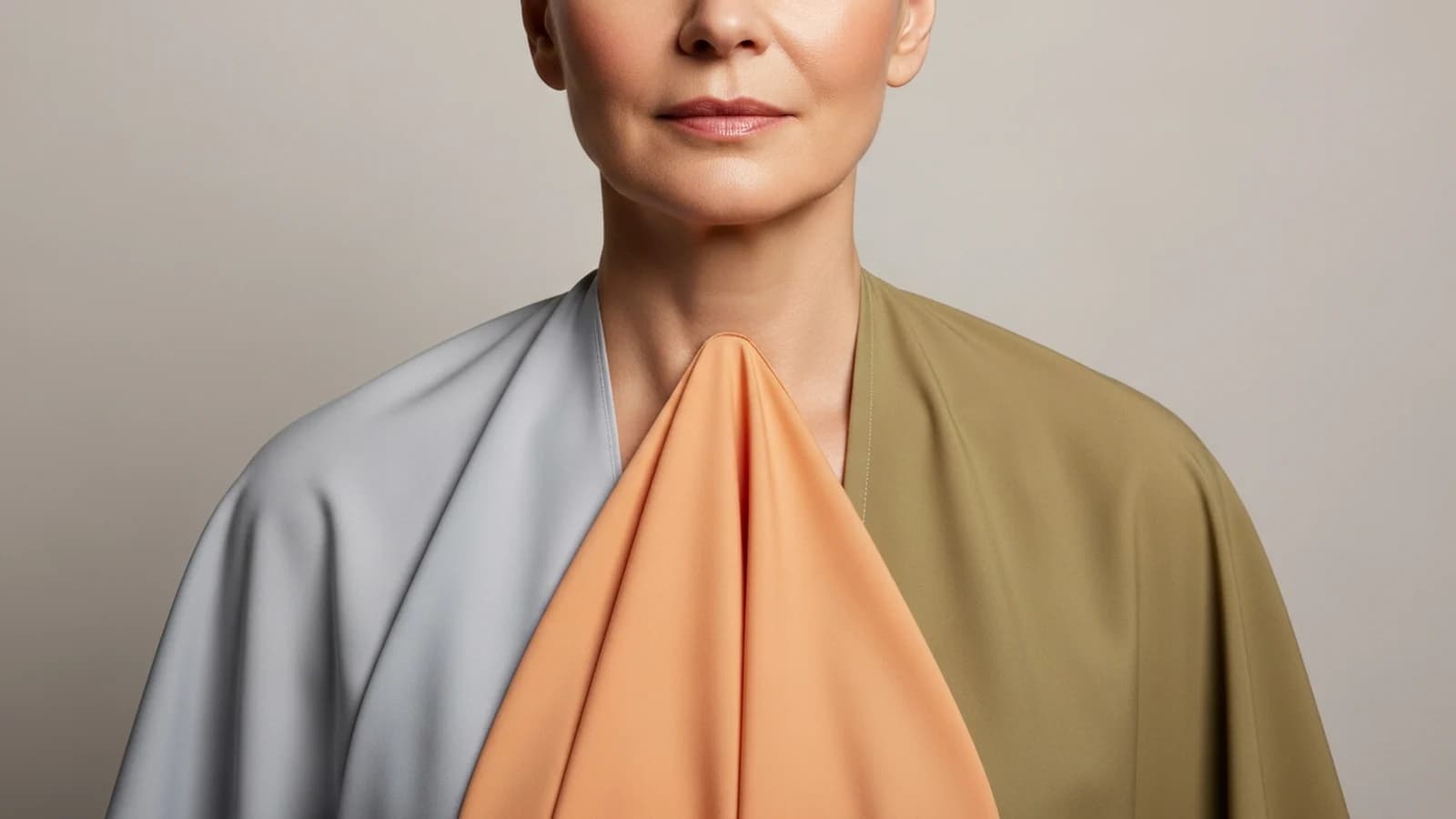
Yet, the warm vs. cool paradigm persists because it does capture a real visual phenomenon in broad strokes. People with very high levels of oxy-hemoglobin in fair skin, for instance, have a noticeable pink (cool) blush to their complexion; people with more carotene or with olive (yellow/greenish-brown) cast appear golden (warm). The ambiguity of undertone arises especially for those in the middle – many individuals are neither obviously peachy nor obviously pink, but somewhere neutral. PCA systems often add a “neutral” category for undertone, acknowledging that not everyone fits neatly into warm/cool. Moreover, the language of undertones can be confusing: in everyday terms, we might describe a “ruddy” (reddish) complexion as warm (because red is a warm color), but in color analysis such a person is labeled “cool” because the red/pink in their skin is closer to blue-red than yellow. Conversely, someone with sallow or yellowy skin might be called “warm.” This is a semantic quirk that can trip people up – the key is that undertone refers to the base hue of one’s skin relative to other skin, not the absolute temperature of the color red vs. yellow.
From a scientific viewpoint, it may be more accurate to say each person’s skin has a particular position in a 2D redness–yellowness space, rather than a binary warm/cool label. Some recent research in color science and social psychology has even examined skin color in these two dimensions to see how they correlate with perceptions of health or attractiveness. For example, slight increases in redness can signal blood flow and health (up to a point), and increases in yellowness (from diet, such as carotenoid intake) can also make a face appear healthy – but these are subtle and can be misinterpreted38. The bottom line is that undertones are real, but they are complex. Personal color analysis simplifies this by calling you warm, cool, or neutral based on comparative draping tests: if silver (cool) fabric makes your skin clarity improve and yellow-gold (warm) makes it worse, they’d deduce you have a cool undertone, for instance. This method, while subjective, attempts to factor in how your undertone behaves under different lighting (since drapes reflect light onto your face). Scientifically, what they are seeing might be that a mismatched undertone causes undesirable optical effects – a too-warm drape on a cool-undertoned face can throw greenish or yellowish reflections onto the skin, exaggerating shadows or blemishes, whereas the right undertone fabric will reflect flattering light. These observations have some basis in physics (complementary colors can emphasize or cancel skin tints by contrast effects), but there’s a need for more formal research to quantify it.
In summary, the warm vs. cool dichotomy in PCA is a useful heuristic rooted in genuine visual differences, but it glosses over the continuous and context-dependent nature of skin color. Scientifically, we prefer to talk about skin color dimensions (lightness, redness, yellowness) rather than strict categories. Recognizing this nuance can help temper expectations – an individual might find they don’t perfectly fit the textbook definition of either undertone, which is normal. The strength of PCA is in using draping to see overall harmony, not in labelling a person’s undertone in isolation as an absolute property.
Evolution of Personal Color Analysis Systems
The idea of matching personal coloring to harmonious colors has a surprisingly rich history, intertwining art, fashion, and color science. A often-cited starting point is the work of Johannes Itten in the early 20th century. Itten was a Swiss painter and instructor at the Bauhaus who noticed that his art students gravitated toward different color palettes in their paintings, often ones that reflected elements of their own coloring or personality. He coined the concept of “subjective color harmony” or “subjective timbre,” observing that individuals choose colors and contrasts that resonate with their personal traits39. In teaching color harmony, Itten famously associated palettes with the four seasons – a metaphorical linkage where, for instance, a person with bright, high-contrast coloring might be likened to Winter (sharp, bold colors), whereas someone with delicate, light coloring might be a Spring or Summer type with gentler colors. Itten’s four-type framework (Spring, Summer, Autumn, Winter) was more art analogy than rigorous system, but it planted the seed that one’s “personal palette” could be described in seasonal terms40.
Building on these ideas, Suzanne Caygill, an American designer in the mid-20th century, developed one of the first formal personal color analysis systems. In the 1940s–50s she began categorizing people into the four seasonal groups and eventually wrote Color: The Essence of You (published 1980) detailing her methodology41. Caygill’s approach was quite intricate – she believed every person had a unique color “essence” and created customized palettes. Within each of the four broad seasons, she described numerous sub-types (e.g. “Early Spring,” “Metallic Autumn,” “Dynamic Winter”) with poetic names, acknowledging that not everyone in a season is identical41. These subgroups attempted to capture variations in intensity, softness, etc., although the system was still qualitative. Caygill’s work had a devoted following and she’s considered a pioneer of custom palette color analysis. Her contemporary, Carole Jackson, brought seasonal color analysis to the masses with the hugely popular Color Me Beautiful book in 198042. Jackson simplified things back to four seasons for accessibility and told readers to sort themselves by traits like whether they looked better in off-white or pure white, gold or silver, etc. (the classic DIY tests). Color Me Beautiful was a cultural phenomenon – it put seasonal analysis on the map and was explicitly aimed at (mostly) white Americans in its first incarnation43. Jackson’s system and its many licensed consultants in the 1980s typically draped clients in the four seasonal palettes. It was, however, relatively simple and often criticized for not accounting well for the diversity of human coloring (many people didn’t fit cleanly, and people of color found the system confusing or inapplicable at times4445).
The next leap came with efforts to increase the precision of color analysis. After the initial fad waned, practitioners in the 1990s sought to refine the four-season system. The influence of scientific color order systems (like Munsell) became more explicit during this period. Notably, Kathryn Kalisz – who had studied color science at the Munsell Color Institute – developed the Sci/ART 12-tone system around 20004647. Kalisz’s approach was a “science meets art” philosophy48. She expanded the palettes to 12 categories (often called the 12 seasons or 12 tones), by adding three sub-seasons under each of the traditional four: for example, Autumn became Soft Autumn, True/Warm Autumn, and Deep Autumn; Summer became Light Summer, True/Cool Summer, and Soft Summer, and so on49. Each of these 12 was defined by a distinct Hue-Value-Chroma profile as we’ve discussed. What set Sci/ART apart was its more rigorous draping methodology and attempt to remove bias. Kalisz insisted on analyzing people in a controlled, neutral-gray environment with full-spectrum lighting, using large drapes that fully cover the person’s torso50. This was done to let the reflected light of the drape onto the face be the main variable. By using larger swaths of color up close to the face (as opposed to small swatches held at a distance, which older systems sometimes did51), the Sci/ART method could better simulate how wearing a garment of that color would actually influence appearance52. Kalisz also downplayed the importance of matching hair/eye color or racial stereotypes – earlier approaches might have assumed, for instance, all people with dark skin are “Autumns” or all blondes are “Springs.” Sci/ART taught consultants to “read the skin” directly under the drapes, watching for effects like healthy glow vs. ashy shadows, eye clarity vs. dullness, etc., rather than relying on the client’s inherent coloring alone5354. This more empirical approach aimed for repeatable results – in essence, treating draping as an experiment with a hypothesis (e.g. “might this person’s optimal palette be soft/cool vs. bright/cool?”) and then systematically confirming by comparison.
The Sci/ART system explicitly drew from Munsell’s concept of a three-dimensional color space24. Every color in the drapes was mapped back to known HVC coordinates, and the 12 palettes themselves can be plotted as regions in the Munsell solid. In Sci/ART theory, any given color belongs in only one of the 12 tone groups55. This is an interesting point: earlier, looser systems might include similar colors in multiple season palettes, but Sci/ART would classify, say, a specific shade of blue into exactly one palette based on its measured hue/value/chroma (if it’s too bright it won’t be in a Soft palette, if it’s too cool it won’t be in a Warm palette, etc.)55. Analysts trained in this method often work almost diagnostically: they may drape and conclude “this blue is too muted for you, it’s better suited for a Summer; you clearly need more chroma, which points us toward Winter”. In theory, if one had the Munsell coordinates of the client’s skin, eyes, and hair, one could predict their season by locating where those coordinates cluster, but in practice it’s more complicated – hence the need for many comparisons via draping.
Since Sci/ART, other systems have emerged or splintered, some extending to 16 types or other variations. But most modern approaches still owe a debt to Itten’s seasonal metaphor and to Munsell’s scientific structure. The 12-season model is probably the most widely used among professional color analysts today, thanks to its balance of nuance and manageability. It’s worth noting that these systems attempt to structure color harmony visually by imposing categorical order on a continuous space. The human eye can distinguish millions of colors, but a consultation has time to test only a few dozen drapes. The seasonal structure acts as a shortcut: by grouping colors into preset harmonious collections, the analyst can jump between palettes rather than testing every color individually56. As Chromology (a Sci/ART-based consultancy) explains, doing a purely individual, unconstrained test of all colors would be impractical – “if we were to compare individual, ungrouped colours from the Munsell system... your consultation would last days”57. So the seasons are a bit of a compromise: they assume that if, for example, Soft Summer is the best fit, all colors within that predefined palette will be harmonious with the person, even if the client didn’t personally get draped in every single one. This works fairly well, but it is also a source of imperfection (real humans don’t always fit neatly into one of 12 boxes). Nonetheless, the historical evolution shows a clear trajectory: from a subjective art to a pseudo-science – each iteration adding more analytic rigor and finer differentiation to address the tremendous variety in human coloring.
Ready to apply this to your own wardrobe?
Use your personal palette as the fastest filter for what belongs near your face.
Color Harmony, Aesthetics, and Scientific Evidence
Personal color analysis is predicated on the notion of color harmony – specifically, the idea that the colors worn by an individual can either harmonize with their natural coloring or clash with it. But what does “harmony” mean in this context, and is there scientific evidence for it? This question straddles the domains of perceptual psychology (what looks pleasing to the eye?), cognitive science (how do we judge faces and colors together?), and even social psychology (how do colors influence impressions?).
From a color theory perspective, harmony often refers to combinations of colors that are pleasing, balanced, or dynamic without being jarring. Classical color theory (going back to Chevreul and Goethe) proposed harmonious combos like complementary colors, triads, analogous colors, etc., largely based on color wheel geometry. Personal color analysis, however, defines harmony in a person-centric way: a color is harmonious with a person if it reiterates the person’s own coloring traits. In practice, analysts often describe it like “when a color suits you, the observer’s focus goes to your face, your eyes look clearer, your skin looks healthier; but when a color is wrong, the color itself overwhelms or you notice skin flaws, dark circles, etc.” These qualitative observations hint at some underlying perceptual phenomena: contrast effects, simultaneous contrast, and even perhaps cognitive averaging. For example, a strong contrasting color might throw a shadow or emphasize a complementary tint in the face (a too-green shirt might make any red in your skin, like blemishes or rosacea, stand out more by afterimage contrast). The right color, by matching your undertone, could create a more uniform look, so the skin appears more even. While formal research directly on draping effects is scant, this is a plausible explanation in line with vision science.
There is growing research indicating that observers do have consistent preferences when it comes to the combination of clothing color and complexion. A 2021 study by psychologists showed that people tend to choose different garment colors for faces with different skin tones: given images of women with fair skin versus tanned skin, observers strongly preferred cool blue hues to go with the fair complexion and warm orange/red hues to go with the deeper, tan complexion58. In other words, they intuitively matched “cool with cool” and “warm with warm” – blue (a cooler color) was felt to suit the cooler-toned skin, whereas a warmer color was judged to flatter the warmer-toned skin58. This aligns exactly with the fundamental rule of PCA that one should wear colors that share one’s skin undertone. The same study noted that red and blue hues in general were popular choices (perhaps because those colors can provide pleasant contrast), but the shift in preference depending on skin type suggests there is an aesthetic logic that people (perhaps subconsciously) follow58. It’s a striking confirmation that the notion of harmony PCA experts talk about can be observed in a controlled experiment: complexion is a basis for aesthetic judgments about clothing59.
Other research in social psychology has explored how clothing color might affect perception of the person. There is the well-known example of red: some studies found that men perceive women wearing red as more attractive or sexually receptive (though follow-ups showed the effect is context-dependent and not as universal as once thought)60. In a professional context, small studies have hypothesized that when a person wears “harmonious” colors (for their personal coloring), they might be judged more favorably in areas like confidence or hireability, presumably because they look more put-together or vibrant. For instance, one paper (1990, reported in abstract) tested female job applicants and found that wearing colors appropriate to their personal coloring correlated with higher perceived employment potential by raters. Such effects tie into color-emotion mappings: colors carry associations (e.g. navy can signal authority, soft pastels can seem approachable, etc.) and when those align with the individual’s own appearance, perhaps the whole image appears congruent.
On the topic of color-emotion mapping more broadly: for centuries, thinkers have tried to map certain hues to emotions or characteristics. Goethe in 1810 wrote about how “plus colors” (reds/yellows) conveyed warmth and cheer, whereas “minus colors” (blue) felt cold or sad. Modern research suggests some of these associations are partly biological (we respond to color contrast like red as a sign of blood/flush) and partly cultural. For example, seeing someone in warm colors might literally raise how warm or outgoing we perceive them to be due to learned association. Color analysis doesn’t heavily delve into personality aspects these days (earlier practitioners sometimes claimed, for instance, Winters have “dynamic” personalities to match their stark coloring, but this is anecdotal). Still, there is a psychological comfort that clients often report when they wear “their” colors – they feel more confident or authentic. This could be placebo, but it could also be that when you know you look good (because the colors harmonize with you), you project more confidence, and others respond in kind.
However, not all is rosy in the realm of personal color analysis. There are limitations and controversies worth noting:
In conclusion, personal color analysis sits at an intersection between art and science. On the one hand, it leverages solid principles of color vision and color theory: the human eye’s response to color stimuli, the quantification of color in perceptual spaces, and the ways colors interact. There is scientific support for some of its claims (we do see that people tend to prefer matching clothing to complexion in experiments58, and the dimensions of color it uses are rooted in how vision works30). On the other hand, it ventures into a realm of aesthetics and individual differences that science hasn’t fully nailed down – beauty is not entirely objective. As research in vision science and psychology continues, we may better understand why certain palettes make a face look brighter or more tired (perhaps it will be explained in terms of optimal facial contrast or color constancy effects). Already, work on facial contrast (the contrast between eyes/lips and surrounding skin) shows it influences perceived age and attractiveness, and this might tie into why high-contrast Winters often get dramatic makeup recommendations whereas low-contrast Summers do not.
Personal color analysis endures because, when done well, many people feel it provides a useful framework to navigate the overwhelming world of color in fashion. It gives individuals permission to ignore trends that don’t flatter them and simplifies shopping decisions – which has a psychological benefit in and of itself (reducing decision fatigue). Whether we call it a science, an art, or a bit of both, PCA at its best is about observing closely how color and human appearance interact. With a basis in the science of human vision and colorimetry, and an eye toward aesthetic tradition, it attempts to quantify something inherently subjective: what makes someone shine. As our scientific understanding grows, these systems will hopefully become more inclusive, evidence-based, and refined – but also, one hopes, without losing the joy and self-expression that come from discovering one’s own unique array of colors.
- Cultural and Racial Bias: As mentioned, the original systems were developed primarily with light-skinned, European-descent individuals in mind44. The seasonal palettes and notions of contrast were anchored to hair/skin/eye combinations common in those populations. People of color sometimes struggle with the seasonal system – for example, a person with very dark skin, eyes, and hair might superficially think “I must be a Winter or Autumn because I’m dark,” but the original meaning of a “Dark Winter” season is someone with high contrast (fair skin with dark hair/eyes)6145. A person of color might actually have low contrast (if skin, hair, eyes are all similarly deep), which could place them in a different season despite all features being “dark.” There has been confusion and misdiagnosing, and some analysts have adapted the criteria to be more inclusive. For instance, it’s now understood that depth of skin tone doesn’t automatically dictate season – you can have a very deep-skinned Bright Winter (if the skin has cool undertones and high clarity) or a light-skinned Soft Autumn, etc. The concept wardrobe notes that many people of color initially assume they belong to a “Dark” season, but unless the dark features are the dominating aspect (prominent contrast), that might not be true4562. Real-world practice is catching up: modern color analysts are trained to drape everyone and not assume season from ethnicity. The palettes themselves have also expanded (color fans now depict how a certain hue would look on deeper versus lighter skin for makeup purposes, for example).
- Subjectivity and Analyst Variability: Despite the scientific trappings (neutral gray rooms, fabric swatches measured by spectrophotometer, etc.), determining someone’s best colors is still ultimately a judgment call. Two well-trained analysts might agree broadly but could sometimes place the same person in different seasons, especially if the person is near a borderline. It’s not like measuring blood pressure – it’s more like an optometrist test (“Which looks better, lens A or lens B?”). The client’s own vision and the analyst’s eye are the instruments. Because of this, skeptics label it an art or even a parlor game more than a science. A recent Atlantic article went so far as to call seasonal color analysis “a quasi-scientific, quasi-philosophical discipline” and likened its appeal to that of astrology – a promise of self-knowledge and belonging wrapped in pseudoscientific terms6364. That is a harsh critique, but it arises from the fact that rigorous peer-reviewed studies on PCA are few, and claims of life-changing effects are anecdotal. The counterpoint proponents offer is that any aesthetic field (fashion, makeup, interior design) has subjective elements, yet can still have guiding principles that yield consistent results when applied by trained professionals. There is also an ongoing effort to increase objectivity – for example, some companies have experimented with digital color analysis apps that attempt to algorithmically “read” a person’s coloring and find matching colors. These use color science (sampling pixels from photos) but have their own limitations (lighting in photos, etc.).
- Lighting and Context: The importance of lighting cannot be overstated in color perception. A color that looks great in midday sunlight might look dull under a fluorescent office light or oddly tinted in a boutique with warm spotlights. Personal color analysis sessions typically use simulated daylight (around 5000K–6500K, often specific D65 standard lighting)65 to approximate a neutral, natural condition. But once in the real world, people encounter all sorts of lighting. A “Spring” wearing their bright colors might not look as glowing in a dim restaurant at night (where everyone’s skin and clothes look warmer and less saturated due to incandescent lighting). This raises the question: should one adjust their palette for different contexts? In practice, most people just use their palette as a general guide and learn to tweak with makeup or accessories if needed. Still, the science of color appearance teaches us that what matters is not just the color of your shirt in absolute terms, but the interaction of that shirt color, your skin, and the ambient illumination66. Color analysts try to minimize unwanted effects by controlling conditions during analysis; it’s then up to the individual to know, for example, that the navy blue that flatters them might look almost black in a dim room (so maybe choose a slightly lighter navy for evening wear if you want the effect).
- Emotional and Personal Preferences: Another limitation is that harmony isn’t the only factor in clothing choices. Psychologically, a person’s favorite color or the cultural significance of colors for them might trump whether it’s in their palette. For instance, someone might feel empowered in bright red even if their analysis says that red is a bit too intense for them. Should they avoid it and feel less happy, or wear it with confidence and perhaps override any minor disharmony? Some experts adapt the palettes to the person’s personality (this echoes Itten’s original point that color expression is tied to who you are). It’s also worth noting that while PCA suggests people look worst in certain colors, many individuals can still wear off-palette colors successfully by using tricks like keeping the color away from the face, mixing it with a favorable color, or just compensating with makeup. So the “rules” are not absolute, and there is a healthy debate about how strictly to adhere to one’s season versus using it as a loose guideline.
Source Notes
The article includes the following annotated references from the original manuscript.
- Vision science of color perception135
- Opponent-process theory in color vision24
- Munsell color system and color space uniformity1113
- CIELAB color space and opponent axes1617
- Personal color analysis use of hue, value, chroma253029
- Warm vs. cool skin undertone nuances3638
- Historical development: Itten, Caygill, 12-season Sci/ART system4048
- Sci/ART methodology and use of Munsell science2450
- Cultural bias in early color analysis systems6167
- Criticisms of seasonal color analysis (Atlantic 2025)6364
- Experimental evidence on complexion and clothing color harmony58
- Color-emotion associations (warm vs cool)868
Sources
- Opponent process - Wikipedia
- The mechanism of human color vision and potential implanted devices for artificial color vision - PMC
- Color and psychological functioning: a review of theoretical and empirical work - PMC
- Personal Colour Analysis and the Munsell Colour Order System — Style Identity
- The Conical Spiral & Color Harmony | Munsell Color System; Color Matching from Munsell Color Company
- CIELAB color space - Wikipedia
- AIC2007 PROCEEDINGS.pdf
- Perceptually uniform color space for image signals including high ...
- Mastering Color Spaces
- SciART™ Personal Colour Analysis | Chromology – Advanced Personal Colour Analysis in London, UK
- Best Practices for Measuring Skin Color in Surveys | Published in Survey Practice
- The False Promise of Seasonal-Color Analysis - The Atlantic
- Color Analysis for People of Color | the concept wardrobe
- Clothing Aesthetics: Consistent Colour Choices to Match Fair and Tanned Skin Tones - PMC
- Complexion is a basis for the aesthetics of clothing color choices