Styling for Men's Body Types: Fit, Fabric, and Proportion
Sartorial Architecture: A Comprehensive Analysis of Men's Body Types and Proportional Styling
Quick answer
The best styling for men's body types starts with geometry: identify whether your frame reads as Rectangle, Triangle, Inverted Triangle, Oval, or Trapezoid, then use fit, fabric weight, lapels, collars, trouser line, and visual direction to add structure where you are narrow and streamline where you carry visual mass.
What you will learn
- Men's body type styling is about shoulder, waist, and hip relationships, not generic size labels.
- Heavy textured fabrics build visual mass; smooth lightweight fabrics streamline and elongate.
- Lapels, shirt collars, button stance, pocket angle, trouser rise, and trouser width can change the apparent proportions of the body.
- Rectangle, Triangle, Inverted Triangle, Oval, and Trapezoid builds each need a different balance strategy.
The discipline of menswear is fundamentally an exercise in structural engineering and architectural geometry. Clothing serves as a physical facade, a constructed carapace designed not merely to cover the human form but to optimize its proportions, redirect visual focal points, and establish a profound aesthetic equilibrium. For centuries, the bespoke tailoring industry has operated on the foundational understanding that an off-the-rack garment is merely a baseline—a two-dimensional suggestion of form that must be meticulously engineered to harmonize with the unique three-dimensional contours of the wearer.1 This principle underscores the critical transition from reactive dressing to strategic, proportion-driven styling.
To achieve a sophisticated visual presentation, it is imperative to move beyond generalized, industrial sizing metrics (Small, Medium, Large) and analyze the male physique through the lens of typological categorization.3 The human body, with its endlessly varying distributions of skeletal width, muscular density, and adipose tissue, requires highly specific, calculated interventions in cut, fabric weight, weave geometry, and hardware to achieve an idealized silhouette.2 A suit, for instance, is not simply fabric sewn together; it is an amalgamation of canvas, horsehair, padding, and worsted wool designed to act as an optical illusion. Heavy textures can widen a narrow skeletal frame, deep V-neck button stances can elongate a stout chest, and the correct trouser break can add perceived height to the legs.1
This guide provides an exhaustive, expert-level analysis of the primary male somatic archetypes. It meticulously details the structural mechanics of textiles, lapel dimensions, collar architecture, and overall attire required to flatter each specific build, explicitly excluding color theory to maintain a pure focus on structural and textural mechanics. Furthermore, this guide integrates direct visual reference links to foundational diagrams and infographics, allowing for practical application of these geometric principles.
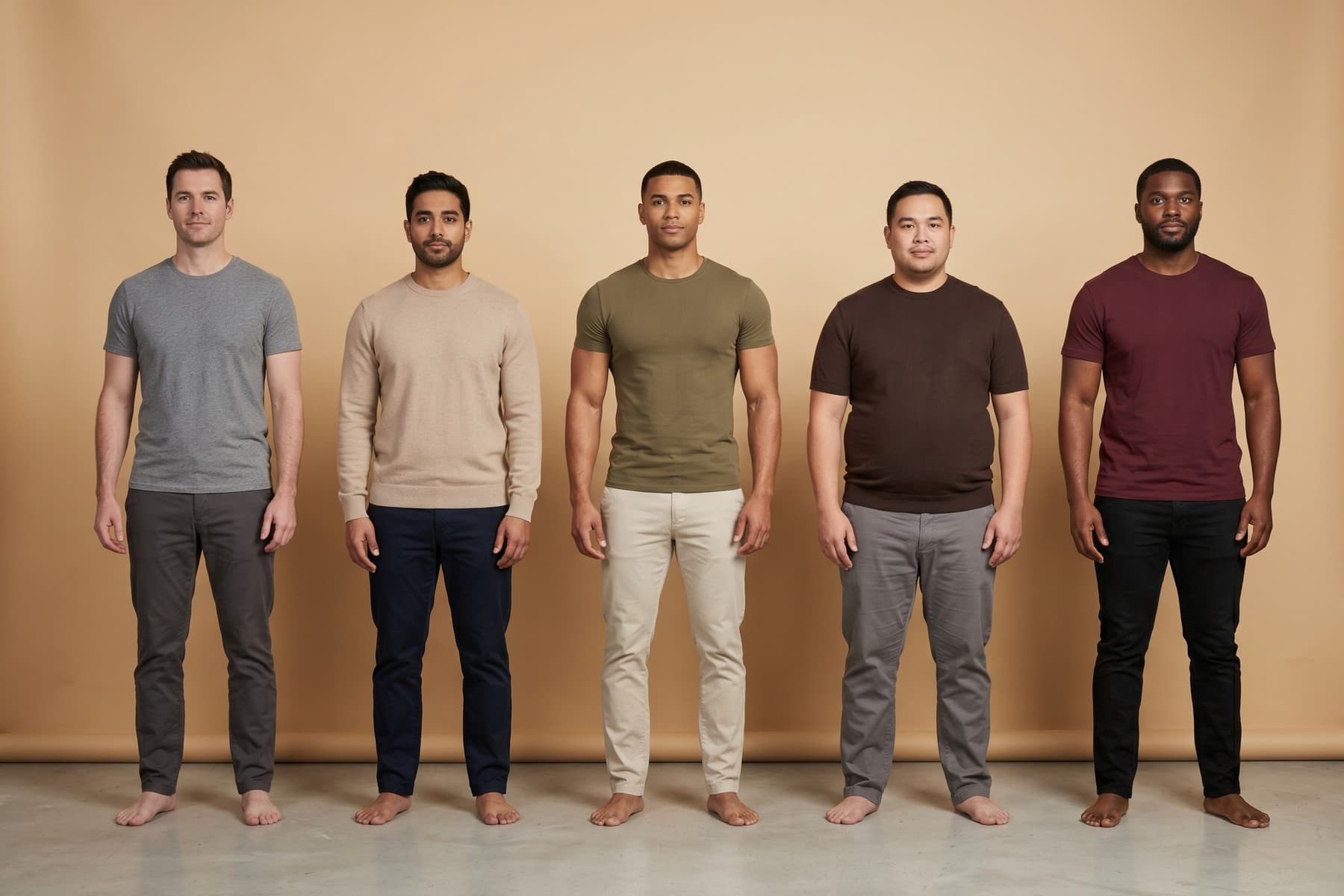
Color After Fit
Fit builds the silhouette. Color brings the face forward.
Once proportion, line, and fabric are working, the colors closest to your face decide whether the outfit looks merely well fitted or fully harmonious.
The Typological Framework: Biological vs. Geometric Categorization of the Male Physique
The classification of the male body has historically relied on biological somatotypes—ectomorph, mesomorph, and endomorph—introduced in the 1940s by psychologist William Sheldon.8 While originally posited with psychological correlations that have since been debunked, the physical descriptions remain heavily utilized in kinesiology, fitness planning, and metabolism tracking.8
The Ectomorph is defined by a naturally slim, linear frame, characterized by a light bone structure, long limbs, and a fast metabolism that makes both muscle and fat accumulation difficult.5 They typically present with narrow shoulders, thin wrists, and a flat chest.5 The Mesomorph represents the naturally athletic and muscular paradigm, possessing a well-proportioned body with broad shoulders, a narrow waist, and a metabolism optimized for muscle hypertrophy.5 Conversely, the Endomorph features a broader, softer, and more rounded skeletal and tissue structure, carrying a propensity for higher body fat, particularly centralized around the midsection.5
While the somatotype framework provides an excellent starting point for understanding physiological tendencies, sartorial styling demands a more granular, dimensional framework based entirely on the geometric relationships between the shoulders, chest, waist, and hips.9 The contemporary menswear paradigm translates these biological predispositions into five distinct, actionable geometric body shapes: the Rectangle, the Triangle, the Inverted Triangle, the Oval, and the Trapezoid.4 To accurately diagnose one's geometric archetype, professional measurements must be taken at three specific circumferences: the shoulders at their absolute widest point, the waist at its narrowest natural point (often above the navel), and the hips at their widest point.9
| Somatic Archetype | Primary Biological Correlation | Structural Characteristics | Geometric Styling Objective |
|---|---|---|---|
| Rectangle | Ectomorph | Shoulders, waist, and hips exhibit roughly equal width, creating a linear, columnar silhouette with minimal natural taper.4 | Create the profound illusion of broader shoulders and a defined, slimmer waist to simulate a V-taper.4 |
| Triangle | Ectomorph / Endomorph | Narrower, often sloping shoulders descending into a broader waist and hips, creating a distinctly bottom-heavy presentation.4 | Broaden the upper torso to counterbalance the lower half and draw the visual focal point sharply upward toward the face.4 |
| Inverted Triangle | Mesomorph | Massively broad shoulders and a highly developed chest tapering sharply to a narrow waist and hips. Top-heavy.4 | Balance extreme top-heavy proportions by minimizing upper bulk and adding visual weight and presence to the lower body.4 |
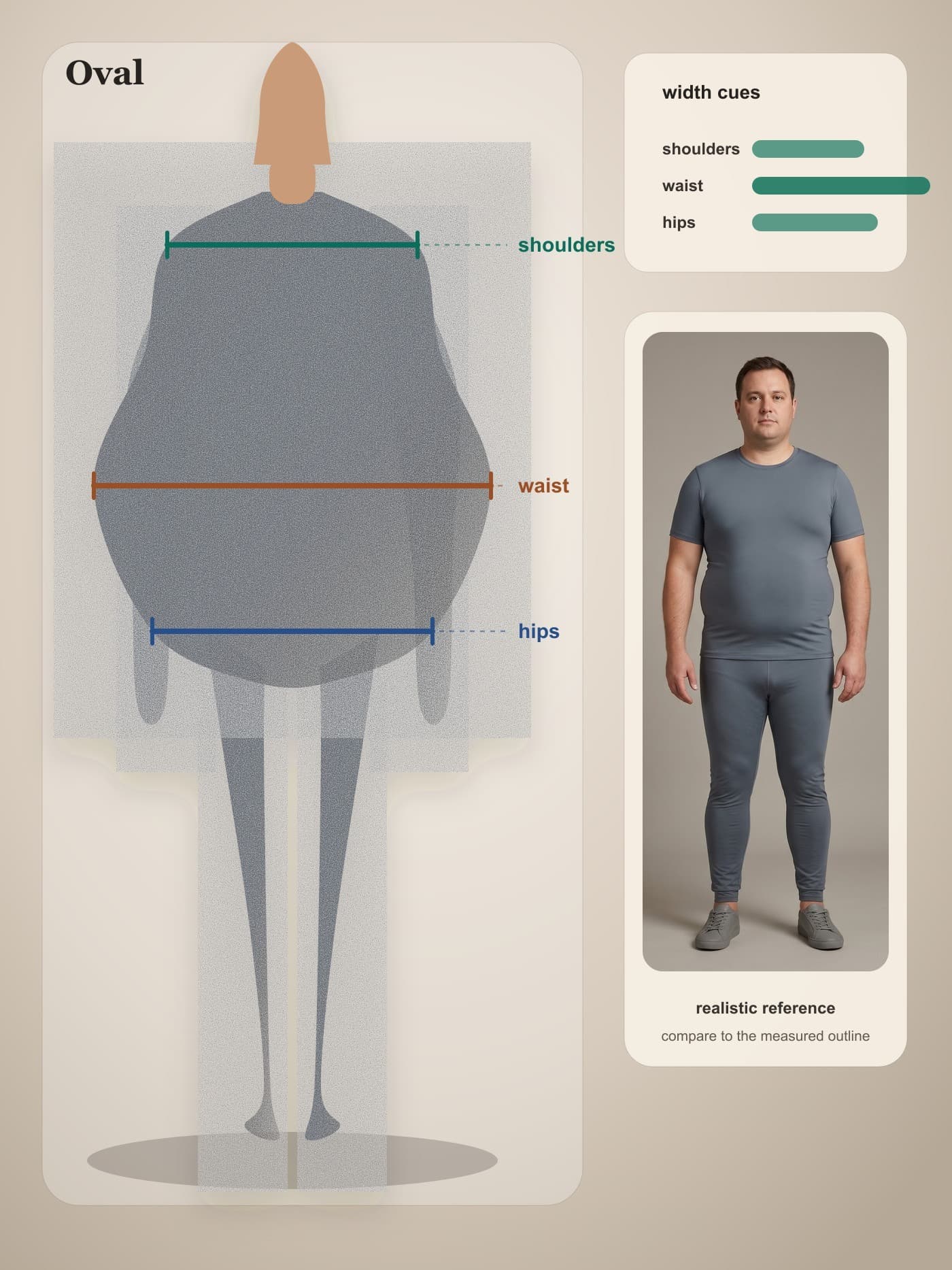
| Oval | Endomorph | A fuller, rounder midsection where the waist is significantly wider than the shoulders and hips. Shorter apparent limbs.4 | Elongate the torso, streamline the overall silhouette, and suppress visual width through strict verticality.4 |
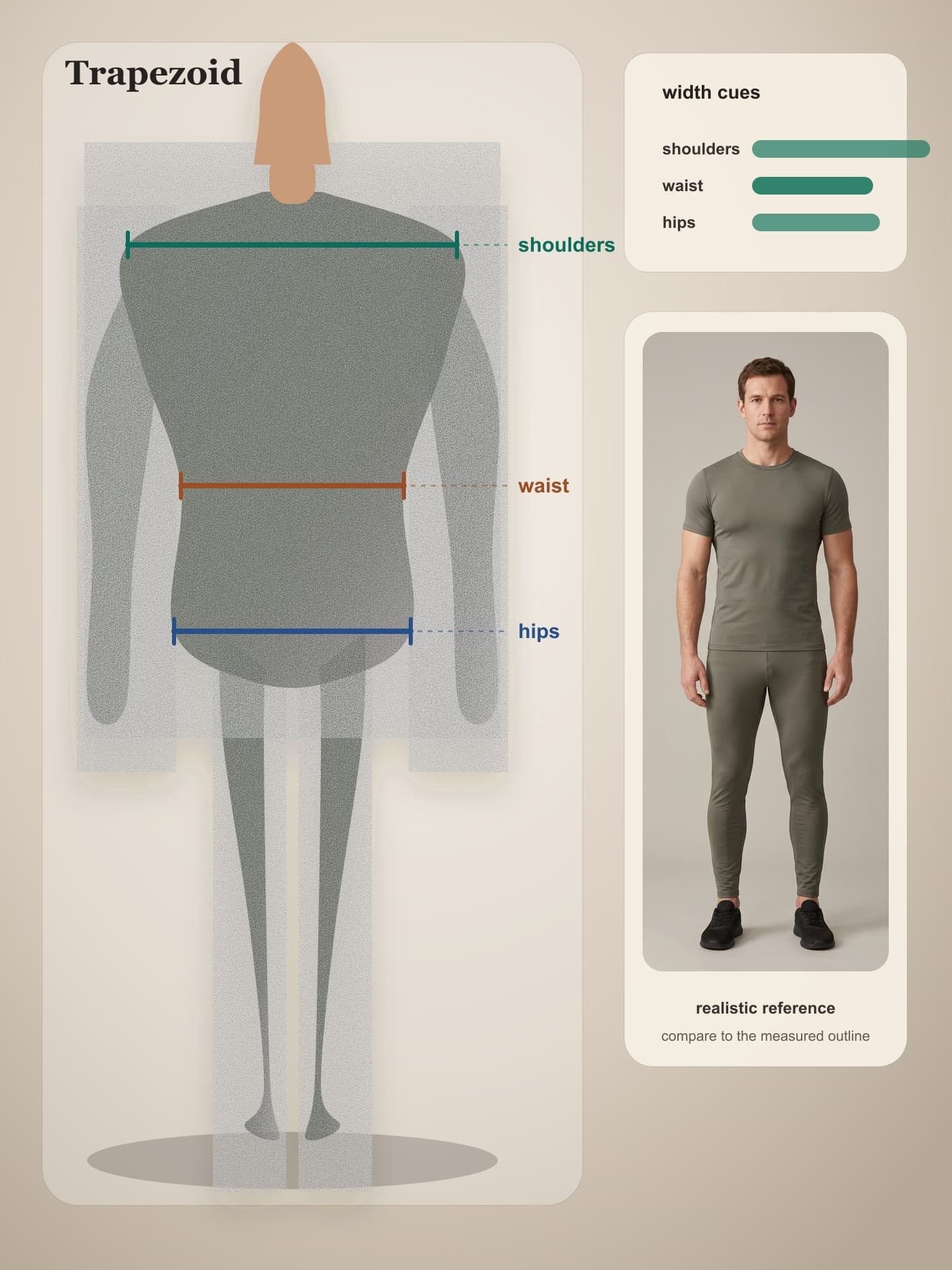
| Trapezoid | Mesomorph (Moderate) | Broad shoulders that taper naturally and proportionally to a moderately narrower waist. The "ideal" average build.4 | Highlight naturally balanced proportions through impeccable fit without introducing asymmetrical bulk or distortion.4 |
Understanding these categories allows for a proactive rather than reactive approach to garment selection. By identifying the geometric discrepancies in the physique, the wearer can deploy specific textiles and tailoring techniques as structural countermeasures. For comprehensive visual diagrams detailing these exact proportions, professionals frequently reference anatomical vectors and illustrations such as those cataloged at https://www.shutterstock.com/search/man-body-type?image_type=illustration12 and https://www.istockphoto.com/illustrations/men-body-types.13
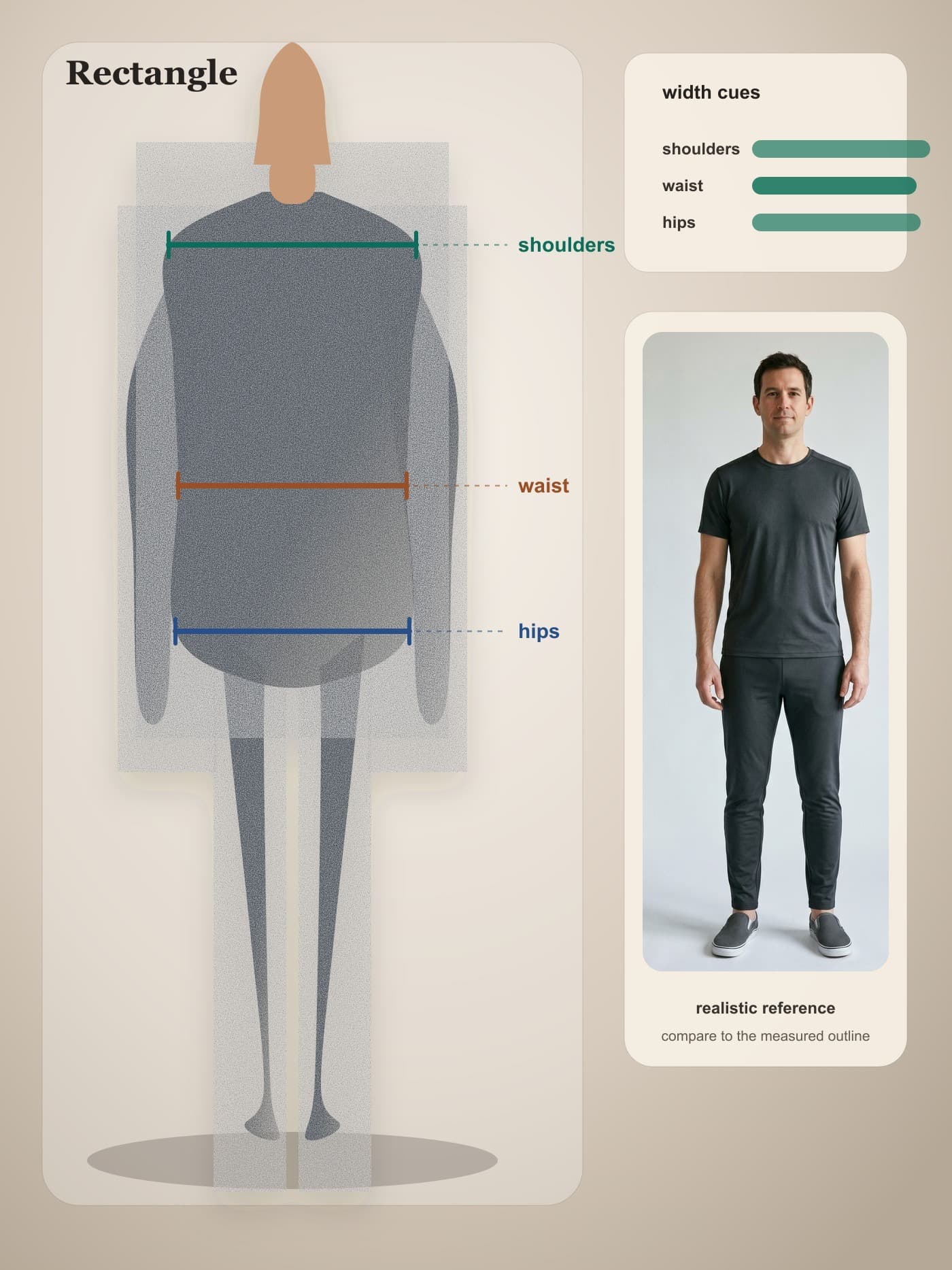
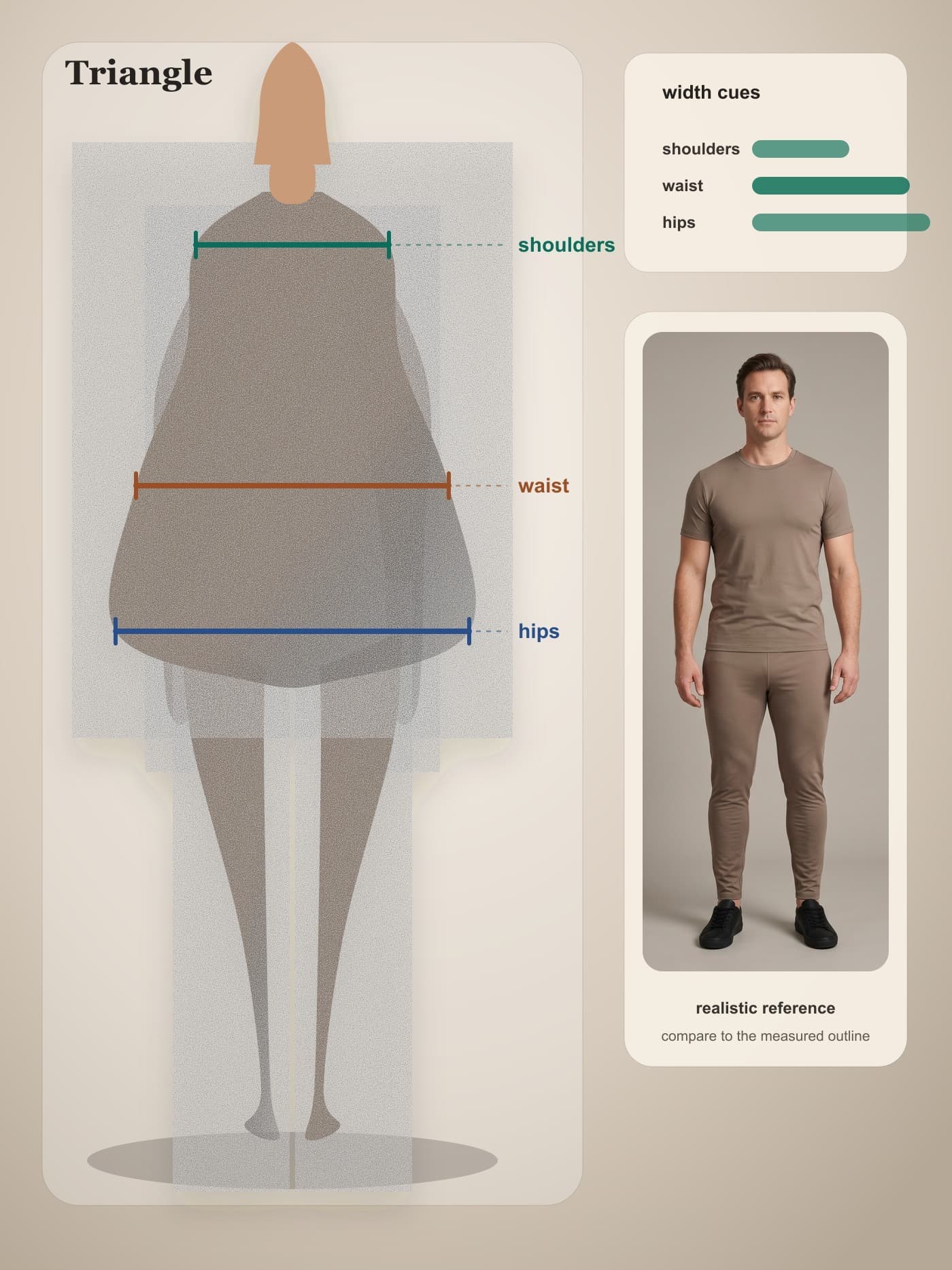
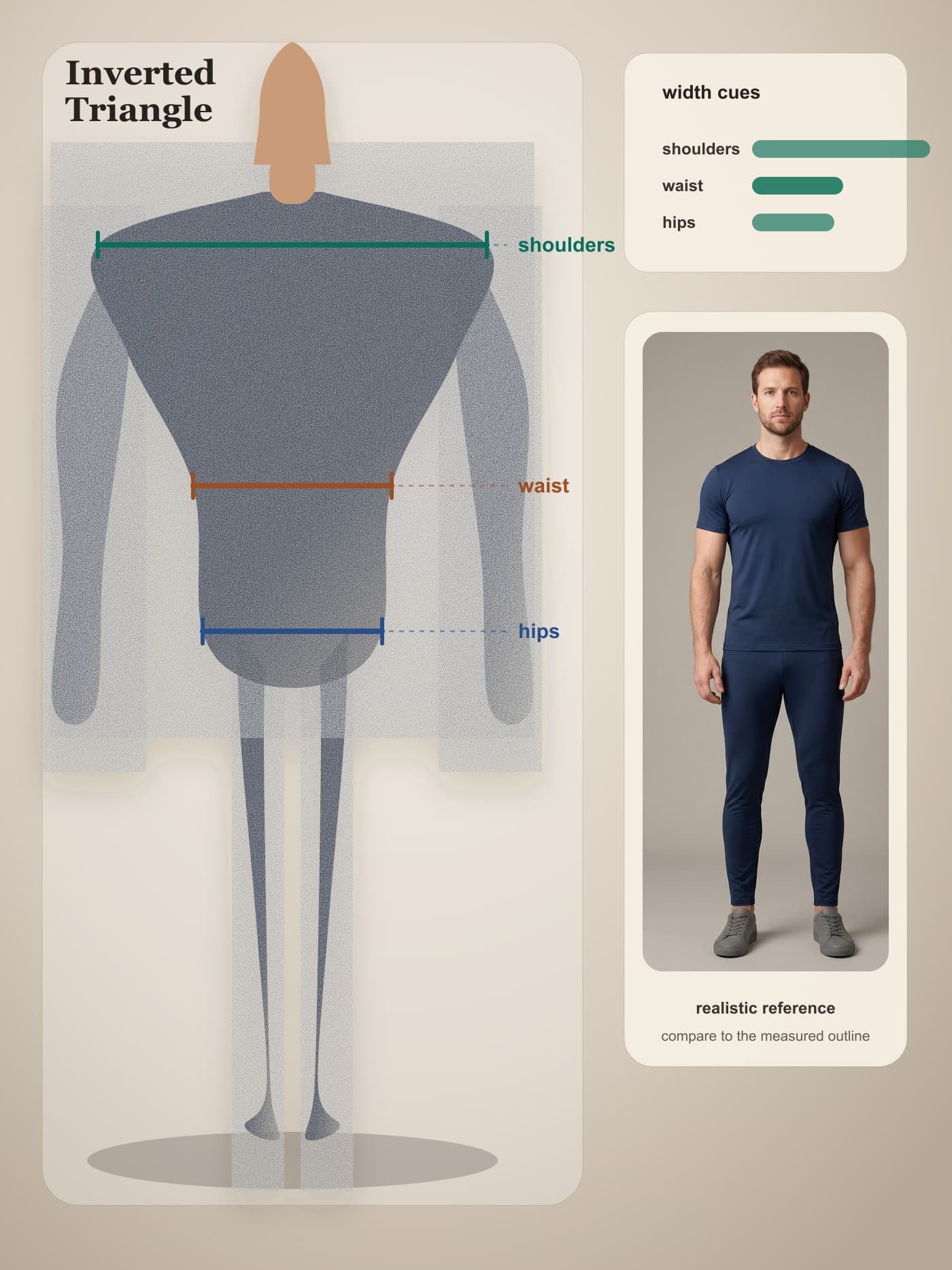
| Shape | Fast identification cue | Main styling correction |
|---|---|---|
| Rectangle | Shoulders, waist, and hips look close in width. | Create shoulder and chest breadth while suppressing the waist. |
| Triangle | Waist, hips, or lower torso look wider than the shoulders. | Add structure and visual interest above; keep the lower half cleaner. |
| Inverted Triangle | Shoulders and chest dominate while waist and hips narrow sharply. | Avoid extra upper bulk and ground the lower body with cloth and footwear. |
| Oval | Midsection is the widest and roundest point. | Create long vertical lines, squared shoulders, and clean trouser suspension. |
| Trapezoid | Shoulders are broad with a moderate, balanced taper to the waist. | Maintain fit precision without adding distortion. |
Textile Mechanics: The Physics of Fiber, Weight, and Weave Architecture
Before analyzing the cut of specific garments, a thorough mastery of raw materials is mandatory. Fabric weight, texture, yarn density, and weave geometry dictate how a garment drapes, how it reflects or absorbs ambient light, and ultimately, how much visual mass it adds to the wearer's frame.6 Ignorance of textile mechanics will render even the finest bespoke tailoring ineffective.
The Foundational Fibers
The base material of any garment sets the parameters for its structural integrity and drape. Wool remains the undisputed king of menswear fabrics, revered for its centuries-old versatility. It drapes impeccably, resists wrinkling, and possesses exceptional breathability and moisture-wicking properties, making it an all-season classic.14 Depending on its processing, wool can be woven into sheer, lightweight tropical suits or milled into dense, heavy tweeds. Cotton offers a more relaxed, breathable alternative with a softer texture, ideal for casual shirting and unstructured summer tailoring, though it lacks the rigid drape of wool and is highly susceptible to creasing.15
Linen, derived from the fibers of the flax plant, is the ultimate hot-weather material.15 It possesses a naturally slubby texture and extreme breathability, yet its defining characteristic is its tendency to crease dramatically.16 This rumpled elegance makes it inherently casual. Finally, silk is utilized primarily for its luxurious sheen and unparalleled drape; it flows over the body seamlessly, making it highly appropriate for formalwear or as a blending agent to soften stiffer wools.15
The Impact of Fabric Weight and Density
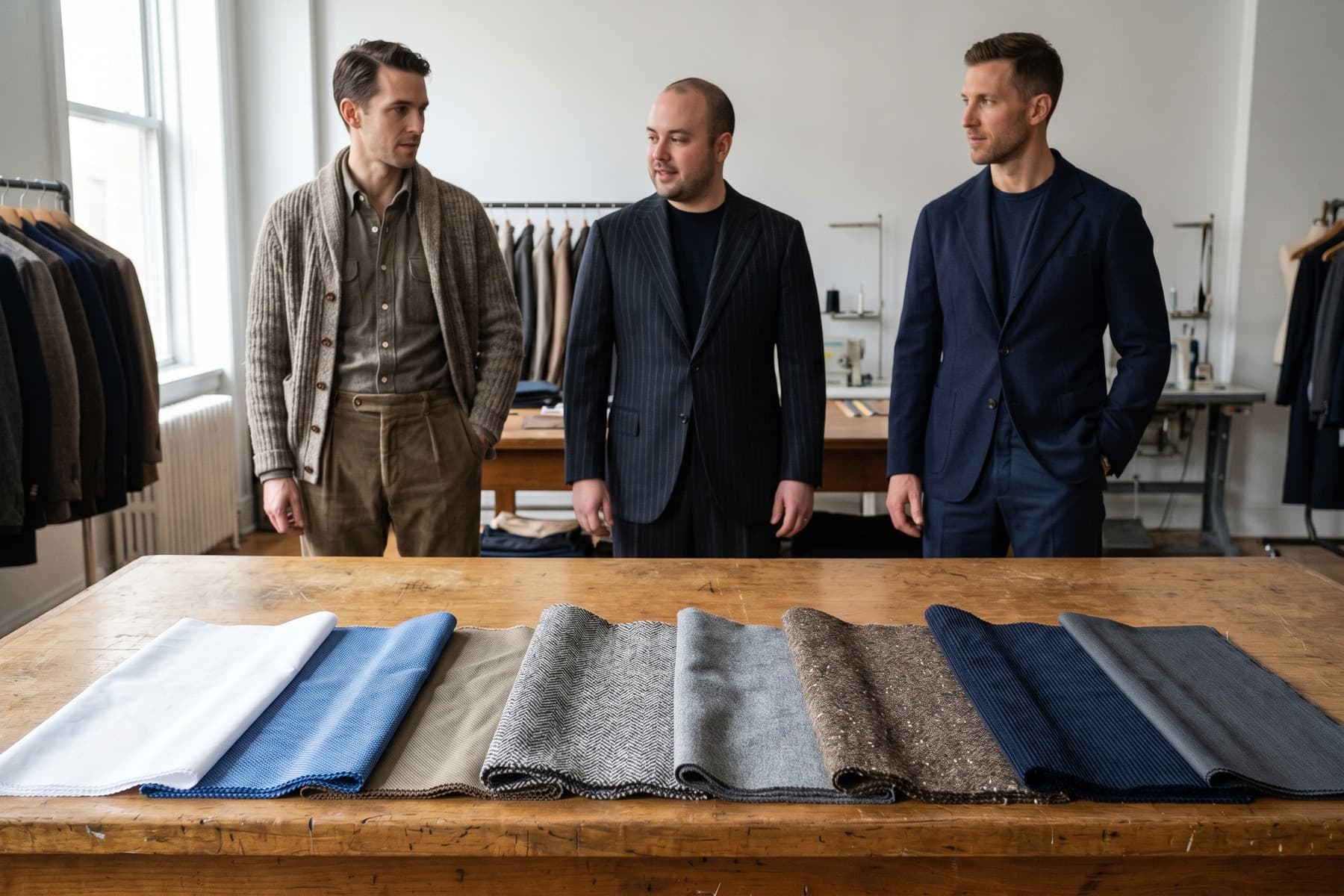
Materials are broadly categorized by their physical weight, which directly translates to the volume they add to the human silhouette. Heavyweight textiles—such as Scottish tweed, heavy selvedge denim, worsted flannel, chunky cable knits, and corduroy—possess immense structural integrity.6 These fabrics do not conform strictly to the skin; instead, they build an architectural shell around the body. Because they stand away from the physical form, they add substantial visual mass, making them highly strategic choices for men with Rectangle or Triangle body shapes who need to artificially construct broader shoulders, a thicker chest, or a wider leg profile.6
Conversely, lightweight fabrics—such as linen, tropical weight worsted wool, poplin, and fine silk—exhibit fluid, conforming drape.6 These materials skim the contours of the body, falling cleanly toward the floor without introducing excess volume. For the Oval and the Inverted Triangle builds, lightweight fabrics are non-negotiable. For the muscular Inverted Triangle, placing heavy fabrics on the upper body would exaggerate an already broad chest into a cartoonish, hulking proportion; for the Oval, heavy, rigid fabrics add unnecessary and highly unflattering circumference to the midsection.6
| Fabric or weave | Visual effect | Most useful for | Use carefully for |
|---|---|---|---|
| Tweed, flannel, corduroy, cable knit | Adds mass, surface depth, and architectural volume. | Rectangle and Triangle frames that need more upper-body presence. | Oval and heavily muscled Inverted Triangle frames. |
| Poplin, fine worsted, high-twist merino | Creates a flat, clean, low-bulk surface. | Oval and Inverted Triangle frames that need streamlining. | Very slim Rectangle frames that need substance. |
| Oxford and pinpoint | Adds moderate texture and thickness without becoming rugged. | Rectangle frames, casual Triangle upper-body balance, and Trapezoids. | Formal looks that require a very sleek surface. |
| Twill and herringbone | Drapes well while adding subtle directional line and texture. | Oval verticality, Trapezoid refinement, and taller lean frames. | Very top-heavy frames if the upper cloth becomes too thick. |
The Architecture of the Weave
Beyond the raw fiber, the specific mechanical method of weaving—how the vertical warp threads and horizontal weft threads are interlaced—alters the textile's visual impact and textural depth.20 The quality and density of these threads are measured in yarn numbers and plys. Higher yarn numbers (e.g., 100 to 200) indicate incredibly fine, thin threads resulting in silky, luxurious fabrics that drape closely, while 2-ply indicates two threads twisted together for strength.21
The specific weave determines whether an observer's eye rests on a textural landscape or glides smoothly past it. Understanding these weaves allows a man to utilize shirts and suits as optical tools:
Poplin (Broadcloth): This is a simple, over-and-under plain weave constructed with twice as many vertical warp threads as horizontal weft threads.16 This dense configuration creates a smooth, crisp, and slightly silky surface with virtually no discernible texture.16 Because it lacks topographical depth, poplin adds zero visual bulk to the frame. It is the ultimate shirting fabric for Oval and Inverted Triangle shapes requiring a clean, flat aesthetic that streamlines the torso.20
Oxford and Pinpoint: The Oxford fabric utilizes a basket weave, where multiple weft threads cross over an equal number of warp threads (often mixing a colored yarn with a white yarn).20 This creates a slightly rougher, significantly thicker texture with a visually porous, chalky appearance.20 The added thickness and coarse texture make Oxford cloth an excellent choice for adding subtle volume and heft to the chests of tall, lean Rectangle and Triangle body types.20 Pinpoint is a finer, tighter variation, offering a middle ground between Oxford's casual bulk and Poplin's formal flatness.22
Twill and Herringbone: Twill is easily identified by its visible diagonal ribbing.20 The structure of the weave allows the fabric to drape exceptionally well and resist wrinkles naturally. Herringbone is a sophisticated twill variant where the direction of the diagonal lines alternates, creating a distinctive V-shaped chevron pattern resembling the bones of a herring fish.20 The inherent verticality of the chevron pattern subtly draws the eye up and down, making it an extraordinary textural choice for Oval builds seeking elongation.1 Simultaneously, the fabric's substantial, warm nature benefits taller, thinner men looking for heft.1
Complex Textures (Birdseye, Houndstooth, Bouclé): Fabrics featuring raised threads or intricate woven patterns—such as birdseye's large round dimples or houndstooth's dual-tone, broken-check bumps—command immediate visual attention.22 The eye is arrested by the complexity of the fabric, which creates the illusion of depth and substance. These are highly powerful tools for the thin or straight-built man (Rectangle) who wishes to dramatically increase his physical presence and apparent body weight through textural topography.1
Sartorial Micro-Architecture: The Geometry of Lapels, Collars, and Hardware
While the overall cut of a suit or shirt dictates the macro-silhouette, the upper torso acts as the primary focal zone in human interaction. Therefore, the micro-adjustments made to suit lapels, shirt collars, and pocket placements represent some of the most critical styling decisions a man can execute. These elements act as geometric framing devices, capable of widening a narrow face, slimming a thick waist, or balancing disproportionate shoulders.
Lapel Dynamics and Perception
The lapel of a tailored jacket dictates the perceived width of the chest and shoulders, acting as the visual boundary between the shirt underneath and the jacket's outer edge.25
Peak Lapels: Defined by edges that point aggressively upward and outward toward the shoulders, peak lapels are a highly formal and bold choice.25 They naturally force the observer's gaze to travel upward along the point, expanding the visual width of the chest while drawing attention away from the midsection.25 This architectural detail is exceptionally flattering for broad-shouldered individuals with an athletic build (Inverted Triangle, Trapezoid), as it seamlessly accentuates their natural musculature.25 Furthermore, peak lapels add the profound illusion of vertical height and elongate the chest, making them highly strategic for Heavy (Oval) builds, particularly when combined with a low-buttoning, deep V-cut jacket.1
Notch Lapels: The standard, most versatile style, featuring a triangular cut where the lapel meets the collar.25 A medium-width notch lapel adds horizontal breadth to the chest without being ostentatious. It is the superior choice for slim, tall frames (Rectangle) seeking to break up their extreme verticality and add perceived, balanced width across the chest.25
Shawl Lapels: Featuring a continuous, uninterrupted rounded edge with no cuts or sharp angles, shawl collars are the hallmark of traditional evening wear and tuxedos.25 The smooth, flowing line provides an uninterrupted vertical flow that significantly elongates the torso.25 This seamless curve is highly effective for shorter or stocky builds, as it removes any harsh horizontal geometric breaks across the chest that might truncate the wearer's height.25
Lapel width must also be meticulously calibrated. Wide lapels complement powerful, broad frames but will entirely overwhelm a slight, narrow body. Conversely, narrow "skinny" lapels create a modern, sleek appearance ideal for petite or highly slender builds, but look comically disproportionate on a broad, muscular chest.25
Shirt Collar Geometry and Facial Framing
The collar dictates the framing of the face and the neck.27 The width of the collar points must consistently inverse the geometric extremes of the wearer's face and upper body to create harmony.
Point Collars (Narrow Spread): The collar points sit close together, creating sharp vertical lines that point directly downward. This effectively elongates the face and neck.28 For men with rounder faces, shorter, thicker necks, or an Oval body shape, point collars are absolutely essential for establishing a slimming vertical axis and reducing perceived width.28
Spread and Cutaway Collars: The points of the collar are pushed far apart, creating a strong horizontal line across the neck and exposing more of the tie knot.28 This creates a massive broadening effect that visually widens the upper portion of the face, neck, and chest. For tall, thin men (Rectangle) or those with narrow, elongated faces, a spread or extreme cutaway collar restores balance by forcefully pulling the observer's eye outward toward the shoulders.1
Hardware, Pockets, and Torso Disruption
The placement of hardware (buttons) and pockets disrupts the sheer expanse of fabric on a jacket, which can be manipulated to advantage. Slanted "hacking" pockets on a jacket draw the eye downward at an angle, subtly slimming the hips, whereas straight horizontal pockets add width. For the very tall, thin man, adding a "ticket pocket" (a smaller third pocket placed above the right main pocket) is highly recommended; it fills the empty vertical space on a lanky torso, breaking up the height.1
Button stance is equally critical. A high button stance closes the jacket high on the chest, creating a smaller "V" shape at the neckline, which can benefit a tall, thin man looking to shorten his torso. Conversely, a deep button stance (fastening the jacket lower down near the natural waist) creates a plunging, dramatic "V" shape that exposes more of the shirt and tie. This elongates the chest and is a mandatory tailoring element for the stout, Heavy (Oval) build aiming to mask a large belly.1
| Detail | Broadening choice | Lengthening or slimming choice | Best body-type use |
|---|---|---|---|
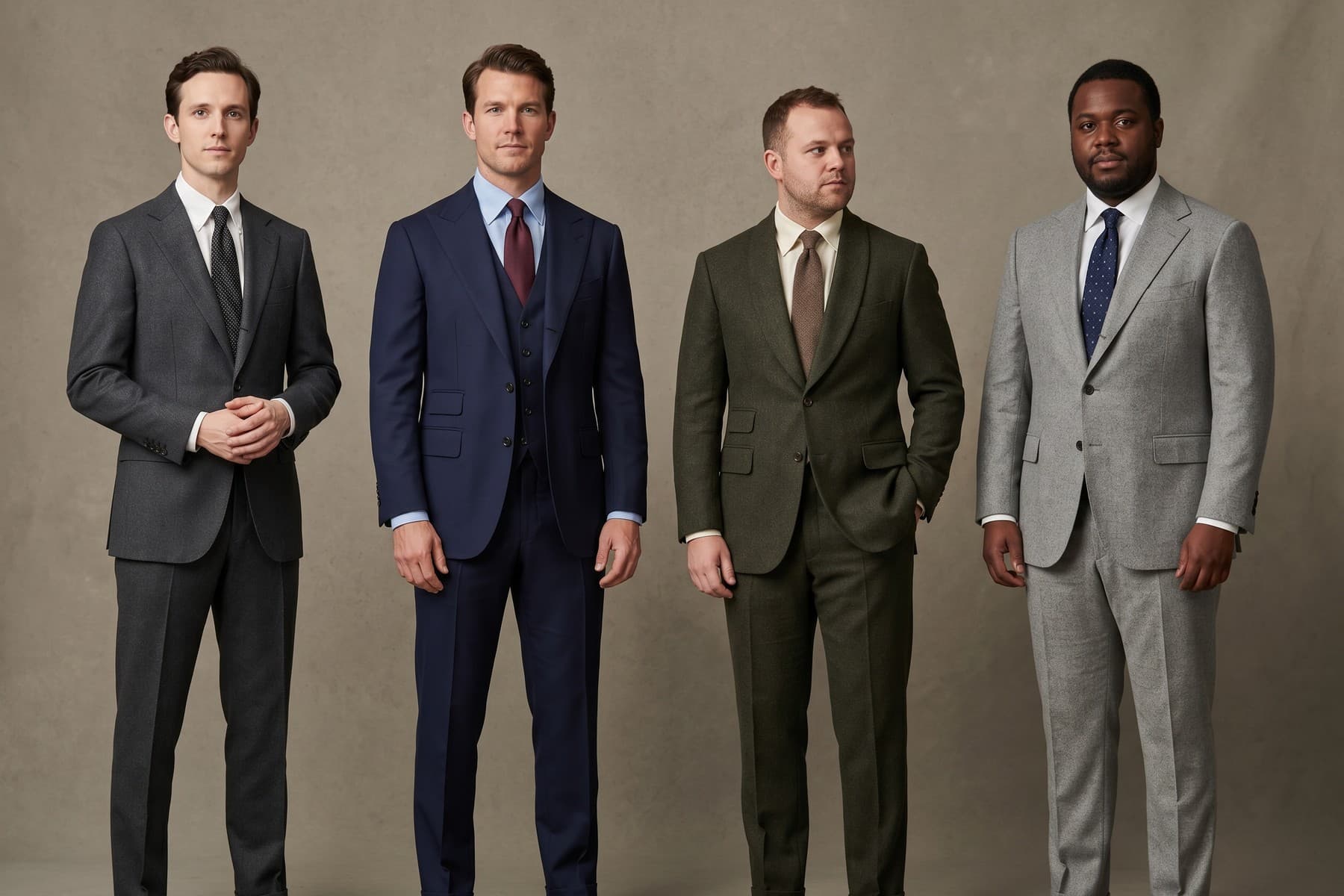
| Lapel | Wider notch or peak lapel. | Shawl lapel or deeper V opening. | Rectangle broadening; Oval elongation; Trapezoid moderation. |
| Shirt collar | Spread or cutaway collar. | Point collar. | Rectangle/narrow face broadening; Oval/round face lengthening. |
| Pocket angle | Straight horizontal pockets. | Slanted hacking pockets. | Rectangle width; Triangle and Oval hip streamlining. |
| Button stance | Higher stance that shortens a long torso. | Lower stance that creates a longer V. | Tall Rectangle shortening; Oval torso elongation. |
Strategic Styling by Somatic Archetype
With the foundational mechanics of fabrics, weaves, and tailoring micro-architecture rigorously established, these principles must now be applied directly to the five geometric male body types. The styling directives detailed below form an exhaustive, actionable blueprint for constructing an idealized, proportional silhouette for each distinct shape.
1. The Rectangle (The Straight, Columnar Build)
Anatomical Profile: The Rectangle build is characterized by a linear, columnar silhouette that lacks natural curves or athletic tapering. The circumferences of the shoulders, waist, and hips are nearly identical.3 Often strongly correlated with the ectomorphic somatotype, these individuals are frequently tall and lean, possessing long, lanky limbs, a narrow chest, and a flat posterior.5 Actors such as Daniel Day-Lewis represent the archetypal tall, thin Rectangle build.1
Styling Objective: The primary sartorial goal for the Rectangle is pure optical illusion: generating artificial width and mass across the shoulders and chest while subtly suppressing the waist to simulate the coveted Trapezoidal or Inverted Triangle silhouette.4
Sartorial Execution:
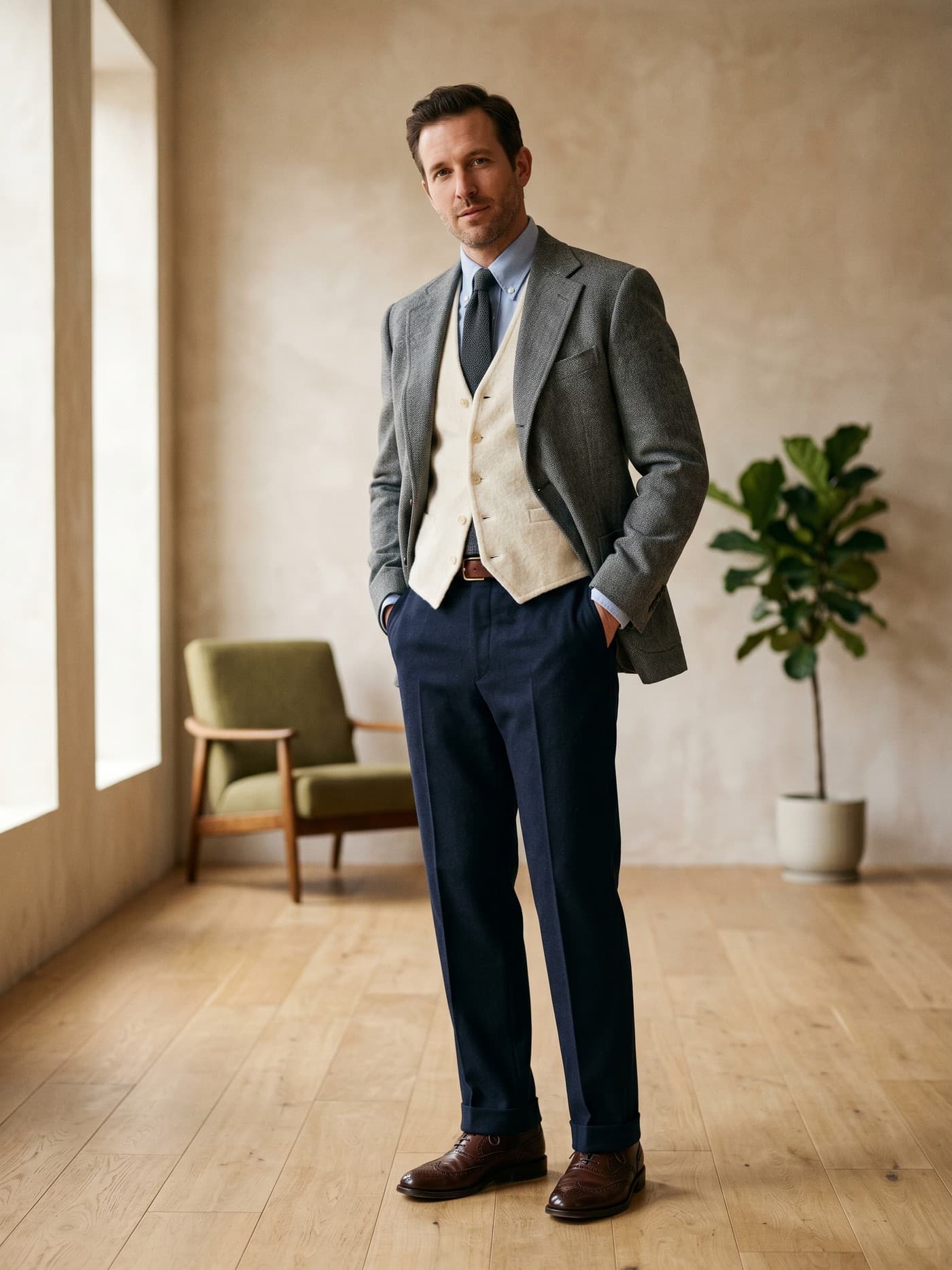
- Jacket Architecture: Structured tailoring is non-negotiable. Jackets must feature heavily padded shoulders (akin to the traditional English cut) to artificially extend the shoulder line horizontally outward.1 The tailoring must incorporate strict waist suppression—nipping the jacket in at the ribs—which contrasts with the padded shoulders to create a faux V-taper. Double-breasted jackets are incredibly effective and highly recommended; the overlapping layers of fabric across the torso, combined with the widened horizontal button stance, forcibly add breadth and girth to a narrow frame.1 Wide notch lapels should be employed to push the chest outward.25
- Textural Layering and Weaves: The Rectangle thrives on added bulk. Utilizing heavyweight, highly textured fabrics like rough tweed, worsted flannel, chunky cable-knit wools, and thick corduroy adds immediate, physical substance to the frame.1 Layering is a vital strategy—pairing a substantial Oxford cloth button-down shirt with a thick shawl-collar cardigan or a tweed waistcoat builds necessary three-dimensional topography atop a slender chest.4
- Patterns and Trouser Mechanics: Horizontal lines are the Rectangle's greatest ally. Bold checks, windowpane patterns, glen plaids, and horizontal stripes draw the eye side-to-side, expanding the perceived width of the torso.1 Trousers should never be skin-tight; they require a straight or slightly relaxed fit to add necessary drape and balance the proportions.7 Implementing double forward pleats and thick trouser cuffs (turn-ups, roughly 1 7/8 inches) adds heavy horizontal breaks and physical weight to the lower half, preventing the legs from looking like stilts.1
- What to Avoid: Boxy, shapeless garments must be strictly avoided; they will simply drape limply from the shoulders and mimic the natural rectangular shape, making the wearer look like a monolith.4 Monochromatic outfits crafted from flat, smooth fabrics (like poplin) should be avoided as they reinforce a linear, unvarying visual line and highlight extreme thinness.1
- Reference Visualizations: To observe how layering and patterns build out the Rectangle shape, review the visual guidelines at https://www.jacamo.co.uk/pages/mens-body-type-style-guide6 and the structural tips found at https://www.mountainkhakis.com/blogs/news/men-s-body-types-for-different-fit.32
2. The Triangle (The Bottom-Heavy Build)
Anatomical Profile: The Triangle archetype features narrower, often visibly sloping shoulders and a relatively smaller chest, which gradually widens as it descends into a broader midsection, waist, hips, and thighs.3 This geometric shape naturally creates an apex at the head and a wide, stable base at the hips, resulting in an imbalanced, bottom-heavy presentation.32 It is incredibly common as men age and metabolisms slow.
Styling Objective: The strategy here is strict geometric inversion. The stylist must employ visual weight, aggressive tailoring structure, and compelling focal points on the upper torso while simultaneously streamlining and darkening the lower half to radically reduce perceived width.4
Sartorial Execution:
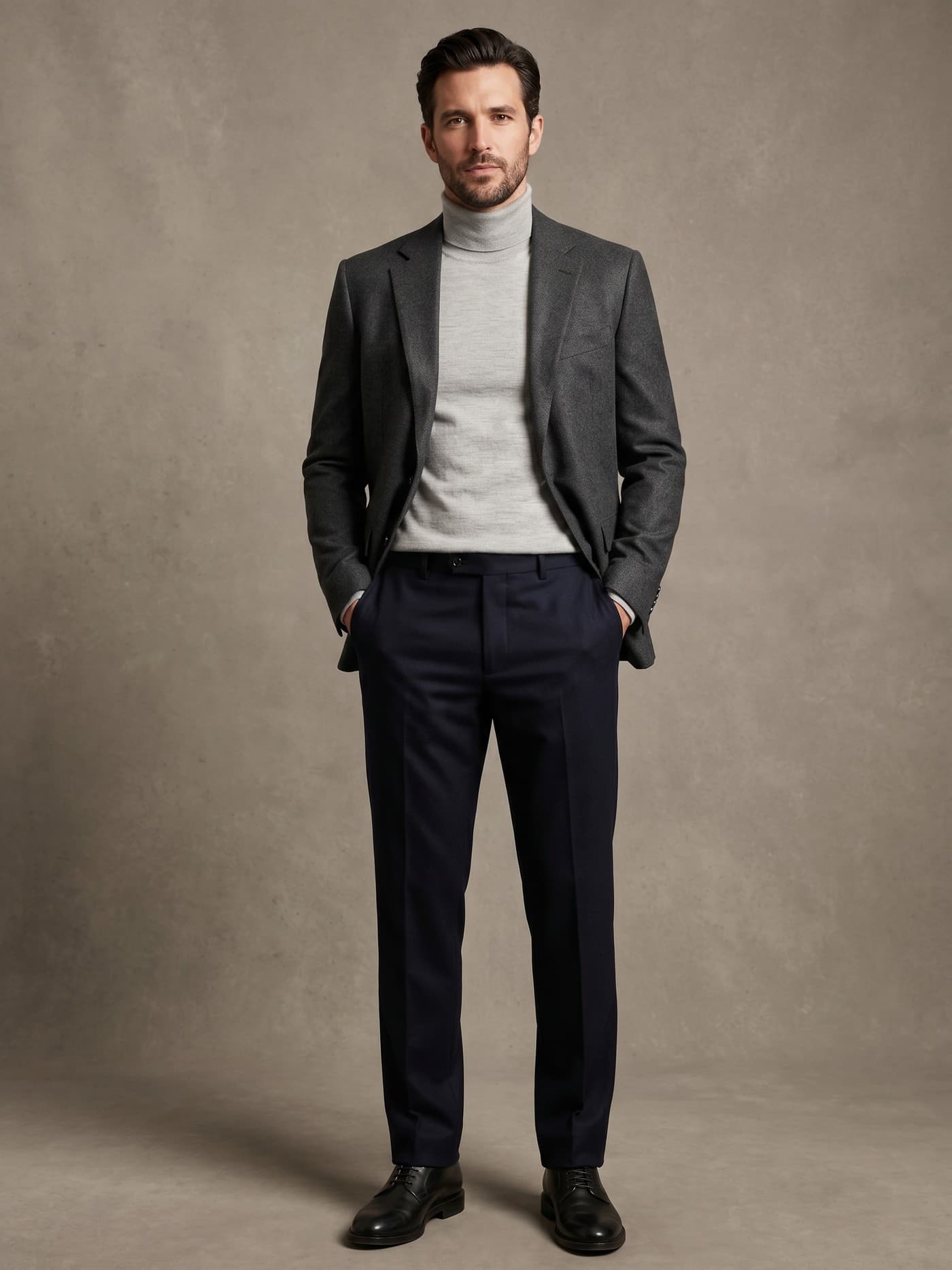
- Upper Torso Expansion: To correct the appearance of sloping, narrow shoulders, heavily structured tailoring is critical. Jackets, topcoats, and blazers must have significant, rigid shoulder padding to square off the upper frame and counterbalance the sheer width of the hips.6 Jackets must strictly be single-breasted; double-breasted jackets add excessive layers of fabric precisely where the wearer needs it least—around the midsection.33 Wide peak lapels are highly recommended to drive the observer's visual focus sharply upward and outward toward the augmented shoulders.25
- Neckline Geometry and Shirting: V-neck sweaters and deep Henley shirts are excellent casual tools for the Triangle. The plunging angle of the V exposes the chest and artificially broadens the clavicle region, drawing all attention upward and away from the stomach.4 Shirts must feature stiff, firm collars (such as a classic or medium spread collar with collar stays) to maintain a strong, commanding presence near the face; soft, floppy, unlined collars will make the neck and shoulders appear weak and undefined in harsh contrast to the wide waist.6
- Lower Torso Streamlining: Trouser mechanics are make-or-break. Trousers must be tailored in a clean, straight-leg cut. This is absolutely vital; the straight, unbroken drop from the thickest part of the thigh down to the ankle neutralizes the width of the hips by creating a parallel visual line.4 Trousers should be cut exclusively from dark, matte fabrics (heavy navy cotton, dark charcoal wool, black denim) which naturally absorb light and recede visually, slimming the lower half.4
- What to Avoid: High-contrast, bright belts create a severe, neon horizontal line directly across the widest, most unflattering part of the body—these are strictly forbidden.6 Skinny jeans or heavily tapered trousers are highly detrimental, as they create a disastrous "carrot effect," shrinking the ankles and heavily exaggerating the width of the hips and thighs by comparison.32 Horizontal stripes across the stomach must also be avoided, as they act as visual tape measures accentuating girth.32
- Reference Visualizations: For precise photographic examples of how to balance the Triangle build, consult the comprehensive style guide at https://www.realmenrealstyle.com/dress-for-body-type/.33
3. The Inverted Triangle (The Athletic, Top-Heavy Build)
Anatomical Profile: The cultural ideal of fitness, characterized by massively developed, broad shoulders and a muscular, protruding chest that taper drastically down to a narrow waist and exceedingly slim hips.3 Frequently resulting from intense hypertrophy and physical training (the mesomorphic extreme), the Inverted Triangle is profoundly top-heavy. While aesthetically desired, it presents severe, almost insurmountable challenges in off-the-rack suiting, invariably resulting in garments that fit the chest but billow heavily like a tent around the waist.33
Styling Objective: The objective is to restore visual harmony by minimizing any further expansion or structural addition to the upper body, while simultaneously adding subtle visual volume and presence to the lower body, bridging the drastic discrepancy between the massive chest and narrow waist.4
Sartorial Execution:
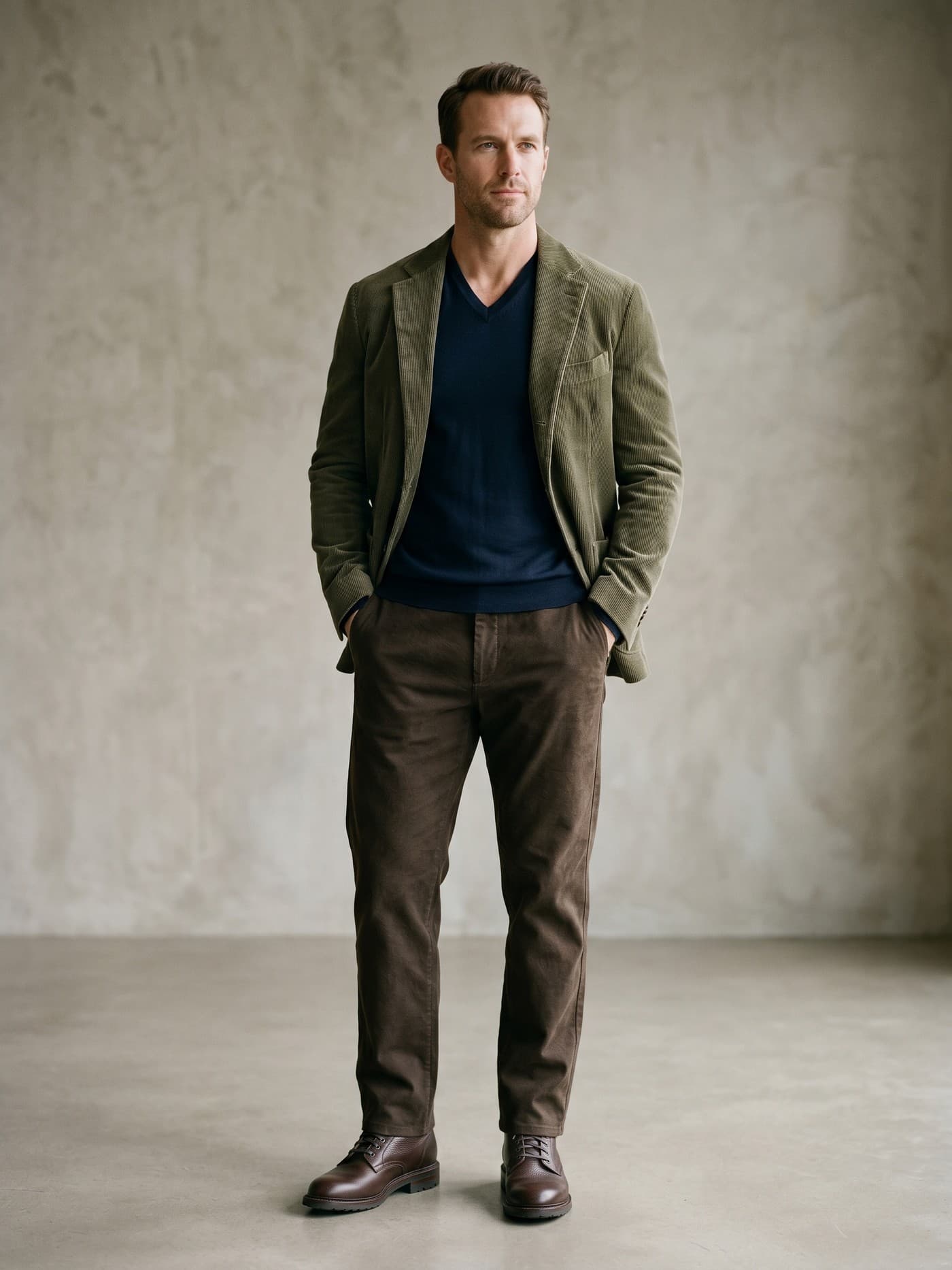
- Deconstructed Tailoring: Traditional structured suiting with heavily padded shoulders is entirely counterproductive; the wearer already possesses immense, natural biological structure. Adding shoulder pads will make the wearer look like a cartoonish caricature. Jackets must feature "soft tailoring"—unstructured, unlined, or lightly canvassed shoulders such as the Italian *spalla camicia* (shirt-sleeve shoulder)—allowing the fabric to drape naturally and smoothly over the existing musculature without exaggerating it.1
- Fabric Selection and Shirting: The upper body should be clad exclusively in lightweight, low-texture, smooth fabrics like fine poplin, high-twist merino wool, and pure linen.6 These materials skim the physique, conforming to the muscles without inflating them. V-neck knitwear helps to break up the vast, intimidating expanse of the upper chest.5 Deep V-necks draw the eye inward and downward, softening the extreme width of the pectorals.
- Balancing the Lower Half: To counteract the massive upper body and prevent a "top-toppling" visual effect, the legs require significant visual weight. This is achieved through straight-leg or relaxed-fit trousers; a slim cut is acceptable, but skinny cuts are lethal.4 Lighter-wash denim, heavily textured trousers (thick corduroy, moleskin), or pants featuring bold patterns (checks, houndstooth) will successfully draw the eye downward and add perceived mass to the narrow hips and legs.4 Heavy, substantial footwear like wingtip brogues or combat boots anchor the look visually.1
- What to Avoid: Extreme skinny jeans will leave the wearer looking completely unbalanced, appearing as though they have skipped leg day.2 Garments with thick shoulder padding, stiff heavy tweeds on the torso, and shirts with tight, restrictive chests will distort the proportions to an unappealing extreme.4
- Reference Visualizations: For a detailed breakdown of styling the athletic frame, review the Inverted Triangle infographics available at https://damanino.com/dressing-for-your-body-type/2 and https://fashionablymelissa.wordpress.com/2014/06/27/dressing-the-male-body-trapezoid-and-inverted-triangle-2/.36
(Note: A sub-category of the muscular build is the "Soccer Player" or Lower Body Heavy build, characterized by a lean upper body but massive, muscular glutes and thighs. For this physique, trousers must be meticulously tailored around the hips with ample room to prevent pocket flare, and jackets should feature no vents to ensure the fabric drapes cleanly over a prominent posterior without splitting open.1)
4. The Oval (The Stout, Rounded Build)
Anatomical Profile: The Oval body shape is characterized by a prominent, rounded, and fuller midsection. The stomach sits wider than the shoulders and hips, and the limbs often appear shorter or slimmer in comparison to the central, spherical mass of the torso.2 This body type carries its weight centrally.
Styling Objective: The sartorial goal is strict, uncompromising verticality. The stylist must elongate the torso, create a streamlined, continuous visual line from the neck to the floor, and construct rigid boundaries around the shoulders to prevent the silhouette from appearing entirely spherical and soft.4
Sartorial Execution:
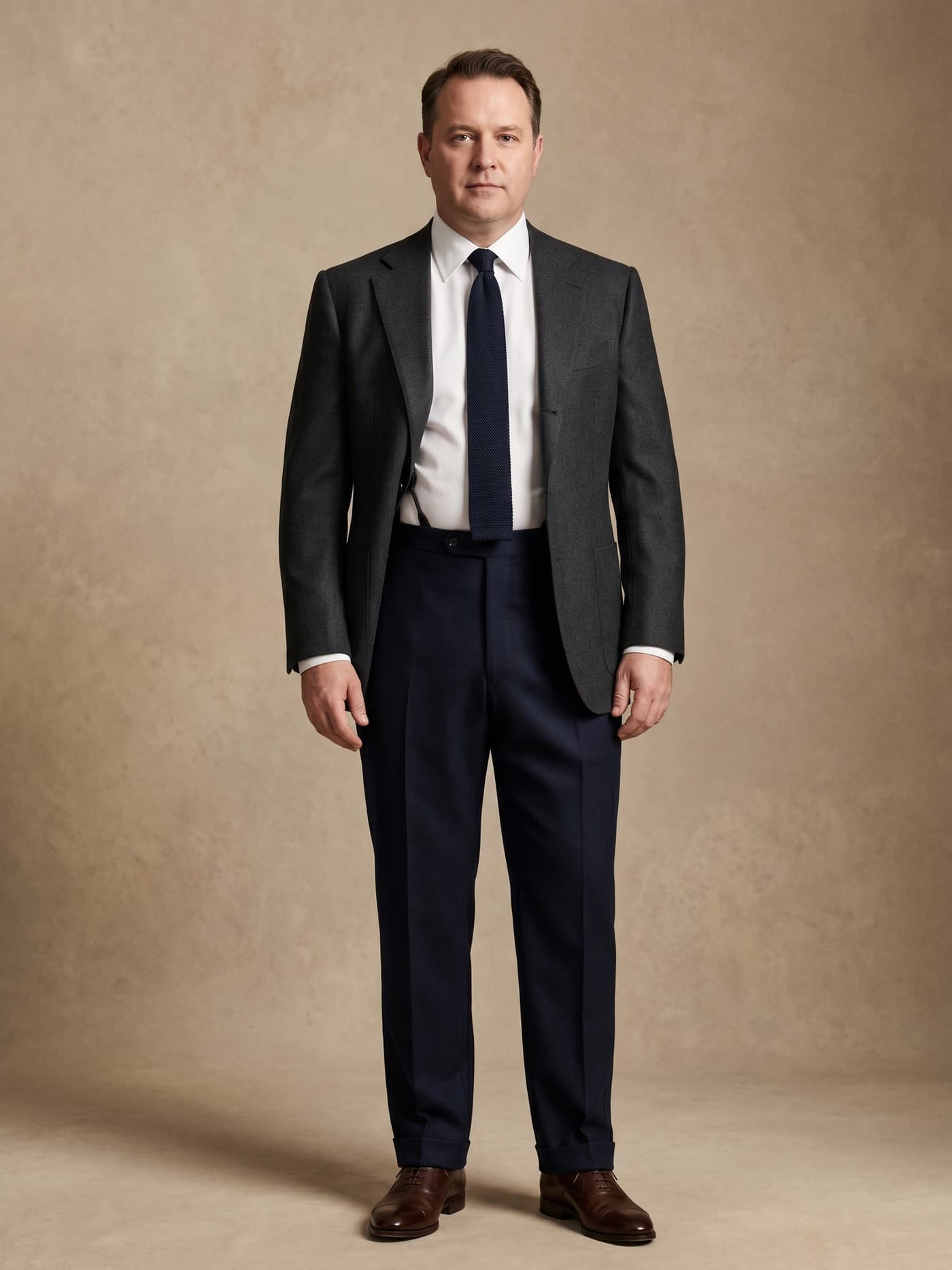
- Structural Shoulders and Torso Elongation: Because the shoulders naturally sit narrower than the waist, the wearer must utilize expertly tailored blazers with structured, firm shoulders. This squares off the frame, creating a clean, sharp vertical drop from the edge of the shoulder point straight down past the stomach, rather than letting the fabric wrap around the belly.4 Two-button jackets featuring a deep "V" gorge are highly recommended; the deep opening pulls the observer's eye vertically down the chest, elongating the torso immensely.1
- Trouser Mechanics and Suspension: The treatment of the waist is the single most critical element for the Oval shape. Trousers must sit high, at the *natural waist* (above the belly button), allowing the fabric to drape smoothly and cleanly down over the stomach.1 Wearing modern low-rise trousers below the stomach (at the hips) forces the stomach to protrude drastically over the waistband, severely truncating the leg line and exaggerating the gut.1 To hold high-waisted trousers securely at the natural waist, suspenders (braces) are an absolute necessity.1 Belts compress the midsection, pinching the fat, and draw a bright, horizontal line across the widest part of the body, bisecting the wearer. Suspenders eliminate this line entirely and allow the trousers to hang elegantly from the shoulders, creating an unbroken vertical plane.1
- Pattern, Fabric, and Collars: Vertical stripes (pinstripes, chalk stripes, and herringbone weaves) are highly recommended, as they continuously draw the eye up and down, offering a profound, undeniable slimming effect.1 Fabrics should be lightweight to medium-weight (fine wools, high-quality poplins), maintaining a clean, crisp drape without adding dense, chunky layers of texture that increase circumference.6 Pointed collars must be worn to elongate the neck and draw the eye down from a rounder face.28
- What to Avoid: Horizontal stripes, bold/loud patterns localized around the midsection, thick heavy belts, double-breasted jackets (which add double layers of overlapping fabric straight across the stomach), and clingy, elastic fabrics that hug the adipose tissue rather than draping cleanly over it.4 Pockets should never be stuffed, as this adds physical bulk to the hips and waist.35
- Reference Visualizations: To study the application of vertical lines and structured shoulders for stout builds, professionals frequently refer to the styling directives at https://www.artofmanliness.com/style/outfit-guide/mens-fashion-body-type/1 and the Oval infographics at https://www.bodyspec.com/blog/post/the_ultimate_guide_to_male_body_types.9
5. The Trapezoid (The Ideal / Average Build)
Anatomical Profile: The Trapezoid is the golden mean, the baseline standard upon which the global menswear industry designs off-the-rack clothing. It features broad shoulders and a prominent chest that taper down smoothly and proportionally to a slightly narrower waist and hips.5 It possesses natural symmetry and balanced proportions without the exaggerated, cartoonish extremes of the Inverted Triangle.4
Styling Objective: Because the anatomical geometry is naturally optimized and inherently balanced, the primary objective is simply to maintain this equilibrium. Clothing must trace the natural silhouette closely without obscuring it under excess fabric or choking it with overly restrictive, painted-on fits.4
Sartorial Execution:
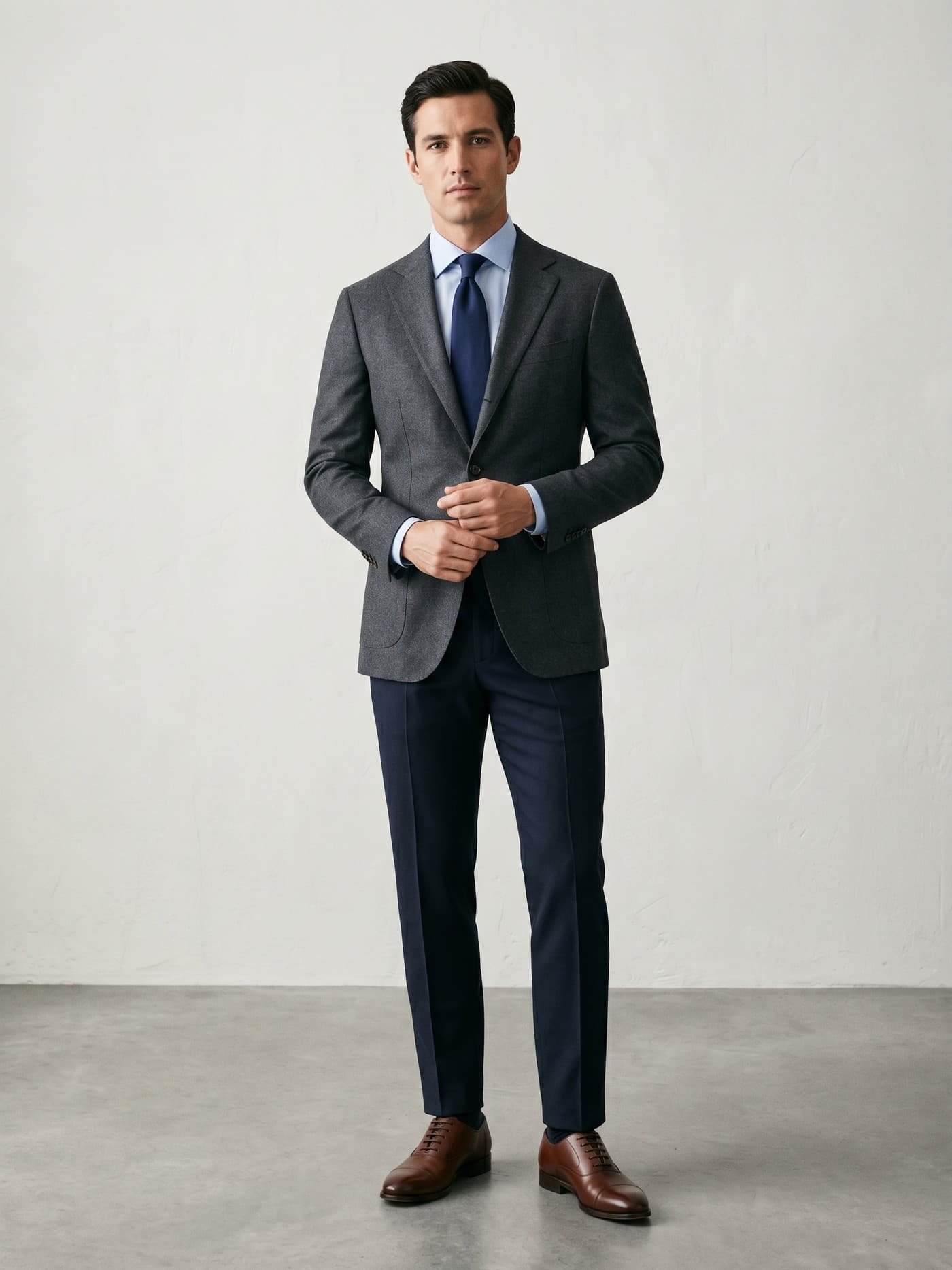
- Flawless Fit as the Primary Metric: The focus for the Trapezoid shifts away from structural optical illusions and heavily toward the purity of fit.5 Well-fitted shirts, exquisitely tailored single-breasted blazers, and slim-to-athletic fit trousers are the standard.4 The waist of a jacket should be subtly suppressed (nipped) to honor and highlight the natural, gentle taper of the body.33
- Textural and Pattern Experimentation: Benefiting from an inherently balanced frame, the Trapezoid can experiment extensively with complex patterns, bold prints, and contrasting textures without fear of throwing off their bodily proportions or looking top-heavy.2 They can transition seamlessly from heavy worsted wools in the winter to lightweight poplins and linens in the summer without altering their silhouette negatively.9
- Lapels and Collars: Medium-width notch lapels and classic, medium-spread collars perfectly echo the moderate, balanced proportions of the wearer's frame, neither widening it excessively nor slimming it down unnecessarily.25
- What to Avoid: The only significant risk for the Trapezoid is complacency. Wearing ill-fitting, baggy, or oversized clothing will completely submerge their ideal proportions, rendering their physique shapeless and effectively downgrading their stellar silhouette to a poorly defined Rectangle.4
- Reference Visualizations: The ideal proportions and versatile styling of the Trapezoid build can be visually confirmed via the style guides at https://www.hockerty.com/en-us/blog/male-body-types4 and https://www.jacamo.co.uk/pages/mens-body-type-style-guide.6
Conclusion: The Architecture of Elegance
The pursuit of refined, elevated menswear is not governed by transient fashion trends, brand logos, or arbitrary stylistic whims. It is governed entirely by the immutable laws of geometric proportion, structural balance, and textile physics. The mastery of personal style begins with an objective, clinical assessment of one's own somatic architecture. By correctly and honestly identifying as a Rectangle, Triangle, Inverted Triangle, Oval, or Trapezoid, a man unlocks the precise, calculated mechanical formula required to engineer his presentation to the world.
Through the strategic deployment of fabric weight—utilizing the heavy, textured heft of tweed to build mass or the crisp, flat drape of fine poplin to streamline bulk—and the meticulous micro-adjustments of lapel width, collar spread, pocket placement, and trouser break, clothing ceases to be a mere bodily covering. It becomes an advanced architectural tool. The successful implementation of these rigorous tailoring principles ensures that the garment serves the wearer implicitly, masking anatomical inconsistencies, highlighting natural symmetry, and ultimately presenting a commanding, proportionate, and deeply harmonious silhouette.
Works cited
- A Man's Style in Relation to His Body Type - The Art of Manliness, accessed May 11, 2026, https://www.artofmanliness.com/style/outfit-guide/mens-fashion-body-type/
- Dressing For Your Body Type - Damanino | Bespoke Suit and Shirt Makers, accessed May 11, 2026, https://damanino.com/dressing-for-your-body-type/
- What Are The 5 Main Body Shapes For Men? | Phill Tarling - London Menswear Stylist, accessed May 11, 2026, https://philltarling.com/5-mens-body-shapes/
- Male Body Types: Get to Know Them and Dress for Your Best Look - Hockerty, accessed May 11, 2026, https://www.hockerty.com/en-us/blog/male-body-types
- Male Body Types– Identify Your Shape with a Detailed Chart Guide - Kettlebell Kings, accessed May 11, 2026, https://www.kettlebellkings.com/blogs/default-blog/male-body-types-identify-your-shape
- Men's Body Type Styling Tips | Dress for Your Shape - Jacamo, accessed May 11, 2026, https://www.jacamo.co.uk/pages/mens-body-type-style-guide
- HOW TO DESIGN A SUIT FOR YOUR BODY TYPE - Articles of Style, accessed May 11, 2026, https://articlesofstyle.com/blogs/news/how-to-design-a-suit-for-your-body-type
- Body Types: Mesomorph, Ectomorph, & Endomorph Explained - NASM Blog, accessed May 11, 2026, https://blog.nasm.org/body-types-mesomorph-ectomorphs-endomorphs-explained
- The Ultimate Guide to Male Body Types - BodySpec, accessed May 11, 2026, https://www.bodyspec.com/blog/post/the_ultimate_guide_to_male_body_types
- What's Your Shape? What's Your Type? Men's Body Shapes - Big Boy Bamboo, accessed May 11, 2026, https://bigboybamboo.com/blogs/news/whats-your-type-mens-body-shape-chart
- Men's Body Shape Guide (Fat, Skinny, Muscular) - Dress Your Body ..., accessed May 11, 2026, https://www.realmenrealstyle.com/dress-body-shape-guide/
- Man Body Type illustrations - Shutterstock, accessed May 11, 2026, https://www.shutterstock.com/search/man-body-type?image_type=illustration
- 47,900+ Men Body Types Stock Illustrations, Royalty-Free Vector Graphics & Clip Art - iStock, accessed May 11, 2026, https://www.istockphoto.com/illustrations/men-body-types
- Different Suit Materials and Which is the Best One to Choose - Oliver Wicks, accessed May 11, 2026, https://www.oliverwicks.com/article/suit-material
- Wool, Cotton, Linen, or Silk? A Beginner's Guide to Suit Fabrics - Paul's Fashion, accessed May 11, 2026, https://paul-fashions.com/wool-cotton-linen-or-silk-a-beginners-guide-to-suit-fabrics/
- About Our Shirt Weaves - Charles Tyrwhitt, accessed May 11, 2026, https://www.charlestyrwhitt.com/us/about-our-shirt-weaves.html
- The Complete Guide to Men's Suit Fabrics | Culwell & Son, accessed May 11, 2026, https://culwell.com/the-complete-guide-to-mens-suit-fabrics/
- Male Body Type Guide: Dress for Your Best Look - Narry Tailor, accessed May 11, 2026, https://www.narrytailor.com/blog/male-body-type-guide-dress-for-your-best-look
- Top 10 fabrics for your suit (Complete Guide), accessed May 11, 2026, https://www.fabricsight.com/blogs/posts/suiting-fabrics-top-10-fabrics-for-your-suit-complete-guide
- Dress Shirt Fabric Weaves Guide - Batch Men's, accessed May 11, 2026, https://www.batchmens.com/pages/dress-shirt-fundamentals-shirt-fabrics-and-weaves-guide
- The Fabric Guide (as requested) : r/malefashionadvice - Reddit, accessed May 11, 2026, https://www.reddit.com/r/malefashionadvice/comments/1ell5j/the_fabric_guide_as_requested/
- The guide to shirting weaves and designs - Permanent Style, accessed May 11, 2026, https://www.permanentstyle.com/2018/04/the-guide-to-shirting-weaves-and-designs.html
- A Guide to Shirt Materials: Which Fabric is Right for You? - Hockerty, accessed May 11, 2026, https://www.hockerty.com/en-us/blog/types-of-shirt-materials
- A Man's Guide to Texture | Understanding Texture in Clothing - Real Men Real Style, accessed May 11, 2026, https://www.realmenrealstyle.com/clothing-texture/
- Which Lapel Style Best Matches Your Body Type?, accessed May 11, 2026, https://andreemilio.com/2024/08/13/lapel-style-matches-your-body-type/
- What Are The Different Jacket Lapel Styles? Comparing Notch, Peak & Shawl Suit Lapels - Bespoke Unit, accessed May 11, 2026, https://bespokeunit.com/suits/lapel/styles/
- Shirt Collar Styles For Men: The Complete Guide - Gentleman's Gazette, accessed May 11, 2026, https://www.gentlemansgazette.com/shirt-collar-styles-a-complete-guide/
- Collar Styles Explained for Custom Dress Shirts - Damiani Miami, accessed May 11, 2026, https://damianistores.com/blogs/blog/collar-styles-explained-for-custom-dress-shirts
- Determining Your Ideal Shirt Collar Shape : r/malefashionadvice - Reddit, accessed May 11, 2026, https://www.reddit.com/r/malefashionadvice/comments/mv304/determining_your_ideal_shirt_collar_shape/
- How to Choose the Perfect Shirt Collar for Your Face Shape - Hockerty, accessed May 11, 2026, https://www.hockerty.com/en-us/blog/best-shirt-collar-based-on-your-face-shape
- Choosing the best shirt collar for your body type - Bespoke Edge, accessed May 11, 2026, https://bespokeedge.com/blog/choosing-the-best-shirt-collar-for-your-body-type
- Men's Body Types for Different Fit - Mountain Khakis, accessed May 11, 2026, https://www.mountainkhakis.com/blogs/news/men-s-body-types-for-different-fit
- How To Dress For Your Body Type - RealMenRealStyle, accessed May 11, 2026, https://www.realmenrealstyle.com/dress-for-body-type/
- Body Shape & Men's Style: How to Dress for Your Body Type - Alpine Swiss, accessed May 11, 2026, https://www.alpineswiss.com/blog/body-shape-mens-style-how-to-dress-for-your-body-type/
- Men's Body Shape Analysis to dress better according to body type., accessed May 11, 2026, https://imageredefined.in/blog/power-dressing-office-etiquette/men-s-body-shape-analysis-to-help-men-dress-better
- Dressing the Male Body: Trapezoid and Inverted Triangle - Haven Street Style Studio, accessed May 11, 2026, https://fashionablymelissa.wordpress.com/2014/06/27/dressing-the-male-body-trapezoid-and-inverted-triangle-2/
- How to Dress Your Body Type (Most Men Ignore This) - YouTube, accessed May 11, 2026, https://www.youtube.com/watch?v=dHw3BZLpc7o
- https://www.narrytailor.com/blog/male-body-type-guide-dress-for-your-best-look#:~:text=Mesomorphs%20should%20stick%20to%20balanced,illusion%20of%20a%20fuller%20frame., accessed May 11, 2026, https://www.narrytailor.com/blog/male-body-type-guide-dress-for-your-best-look#:~:text=Mesomorphs%20should%20stick%20to%20balanced,illusion%20of%20a%20fuller%20frame.