The Science of Style: An Exhaustive Evidence-Based Guide to Female Body Shapes, Visual Perception, and Clothing Silhouettes
A research-backed article on anthropometry, visual perception, enclothed cognition, and silhouette strategy for female body shapes.
Quick answer
Clothing looks flattering when it redistributes visual weight, restores proportion, and guides the eye with line, contrast, drape, and color. Body shape sets the geometry; silhouette and palette determine how that geometry is perceived.
What you will learn
- Modern body-shape systems come from measurable torso ratios, not vague fashion folklore.
- The eye responds to balance, vertical continuity, and contrast long before it notices trend language.
- Silhouette solves proportion, but color, value, and contrast often decide whether an outfit looks harmonious on the person wearing it.
The Anthropometric Foundations of Female Body Shape Classification
For decades, the apparel and garment manufacturing industries relied on subjective visual assessments and two-dimensional measurements to categorize the female figure, leading to widespread inconsistencies in sizing, fit, and consumer satisfaction. The advent of large-scale, technologically advanced anthropometric surveys—most notably the Civilian American and European Anthropometric Resource (CAESAR) database and the SizeUSA initiative—revolutionized this paradigm by introducing precise three-dimensional (3D) body scanning technologies.1 These integrated databases captured millions of highly specific surface data points across thousands of diverse demographic populations spanning the United States, The Netherlands, and Italy.3
By applying advanced statistical modeling frameworks, principal component analysis (PCA), and k-means clustering algorithms to human surface geometry, researchers were able to identify the most dominant variables defining the female torso.1 Empirical analysis of these anthropometric datasets revealed that waist circumference acts as the primary dominant variable defining overall female torso size, while the chest-waist drop and the waist-buttock drop jointly define the local shape, curvature, and spatial volume of the torso.2 These findings proved that human bodies do not scale linearly from a single base size; rather, the relative proportion of weight and surface area shifts drastically based on intrinsic skeletal structure, fat distribution patterns, and age-related physiological changes.5
To translate this complex geometric surface data into actionable, objective categories for apparel manufacturing, academic researchers developed the Female Figure Identification Technique (FFIT).7
The Female Figure Identification Technique (FFIT)
Developed by Simmons, Istook, and Devarajan in 2004, the FFIT software utilizes a sequential, flowchart-like algorithmic approach to classify female body shapes.6 Moving away from subjective visual interpretation, the FFIT relies exclusively on the numerical ratios and mathematical differentials between six key circumferential measurements captured via 3D scanning: the bust, waist, hips, high hips, stomach, and abdomen.6
By prioritizing strict mathematical formulas over subjective visual silhouettes, the FFIT establishes an objective standard for identifying nine distinct body shape categories among women, facilitating highly targeted apparel design and pattern-making protocols.8 The structural definitions of these shapes rely heavily on the precise differential values between anatomical zones.
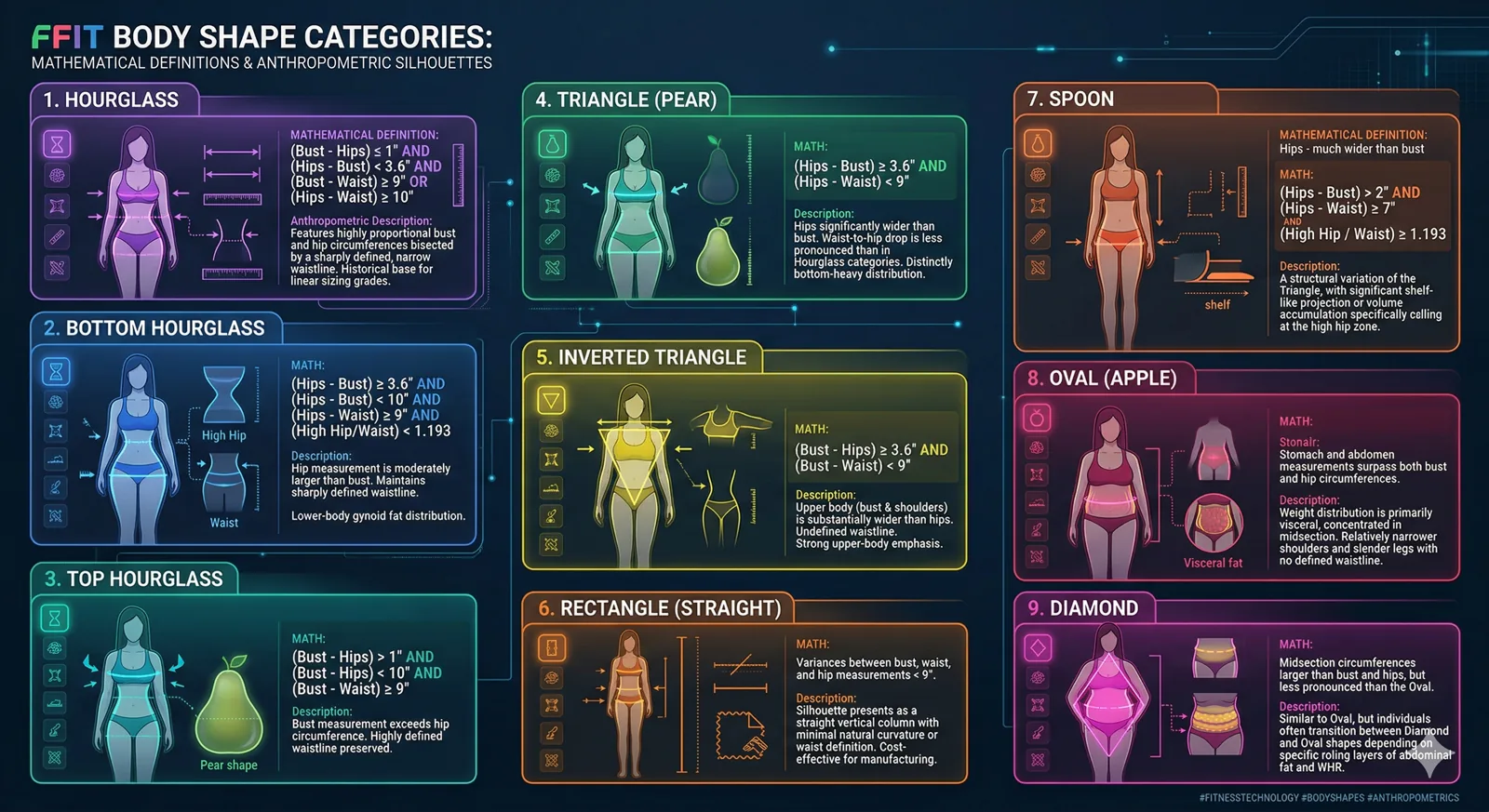
| FFIT Shape Category | Mathematical Definition (Measurement Differentials in Inches) | Anthropometric Silhouette Description |
|---|---|---|
| Hourglass | (Bust - Hips) ≤ 1" AND (Hips - Bust) < 3.6" AND (Bust - Waist) ≥ 9" OR (Hips - Waist) ≥ 10" | Features highly proportional bust and hip circumferences bisected by a sharply defined, narrow waistline. This shape represents the historical base for linear sizing grades.6 |
| Bottom Hourglass | (Hips - Bust) ≥ 3.6" AND (Hips - Bust) < 10" AND (Hips - Waist) ≥ 9" AND (High Hip/Waist) < 1.193 | The hip measurement is moderately larger than the bust, but the figure maintains a sharply defined waistline, indicating lower-body gynoid fat distribution.6 |
| Top Hourglass | (Bust - Hips) > 1" AND (Bust - Hips) < 10" AND (Bust - Waist) ≥ 9" | The bust measurement exceeds the hip circumference, yet the highly defined waistline is preserved.6 |
| Triangle (Pear) | (Hips - Bust) ≥ 3.6" AND (Hips - Waist) < 9" | The hips are significantly wider than the bust, but the waist-to-hip drop is less pronounced than in the Hourglass categories, creating a distinctly bottom-heavy distribution.7 |
| Inverted Triangle | (Bust - Hips) ≥ 3.6" AND (Bust - Waist) < 9" | The upper body (bust and shoulders) is substantially wider than the hips, accompanied by an undefined waistline.6 |
| Rectangle (Straight) | Variances between bust, waist, and hip measurements are less than 9 inches. | The silhouette presents as a straight vertical column with minimal natural curvature or waist definition. Fabric utilization algorithms indicate this shape is the most cost-effective for garment manufacturing.1 |
| Spoon | (Hips - Bust) > 2" AND (Hips - Waist) ≥ 7" AND (High Hip / Waist) ≥ 1.193 | A structural variation of the Triangle, characterized by a significant shelf-like projection or volume accumulation specifically at the high hip zone.6 |
| Oval (Apple) | Stomach and abdomen measurements surpass both the bust and hip circumferences. | Weight distribution is primarily visceral, concentrated in the midsection, resulting in relatively narrower shoulders and slender legs with no defined waistline.6 |
| Diamond | Midsection circumferences are larger than the bust and hips, but less pronounced than the Oval. | Similar to the Oval, but individuals often transition between Diamond and Oval shapes depending on the specific rolling layers of abdominal fat and waist-hip ratios.6 |
The distribution of these shapes varies heavily across populations, and subsequent studies utilizing these formulas indicate that the "standard" Hourglass shape—upon which much of the legacy fashion industry bases its linear grading systems—represents a remarkably small percentage of the actual female demographic.6 In studies analyzing plus-size body scans, it was found that zero percent of the subjects met the mathematical criteria for an Hourglass or Top Hourglass shape, demonstrating a critical need for proportion-based design interventions that accommodate a wider spectrum of geometries.6
Evolutionary Psychology and the Visual Processing of the Waist-to-Hip Ratio
Beyond the purely mathematical classification of body types, the human visual system exhibits a hardwired, evolutionary bias toward specific geometric proportions. The Waist-to-Hip Ratio (WHR)—calculated by dividing the waist circumference by the hip circumference—serves as a primary, cross-cultural biomarker for physical attractiveness, biological sex identification, and perceived reproductive viability.13
An optimally balanced WHR of approximately 0.70 is classically associated with the Hourglass silhouette and gynoid fat distribution—a physiological state where adipose tissue is stored predominantly in the hips, thighs, and glutes rather than as visceral fat in the midsection.13 From an evolutionary psychology perspective, this specific distribution pattern historically signaled health, youth, and optimal hormonal balance, though researchers continue to debate whether this preference is fundamentally driven by fecundability indicators or broader assessments of descendant quality and general health.13
Regardless of the underlying evolutionary intent, electrophysiological research mapping the brain's visual processing pathways reveals that an artificially adjusted WHR of 0.70 triggers an early, distinct, and automatic sensitivity in the human brain's posterior regions.17 When human subjects view images of female bodies manipulated to possess varying WHRs, the P1 component (firing between 80-120 milliseconds) and the N1 component (firing between 130-170 milliseconds) are the earliest neural mechanisms to exhibit modulation based on these bodily proportions.17 Furthermore, the vertex-positive potential, a brainwave occurring between 120 and 180 milliseconds, produces a measurably greater positivity specifically when processing a 0.70 WHR compared to ratios of 0.6, 0.8, or 0.9.17
This neuro-imaging data provides foundational evidence that the preference for certain body proportions is not merely a superficial cultural construct, but an automatic, rapid-fire cognitive response embedded in early visual processing.17 Consequently, the overarching goal of strategic, first-principled apparel design is to use optical illusions to visually approximate this 0.70 WHR and balance the upper and lower body, regardless of the wearer's underlying anthropometric baseline.
Enclothed Cognition and the Psychological Influence of Fashion
The functional utility of clothing extends far beyond physical protection, modesty, and aesthetic display; it operates as a profound psychological trigger that influences both the wearer and the observer. The concept of "enclothed cognition" explores the systematic influence that clothes have on the wearer's psychological processes, demonstrating that the symbolic meaning of a garment, combined with the physical experience of wearing it, directly impacts cognitive performance, emotional state, and behavioral readiness.18
Clothing acts as a structural input into psychological functioning. In foundational empirical studies regarding enclothed cognition, participants who were randomly assigned to wear a white lab coat—a garment symbolically linked to scientific precision, intelligence, and careful attention—performed measurably better on cognitive tasks requiring sustained focus compared to individuals who wore the exact same coat but were told it was a painter's smock.18 The physical garment was identical, but the psychological effect shifted entirely based on the symbolic meaning the wearer internalized.18 Similar causal effects have been observed in studies where participants wearing professional business attire reported higher levels of self-esteem, perceived competence, and abstract cognitive processing compared to those assigned to wear casual clothing.20 Furthermore, participants assigned to wear athletic gear performed significantly better on physical exertion tasks, indicating that attire effectively primes the neurological system for specific behaviors.20
The physical fit, proportional balance, and perceived "flattery" of a garment also act as a critical dimension of body acceptance and overall mental well-being. Clothing that successfully balances proportions through visual illusions can mitigate internalized body shame, reduce clothing-related anxiety, and foster an enhanced state of self-efficacy.19 During periods of acute global stress, such as the COVID-19 pandemic, research on emerging adults demonstrated a positive correlation between fashion involvement and the use of clothing as a mood enhancer.22 Individuals actively utilized strategic clothing selections to bolster their self-concept, increase feelings of security, and camouflage physical areas with which they were dissatisfied, proving that fashion serves as a legitimate coping mechanism.22 Conversely, poorly proportioned garments that emphasize perceived physical flaws or fail to accommodate a specific body shape can induce a metabolism-crushing cycle of self-criticism, severely impacting an individual's self-esteem and willingness to engage in social interaction.24
The psychological influence of fashion is highly bilateral. Not only does the wearer internalize the structural qualities of the garment, but observers rely heavily on target dress to form rapid, unconscious inferences regarding the wearer's social category, cognitive state, status, and aesthetic value.26 Therefore, mastering the geometric principles of clothing design allows individuals to intentionally calibrate both their internal psychological readiness and their external social signaling.18
Top Colors First
Silhouette solves geometry. Color decides where the eye rests.
Once you understand line and proportion, your top colors become the fastest way to brighten the face and make the full outfit read as coherent instead of merely correct.

The First Principles of Visual Perception and Geometrical-Optical Illusions
The fundamental premise of illusion dressing is that the human eye does not interpret raw visual data objectively. Instead, the visual cortex relies on spatial heuristics, contextual cues, temporal processing delays, and past experiences to rapidly estimate size, depth, angle, and proportion.27 By strategically manipulating lines, shapes, geometric blocking, colors, and physical textures, apparel acts as a visual interface that actively hacks these cognitive shortcuts. This allows designers to create the illusion of a narrower waist, broader shoulders, or elongated limbs without altering the physical form.30
The Rule of Thirds and the Golden Ratio
Derived from architectural theory, classical art composition, and photography, the Rule of Thirds—often associated with the Golden Ratio—dictates that spatial canvases divided into uneven, complementary segments are inherently more dynamic, harmonious, and aesthetically pleasing to the human eye than those divided symmetrically.32
In sartorial application, a balanced 1:1 vertical ratio is visually stagnant. For example, wearing an untucked shirt that ends exactly at the midpoint of the body visually bisects the wearer in half, resulting in a static, boxy, and structurally unappealing silhouette that creates an illusion of width and shortens the leg line.33 To achieve visual harmony, the silhouette should be partitioned into a roughly 1/3 to 2/3 ratio.33
Executing this proportion requires the manipulation of the "visual line," which is determined primarily by color contrast and hemline placement. Tucking a blouse into high-waisted trousers establishes the upper body as the 1/3 visual segment and the elongated legs as the 2/3 segment.33 This structural technique—whether achieved through front-tucking, strategic belting, or wearing cropped jackets—creates an optical elongation of the lower body while drawing intense focal attention to the waistline, optimizing the overall proportion regardless of the wearer's actual height.33
Geometrical-Optical Illusions in Apparel Architecture
Extensive psychophysical research into classic geometrical-optical illusions provides the empirical formulas required for structural fashion design. When properly executed, these illusions physically alter the observer's spatial processing and dimensional estimates.
| Optical Illusion Category | Cognitive Mechanism and Visual Distortion | Sartorial Application and Structural Impact |
|---|---|---|
| Helmholtz Illusion | A square filled with horizontal stripes appears physically taller and narrower than an identical square filled with vertical stripes.37 | Debunks the pervasive myth that horizontal stripes widen the body. Empirical psychometric functions demonstrate that a figure clad in horizontal stripes possesses a relative slimming effect, requiring a 10.7% broader physical silhouette to match the perceived width of a figure in vertical stripes.39 The duty cycle and frequency of the stripes govern the intensity of the diminishing effect.40 |
| Müller-Lyer Illusion | Two identical lines appear to be different lengths depending on their terminal adornments; a line terminated by inward-pointing arrows appears significantly shorter than one terminated by outward-pointing arrows.42 | V-necklines function as inward-pointing arrows, visually elongating the neck while narrowing the perceived expanse of the upper torso.31 Conversely, high-cut swimwear legs utilize outward-pointing mechanics, successfully tricking the visual cortex into perceiving human legs as up to 5% longer.46 |
| Vertical-Horizontal (T) Illusion | An inverted 'T' configuration causes the vertical line to appear significantly longer than an intersecting horizontal line of the exact same physical length, due to retinal projection and visual scanning patterns.47 | Drop-waist dresses or stark horizontal color-blocking placed at the widest part of the hips severely disrupt vertical continuity. This creates an unflattering broadening effect across the pelvis while simultaneously truncating the perceived length of the legs.34 |
| Ponzo Illusion | Two identical parallel lines appear to be different lengths when placed over a background of converging diagonal lines (the perspective or framing-effects hypothesis).51 | A-line skirts and flared, wide-leg trousers taper sharply upward toward the waist. The converging diagonal side seams force the brain to perceive the waistline as significantly narrower and further away compared to the expansive horizontal dimension of the hemline.31 |
| Ebbinghaus (Titchener) Illusion | A central object is perceived as smaller when surrounded by larger context figures, and larger when surrounded by smaller context figures, due to size-contrast processing in the visual system.53 | Accessory and component scaling. A highly petite woman carrying a massive, oversized tote bag will appear physically smaller, while a plus-size woman carrying a microscopic clutch purse will appear physically larger due to extreme size contrast interactions.53 |
| Zöllner & Hering Illusions | Intersecting acute angles and radial background patterns cause parallel straight lines to appear bent, bowed, or misaligned due to lateral inhibition and temporal processing delays in the visual cortex.28 | Strategic color-blocking and curved side-seams (such as princess seams) trick the eye into perceiving a highly contoured hourglass curvature on a purely rectangular body shape. The intersecting lines force the brain to perceive a non-existent waist indentation.28 |
| Oppel-Kundt Illusion | Space that is filled or subdivided (by textures or patterns) appears physically larger and more expansive than empty, continuous space of the exact same physical dimensions.27 | Highly textured fabrics (bouclé, velvet), heavy layering, and busy prints add immense visual volume to the body. Placing a dense, vibrant print exclusively on the bust makes it appear larger, while wearing solid, matte colors creates a receding, slimming effect.30 |
The real-world application of these illusions is not merely anecdotal or theoretical. Experimental psychophysical trials utilizing advanced technologies—including head-mounted virtual reality displays, MIRAGE-mediated reality systems, and customized 3D avatars—have empirically proven that viewing oneself in garments engineered with specific optical patterns significantly alters the wearer's implicit spatial perception.60 Participants viewing avatars of their own bodies dressed in optical illusion garments engineered to mimic an hourglass shape reported significantly higher levels of body satisfaction and an altered perception of their actual physical dimensions.60 Conversely, surrealist fashion trends utilizing "Trompe L'oeil" (trick of the eye) techniques intentionally deploy these illusions to create visual deception, rendering heavy fabrics like leather to appear as soft flannel or manipulating denim to look like silk, effectively hijacking the observer's cognitive expectations.63
Evidence-Based Styling and Silhouette Manipulation by Primary Archetype
Understanding the geometric principles of visual perception allows for the highly objective evaluation of clothing silhouettes. A garment is deemed "flattering" when it successfully utilizes optical illusions to balance the specific anthropometric extremes of the wearer's body, driving the overall silhouette toward the culturally and biologically preferred proportions (i.e., the 0.70 WHR and the 1/3 to 2/3 Rule of Thirds).13 Conversely, a garment is "unflattering" when it exacerbates a structural imbalance, truncates vertical continuity, or indiscriminately adds visual volume via the Oppel-Kundt illusion to a bodily zone that is already anthropometrically dominant.33
The following sections detail the precise application of these psychophysical principles across the primary female body archetypes.
The Apple (Oval) Body Shape
The Oval shape is anthropometrically defined by a dense concentration of visceral weight in the midsection. The stomach and abdomen circumferences exceed those of the bust and hips, resulting in an undefined waistline, a broad torso, and comparatively narrow shoulders accompanied by slender legs.10
The primary sartorial objective for the Oval shape is to construct an elongated vertical line through the torso, bypass the natural waistline without adding Oppel-Kundt bulk, and draw the visual focus upward toward the face and downward toward the legs.
| Structural Technique | Flattering Application & Optical Mechanics | Unflattering Application & Optical Mechanics |
|---|---|---|
| Waist Articulation | Empire Waists & A-Line Dresses: Garments that nip in directly beneath the bust (the narrowest point on an Oval torso) and skim loosely over the midsection create a faux waistline. The outward flare of the A-line introduces the Ponzo illusion, forcing the upper torso to appear narrower relative to the wide hem.51 | Tight Belts at the Natural Waist: Forcing a structured waistline where one does not anthropometrically exist creates a stark horizontal bisection at the body's widest physical point. This traps the eye and drastically emphasizes the total circumference of the abdomen.68 |
| Necklines | Deep V-Necklines: Utilizing the Müller-Lyer illusion, V-necks act as inward-pointing arrows, establishing a strong vertical vector that breaks up the broad horizontal expanse of the chest, elongating the upper body and drawing focus upward.42 | High Boat Necks & Chokers: High, horizontal necklines cut off the vertical line of the neck, creating an unbroken, wide expanse across the chest that maximizes the perceived width of the upper torso.68 |
| Fabric Properties | Matte, Draping Materials: Fabrics that possess structural weight but drape cleanly (such as heavy crepe or linen) fall straight down from the bust, smoothing the midsection without adhering to specific abdominal curves.30 | Clingy Jerseys & High-Shine Satins: Non-structured fine jerseys adhere tightly to every physical curve. Highly reflective fabrics (satin) bounce light multidirectionally, visually expanding the surface area and magnifying the midsection.30 |
| Vertical Continuity | Monochromatic Layering: Wearing a continuous column of a single color removes horizontal bisections. Introducing a contrasting, structured open cardigan or blazer over the column creates two long vertical lines down the front of the body, slimming the torso.49 | Low-Rise Trousers: These garments place a harsh horizontal line directly across the lower abdomen, destroying the 2/3 leg line required by the Rule of Thirds and causing severe visual truncation.33 |
The Pear (Triangle) Body Shape
The Triangle shape features a prominent lower body where the hip and upper thigh circumference is substantially larger than the bust (a mathematical difference of 3.6 inches or more), accompanied by a highly defined waistline and sloped, narrower shoulders.10
The structural objective for the Pear shape is to add optical volume to the upper body to balance the width of the hips, thereby synthesizing an artificial Hourglass silhouette while meticulously preserving the definition of the waistline.
| Structural Technique | Flattering Application & Optical Mechanics | Unflattering Application & Optical Mechanics |
|---|---|---|
| Upper Body Volumization | Boat Necks & Structural Sleeves: Wide necklines (bateau, off-the-shoulder) stretch the shoulder line horizontally, expanding the upper third of the body. Puff sleeves, batwings, or structured epaulettes add literal physical volume, balancing the hip ratio.66 | Raglan Sleeves & Drop Shoulders: These seam lines slope downward, artificially narrowing the shoulders and exacerbating the existing anthropometric imbalance, making the bottom half appear comparatively massive.71 |
| Pattern & Texture Distribution | Upper-Body Prints: Applying the Oppel-Kundt illusion, wearing heavy textures (cable knit), horizontal stripes, or bright, busy patterns exclusively on the upper body tricks the brain into perceiving the chest and shoulders as physically larger and more expansive.30 | Hip Detailing & Whiskering: Any hardware, cargo pockets, horizontal fade lines (whiskering), or bright prints located across the hips act as high-contrast focal magnets, instantly drawing the eye to the widest point and compounding visual weight.71 |
| Lower Body Contouring | Dark, Clean-Lined Bottoms: Matte, dark fabrics absorb light, producing a receding, slimming optical effect. Straight-leg or subtly flared trousers in dark hues smooth the hip line and extend the leg line downward without adding focal interest.30 | Skinny Jeans with Tapered Ankles: A severe taper to the ankle creates an inverted triangle shape on the lower half. This places the wide hips in direct size contrast with the extremely narrow ankle, drastically exaggerating pelvic width.71 |
| Waist Articulation | High-Waisted Bottoms: Securing trousers or skirts at the natural waist highlights the Pear's primary asset. When paired with a tucked, voluminous top, it perfectly executes the Rule of Thirds.33 | Drop-Waist Dresses: By lowering the visual division line to the hips, drop waists completely obscure the defined waist and create an unflattering 1:1 ratio that makes the legs appear stunted and the torso heavy.33 |
The Inverted Triangle Body Shape
The inverse of the Pear, this archetype features an athletic upper body with broad shoulders and a full bust that measure significantly wider than narrow hips and flat buttocks, usually accompanied by a relatively undefined waist.10
The primary styling goal is to minimize the upper body's visual footprint while employing the Oppel-Kundt and Ponzo illusions to artificially expand the lower body, drawing attention downward to create equilibrium.
| Structural Technique | Flattering Application & Optical Mechanics | Unflattering Application & Optical Mechanics |
|---|---|---|
| Lower Body Expansion | Wide-Leg Trousers & Palazzo Pants: Adding massive fabric volume to the lower half physically balances the broad shoulders. Bright colors, pleats, and bold prints on the lower body successfully draw the eye downward and simulate hip width via the Oppel-Kundt illusion.40 | Skinny Pants & Pencil Skirts: Form-fitting lower garments highlight the severe lack of hip width. When paired with broad shoulders, the resulting silhouette mimics a literal inverted triangle, which the brain perceives as top-heavy and structurally unstable.72 |
| Neckline Geometry | Deep V-Necks & Halters: Halter tops cut inward toward the neck, visually slicing the broad horizontal expanse of the chest into narrow vertical segments. Deep V-necks drive the eye vertically rather than side-to-side, minimizing shoulder width.45 | Boat Necks & Off-the-Shoulder Tops: Adding any horizontal lines across the clavicle drastically exacerbates the top-heavy nature of the anthropometric profile, stretching the upper body to an unbalanced extreme.45 |
| Hemline Dynamics | A-Line & Peplum Skirts: Flaring outward from the waist, these silhouettes utilize converging lines to construct artificial curvature on the lower half, establishing a balanced X-frame aesthetic that counters the broad shoulders.45 | Cropped, Boxy Jackets: Jackets that end squarely above the hip without waist definition add bulk to the torso while failing to distribute any volume to the lower body, creating an overly masculine, square silhouette.45 |
| Strap Proportions | Thick, Supportive Straps: Wide tank top straps break up the surface area of the shoulder, keeping the proportions relatively balanced.77 | Thin Spaghetti Straps: Based on the Ebbinghaus size-contrast illusion, microscopic straps placed against a broad chest make the shoulders appear even larger and more expansive by direct comparison.53 |
The Rectangle (Straight) Body Shape
The Rectangle shape is characterized by an athletic, linear silhouette where the bust, waist, and hips are essentially uniform in circumference (differing by less than 9 inches).10 The lack of natural indentation at the waist requires the illusion of curvature to be manufactured entirely through clothing architecture and optical deceptions.
| Structural Technique | Flattering Application & Optical Mechanics | Unflattering Application & Optical Mechanics |
|---|---|---|
| Waist Simulation | Color-Blocking & Zöllner/Hering Illusions: Utilizing dresses with dark, inward-curving side panels (princess seams) against a lighter central panel tricks the visual cortex. The intersecting angles force the brain to perceive a non-existent waist indentation, artificially carving out a 0.70 WHR.28 | Horizontal Color Blocks at the Waist: Placing a bright, horizontal band of color strictly at the waistline highlights the exact anatomical area where the body lacks indentation, drawing focus to the absence of a curve rather than manufacturing one.66 |
| Structural Sculpting | Belted Tailored Jackets: Wearing highly structured garments—such as a rigid blazer that includes shoulder pads and flares at the hip—adds physical volume to the top and bottom. Cinching this structure firmly at the waist forces the fabric itself to create geometric curves.78 | Shapeless, Baggy Shift Dresses: Garments that fall straight from the shoulder to the hem without any waist articulation emphasize the boxy, linear nature of the Rectangle shape, presenting the body as an undifferentiated block.78 |
| Volume Distribution | Fit-and-Flare Dresses: By combining a highly fitted bodice with a voluminous, flared skirt, the garment breaks up the straight vertical column, inserting the necessary horizontal expansion at the hem to make the waist appear smaller by contrast.33 | Monochromatic Skintight Bodysuits: Without any fabric volume, layering, or structural intervention, tight garments simply trace the straight, linear lines of the body, offering no opportunity to hack the observer's visual perception.78 |
The Hourglass Body Shape
Representing the classical ideal that most strategic styling attempts to emulate, the Hourglass features bust and hip measurements that are roughly equal, bisected by a highly defined waist that is at least 9 to 10 inches smaller.10 Because the body already possesses the mathematically optimal WHR, the primary goal is to utilize clothing that adheres to and highlights the natural geometry without distorting or obscuring it.13
| Structural Technique | Flattering Application & Optical Mechanics | Unflattering Application & Optical Mechanics |
|---|---|---|
| Waist Enhancement | Wrap Dresses: The diagonal lines of a wrap dress conform perfectly to the bust and hips while terminating precisely at the natural waist. This intersection highlights the narrowest point of the body without adding artificial volume or bulk.45 | Oversized, Boxy Sweaters: Garments that drape directly down from the bust bypass the waist entirely. On an Hourglass figure, this vertical line connects the wide bust directly to the wide hips, effectively hiding the narrow waist and making the wearer appear significantly larger and rectangular.33 |
| Lower Body Contouring | High-Waisted Pencil Skirts & Trousers: These garments securely trace the natural curvature of the gynoid fat distribution. By combining high waists with tucked-in tops, the silhouette perfectly executes the 1/3 to 2/3 Rule of Thirds, elongating the legs while celebrating the waist-to-hip drop.33 | Drop Shoulders & Dolman Sleeves: These upper-body styles add significant, unstructured bulk to the torso and arms. When paired with a large bust, they overwhelm the upper half of the body and obscure the clean lines necessary to define the waist.72 |
| Fabric Selection | Soft, Stretchy, Draping Blends: Fabrics containing elastane or high-quality knits allow the garment to contract at the waist and expand seamlessly over the curves, maintaining the visual integrity of the body's natural 0.70 WHR.13 | Stiff, Bulky Fabrics: Heavy, unyielding fabrics do not drape cleanly over extreme curves. Instead, they tent outward from the widest points (the bust and hips), adding unwanted optical mass via the Oppel-Kundt illusion and completely obliterating the body's natural proportions.40 |
Next Step
Once the line is right, your palette decides whether the outfit actually comes alive.
Body-shape strategy can fix balance, but undertone, value, and contrast decide whether the face looks clear, bright, and expensive. Use your top colors as the last filter.

Digital Visibility and Evergreen SEO Integration in Fashion Research
As the global fashion industry increasingly pivots toward digital commerce and online style curation, the intersection of objective body shape analysis and search engine optimization (SEO) has become a critical mechanism for delivering high-value stylistic solutions to consumers. Evergreen fashion content—material that remains consistently relevant over time regardless of micro-trend cycles—relies heavily on capturing informational search intent.82 Consumers consistently seek out robust, solution-oriented styling guides tailored to their specific anthropometric profiles, looking for definitive answers to their proportion-based challenges.
Understanding the underlying psychophysics of clothing allows digital publishers and e-commerce brands to target highly lucrative, long-tail informational keywords. Searches such as "how to style wide-leg trousers for petite pear shapes," "best necklines for broad shoulders," or "dresses to hide an apple body shape" reflect a consumer base actively attempting to solve visual geometry problems.85 By structuring online content with clear hierarchical headings (H2/H3), utilizing detailed schema markup, and answering these queries with evidence-based visual principles—such as explicitly explaining the Ponzo illusion's effect on wide-leg trousers or the Müller-Lyer illusion's effect on V-necks—fashion platforms can secure featured snippets and zero-click search dominance on Google.86 This approach satisfies the algorithm's demand for high-quality, authoritative responses that answer user intent in under 40 words.87
While the fundamental geometric principles of the human body and optical physics remain permanently static, this evergreen framework can seamlessly integrate rotating seasonal trends to maintain freshness and drive continuous traffic. For example, a timeless, evergreen guide on manipulating the Rule of Thirds for a Rectangle body shape can naturally incorporate projected seasonal color palettes and aesthetic micro-trends. If forecasting indicates that "vanilla yellow" or "powder pink" will dominate the Spring/Summer 2025 seasons, SEO strategies can optimize content around "soft blush pink tailored blazers for rectangle shapes" or incorporating "'90s grunge plaid" into A-line skirts to achieve necessary lower-body volume for inverted triangles.88 Furthermore, recognizing the resurgence of ultra-short hemlines, platforms can optimize for keywords like "high-waisted hot pants for hourglass figures," merging the trend with the structural advice to maintain the 1/3 to 2/3 ratio.88
By merging transient aesthetic trends with the permanent physics of optical illusions and authoritative sizing education, fashion content achieves high user engagement, builds profound topical authority, reduces e-commerce return rates through better fit education, and drives sustained organic traffic that outlasts the traditional fast-fashion life cycle.82
Conclusion
The determination of what constitutes flattering apparel is not a subjective, esoteric guessing game ruled by the whimsical dictates of haute couture; rather, it is a highly quantifiable and empirical science. Through the rigorous synthesis of three-dimensional anthropometric data, evolutionary psychology, and the physics of visual perception, it becomes unequivocally evident that clothing serves as a sophisticated architectural tool used to manipulate the cognitive processing of the human eye. By mastering the mechanics of geometrical-optical illusions—from the waist-narrowing, perspective-shifting effects of the Ponzo and Zöllner illusions to the volume-enhancing, size-contrast mechanics of the Oppel-Kundt and Ebbinghaus illusions—individuals can systematically balance their unique anthropometric proportions.
Whether generating the illusion of sweeping curves on a linear rectangular frame, mitigating the top-heavy instability of an inverted triangle, or elongating the torso of an oval silhouette, the deliberate application of these first principles allows for absolute control over the visual narrative. Ultimately, understanding the fundamental science of style removes the anxiety, guesswork, and self-criticism from dressing. It transforms garments from mere pieces of woven fabric into precise, strategic instruments of cognitive influence, structural harmony, and profound psychological empowerment.
Works Cited
Complete bibliography imported from the original manuscript.
- Female Body Shape Classifications and Their Significant Impact on Fabric Utilization
- A shape classification scheme for female torso | Request PDF - ResearchGate
- UMTRI BioHuman: CAESAR®
- (PDF) Body shape and bust variations by ethnicity and BMI using ...
- Body Shape Classifications of Males 26 to 35 Using Size USA - Semantic Scholar
- Modification of the Female Figure Identification Technique (FFIT) Formulas to Include Plus Size Bodies - Scholars' Bank
- (PDF) Female Figure Identification Technique (FFIT) for apparel part I: Describing female shapes - ResearchGate
- Investigating The Impact of Body Shape on Garment Fit - The University of Manchester
- Identifying female body shapes and key measurements using supervised machine learning algorithms | Research Journal of Textile and Apparel | Emerald Publishing
- Body Type Calculator
- What Body Shape Are You? Body Type Calculator - Sumissura
- validation of 'female figure identification technique (ffit) for apparel©' software - ergo-eg.com
- Hourglass Body Type: Measurements, Style & Health - BodySpec
- Evolutionary Theories and Men's Preferences for Women's Waist-to-Hip Ratio: Which Hypotheses Remain? A Systematic Review - PMC
- (PDF) Waist–hip ratio and attractiveness - ResearchGate
- Evolutionary Theories and Men's Preferences for Women's Waist-to-Hip Ratio: Which Hypotheses Remain? A Systematic Review - Frontiers
- Waist-to-hip ratio affects female body attractiveness and modulates early brain responses
- The Psychology of Attire: How Clothing Shapes Identity and Perception - Professor RJ Starr
- The Psychological Influence of Fashion | Research Archive of Rising Scholars
- INVESTIGATING THE PSYCHOLOGICAL EFFECTS OF CLOTHING CHOICES ON WEARER'S MOOD, CONFIDENCE, AND BEHAVIOUR NANCY AKU AMEKPLENU TUTO
- The Psychological Influence of Fashion: How Clothing Affects Confidence, Perception, and Interaction With Others By Arisa Jinnah - Critical Debates in Humanities, Science and Global Justice
- The use of clothing as a mood enhancer and its effect on mental health in emerging adults in Canada during a global pandemic - ResearchGate
- The use of clothing as a mood enhancer and its effect on mental health in emerging adults in Canada during a global pandemic | International Textile and Apparel Association Annual Conference Proceedings
- Body Shapes Flattering Clothing Rules Myths - Refinery29
- Body Perceptions and Psychological Well-Being: A Review of the Impact of Social Media and Physical Measurements on Self-Esteem and Mental Health with a Focus on Body Image Satisfaction and Its Relationship with Cultural and Gender Factors - PMC
- Dress is a Fundamental Component of Person Perception - PMC - NIH
- International Journal of Sport Culture and Science » Makale » Optical Illusions and Effects on Clothing Design - DergiPark
- Hering illusion - Wikipedia
- International Journal of Sport Culture and Science » Submission » Optical Illusions and Effects on Clothing Design - DergiPark
- Visual Illusion Principles: Impactful Fashion Designs - ByFERIAL Image & Color Institute
- (PDF) An analytical study on the use of optical illusions in clothing to enhance feminine aesthetics - ResearchGate
- What is the Rule of Thirds? — updated 2026 | IxDF
- Understanding Rule of Thirds in Fashion | Jo-Lynne Shane
- Rule of Thirds in Fashion: Mastering Balance and Style | by Poyaxil | Medium
- The rule of thirds: a beginner's guide to transforming your look | Fashion | The Guardian
- Why Your Outfits Feel “Off” — The Proportion Rule That Changes Everything - YouTube
- Helmholtz illusion excerpt reference - PMC
- Helmholtz Versus Haute Couture: How Horizontal Stripes and Dark Clothes Make You Look Thinner - PMC
- (PDF) Applying the Helmholtz Illusion to Fashion: Horizontal Stripes Won't Make You Look Fatter - ResearchGate
- Applying the Helmholtz illusion to fashion: horizontal stripes won't make you look fatter
- Helmholtz Square Illusion Help You Find the Most Figure-Flattening Striped Shirt
- The Müller-Lyer illusion explained by the statistics of image–source relationships - PMC
- Enhancing Feminine Look Through Optical Illusion T.D.Kumanayake, C.P.Vithanage - IOSR Journal
- What size is an object? Your description might depend on your intentions - UChicago News
- How to dress an inverted triangle body shape - Chums
- (PDF) An application of the Müller-Lyer Illusion - ResearchGate
- Midpoint estimation applied to the vertical-horizontal illusion - OAsis: UNLV's - University of Nevada, Las Vegas
- The Effect of Visual Illusions on the Graphical Display of Information - OpenKnowledge@NAU
- EXPLORING ILLUSIONS OF HEIGHT IN SUIT DESIGN - UKnowledge
- Slim Your Body With Fashion Optical Illusion - Bridgette Raes
- Ponzo illusion - Wikipedia
- The Ponzo illusion and the perception of orientation - PubMed - NIH
- Quantifying the Ebbinghaus figure effect: target size, context size, and target-context distance determine the presence and direction of the illusion - Frontiers
- Is the Ebbinghaus illusion a size contrast illusion | JOV - Journal of Vision
- Is the Ebbinghaus illusion a size contrast illusion? - PubMed
- Correlation between perceived size and depth changes in the Dynamic Ebbinghaus illusion
- Sizing up the crowd: Assessing spatial integration difficulties in body size judgements across eating disorder symptomatology - PMC
- Zöllner illusion - Wikipedia
- The Global Figural Characteristics in the Zöllner Illusion - PubMed
- An Exploratory Study of the Impact of Optical Illusion Garments on Women's Self-Perceptions - Iowa State University Digital Press
- An eye for fashion: Researcher finds optical illusion garments can improve body image | ScienceDaily
- The effect of visually manipulating back size and morphology on back perception, body ownership, and attitudes towards self-capacity during a lifting task - PMC
- Fashion Trend 2023: Optical Illusions. How to wear this trend.
- Trompe L'oeil Fashion Trend: Optical Illusions Clothes - Refinery29
- Optical Illusions Are Fashion's Latest Trend | ELLE Canada Magazine
- How to Achieve Your Ideal Body Shape Through Illusion Dressing - Style Rises
- The five body types-Apple, Pear, Hourglass, Rectangle, and Inverted tr - Dress Blank
- Apple Body Shape: A Comprehensive Guide | the concept wardrobe
- Apple Body Shape: The Complete Guide to Mastering Your Style - Sumissura
- Apple Body Shape: Ultimate Guide to Building a Wardrobe - Gabrielle Arruda
- Pear Body Shape: A Comprehensive Guide | the concept wardrobe
- 9 Styles That Are (Surprisingly) Unflattering - Nada Manley - Fun with Fashion Over 50
- Avoid These Styling Mistakes If You Have A Pear-Shaped Body - What Savvy Said
- A Personal Stylist's Ultimate Guide to the Pear Body Shape - Niki Whittle
- The Rule of Thirds in Fashion: A Proportion Trick Plus Size Style Swears By
- Inverted Triangle Body Shape: A Comprehensive Guide | the concept wardrobe
- A Style Guide for Inverted Triangle Body Shapes - Lookiero
- Rectangle Body Shape: A Comprehensive Guide | the concept wardrobe
- Dressing the Rectangle Body Shape | Everyday Style
- How to dress if you have a rectangle body shape - C&A
- Inverted Triangle Body Shape: Your Comprehensive Styling Guide - Sumissura
- Fashion Brands: SEO Strategies to Improve Visibility in 2025 - LinkGraph
- Evergreen Content for SEO: Drive Long-Term Traffic | CO- by US Chamber of Commerce
- What Is Evergreen Content? Create Timeless SEO Assets - Search Engine Land
- 90+ Best Fashion Keywords for 2025 [Research] - Serpzilla.com
- 100 of the top-ranking keywords in women's fashion - Embryo
- Evergreen SEO Tactics That Keep Leads Flowing in 2025 - BusySeed
- 10 Spring/Summer 2025 Keywords Your Online Store Can't Ignore