Styling for Women's Body Types: Silhouettes, Fabrics, and Proportion
Architectural Harmony in Fashion: A Comprehensive Analysis of Somatotypes, Silhouettes, and Textile Dynamics
Quick answer
The best styling for women's body types combines proportional balance with textile physics: add visual weight where the body is narrower, let fuller areas skim instead of cling, use vertical or horizontal lines deliberately, and choose fabrics whose drape, weight, texture, and shine support the intended silhouette.
What you will learn
- Body type is about proportion and visual weight distribution, not dress size or worth.
- The rule of thirds, necklines, seams, hems, and color breaks can make an outfit look longer, wider, softer, sharper, or more balanced.
- Fabric choice is structural: fluid textiles follow curves, matte surfaces recede, shiny or textured surfaces advance, and stiff textiles build architecture.
- Hourglass, Pear, Spoon, Inverted Triangle, Rectangle, Apple, Oval, and Diamond shapes each benefit from different balance strategies.
The intersection of human anatomy and sartorial design represents a highly complex discipline that meticulously marries the principles of geometric proportion, structural physics, and visual psychology. Clothing functions as far more than a superficial covering; it operates as an architectural medium that interacts dynamically with the body's natural lines, superficial curves, and underlying skeletal framework. To dress a body effectively requires a deeply nuanced understanding of morphology--the shape, structure, and weight distribution of the human form--coupled with an intimate knowledge of the mechanical and optical properties of textiles.1 The ultimate objective of fashion styling is fundamentally not to disguise the human form, nor to force diverse bodies into a singular, standardized ideal, but rather to achieve a state of visual balance and proportional harmony.1
By analyzing the specific distribution of visual weight across different body types, styling professionals can manipulate garment silhouettes, fabric weights, surface textures, and structural lines to guide the observer's eye.4 This comprehensive analysis explores the physiological basis of body shapes, the physics of fabric drape, and the geometric strategies required to dress the eight primary female morphologies--Hourglass, Pear, Spoon, Inverted Triangle, Rectangle, Apple, Oval, and Diamond--providing a definitive guide to achieving sartorial equilibrium. Extensive visual guides and silhouette templates offer foundational blueprints for recognizing these proportional differences.6
Color After Shape
Silhouette balances the body. Color brings the face forward.
Once the lines, drape, and proportions are working, the colors closest to your face decide whether the outfit looks merely correct or fully harmonious.
The Theoretical Foundations of Morphological Classification
The systematic categorization of the human body has evolved significantly over the past century, moving from purely medical and anatomical assessments to aesthetic and structural analyses. Understanding the origins of these classifications is essential for grasping why specific garments interact with the body in predictable ways.
Sheldon's Somatotypes: The Anatomy of Form
In the 1940s, the psychologist Dr. William Sheldon introduced the concept of somatotypes, which sought to classify human bodies based on the natural distribution of muscle, adipose tissue (fat), and bone structure.4 Sheldon proposed three primary structural classifications that remain highly relevant in understanding how clothing drapes:
The Ectomorph: Characterized by a slim, long-limbed, and delicate skeletal framework. This body type features minimal muscle mass and low body fat. From a styling perspective, ectomorphic frames often require structural garments, heavy layering, or stiff textiles to artificially construct volume and dimension.4
The Mesomorph: Defined by a naturally balanced, athletic structure with highly visible muscle tone and a dense skeletal frame. This body type inherently possesses structure, meaning it looks exceptional in precisely tailored fits, clean architectural lines, and garments that follow the body's natural geometry without adding excess bulk.4
The Endomorph: Characterized by a softer, curvier presentation with a fuller midsection or hips, and a higher percentage of adipose tissue relative to muscle. Endomorphic frames are best optimized by fluid, yielding fabrics that move with the body, elongate the silhouette, and avoid rigid constriction.4
While Sheldon's original theories problematically attempted to link these physical types to specific personality traits--a notion long since debunked by the scientific community--the core structural categories remain a critical foundation.7 Most individuals exist as a hybrid of these types (e.g., an ecto-mesomorph). For a personal stylist or designer, recognizing these somatotypes is the first step in predicting how a specific fabric, cut, and silhouette will physically behave when placed on a living, moving form.4
Modern Geometric Proportions
Building directly upon the anatomical realities of somatotypes, the modern fashion industry employs a more geometric and visual categorization system. These are commonly referred to as the standard female body shapes. Rather than focusing solely on mass, this system evaluates the mathematical ratio between the cross-sectional widths of the shoulders, bust, natural waist, and hips.1
The primary categories include the Hourglass, the Pear (Regular Triangle), the Apple (Round), the Rectangle (Straight/Athletic), and the Inverted Triangle.9 Secondary classifications, such as the Spoon, Oval, and Diamond, offer further, highly specific granularity to account for subtle variations in fat distribution and skeletal width.10 It is vital to recognize that these shapes are entirely independent of dress size or overall body weight.1 An individual can be a size 2 Apple or a size 22 Apple; the underlying skeletal and proportional geometry remains the same.1
These shapes dictate where visual weight sits naturally. If a body carries visual weight disproportionately in the lower half (as in the Pear shape), the architectural styling goal is to add equal visual weight to the upper half, thereby achieving optical equilibrium.1 Comprehensive female body type charts and body shape visual indexes are utilized heavily by wardrobe stylists to demonstrate how these geometries translate into everyday anatomical variations.12
The Mathematics of Aesthetics: Visual Balance and Proportion
The human eye and brain are biologically hardwired to seek out balanced, harmonious compositions. In the realm of fashion styling, this visual balance is not an accident; it is achieved through the deliberate, mathematical application of structural lines and proportional ratios.2
The Rule of Thirds and The Golden Ratio
The "Rule of Thirds," a compositional principle deeply rooted in classical art, architecture, and photography, is fundamentally applicable--and critical--to fashion styling. This principle suggests that an object or image is most visually appealing when it is divided into three unequal parts, specifically utilizing a 1/3 to 2/3 ratio.14
When a human body is dressed in garments that divide the silhouette directly in half (a 1:1 ratio), the visual result is often perceived as boxy, blocky, and stagnant.15 A 1:1 division artificially truncates the body's natural length, creating a jarring visual stop directly at the visual center.15 Conversely, placing a distinct visual break--such as a hemline, a contrasting belt, or a drastic color transition--at either the upper third or lower third of the body creates a profound illusion of elongation, elegance, and dynamic movement.14
To put this into practical styling application: a top that is tucked in to end precisely at the natural waist, paired with a long, flowing skirt that reaches the floor, creates a 1:2 ratio.14 The top occupies the top third of the visual field, while the skirt occupies the bottom two-thirds. This proportion tricks the eye into perceiving longer, leaner lines, elevating the entire silhouette.14 Similarly, a long tunic sweater worn over cropped, fitted trousers shifts the ratio to 2:1, maintaining the uneven and aesthetically pleasing proportion.
The underlying psychological preference for this division is frequently linked by aesthetic theorists to the Golden Ratio (1:1.618), a mathematical proportion found ubiquitously throughout nature, from the spirals of nautilus shells to the proportions of the human face and skeletal system.15 When clothing aligns with these naturally occurring mathematical ratios, the observer instinctively registers the outfit as beautiful and harmonious.15
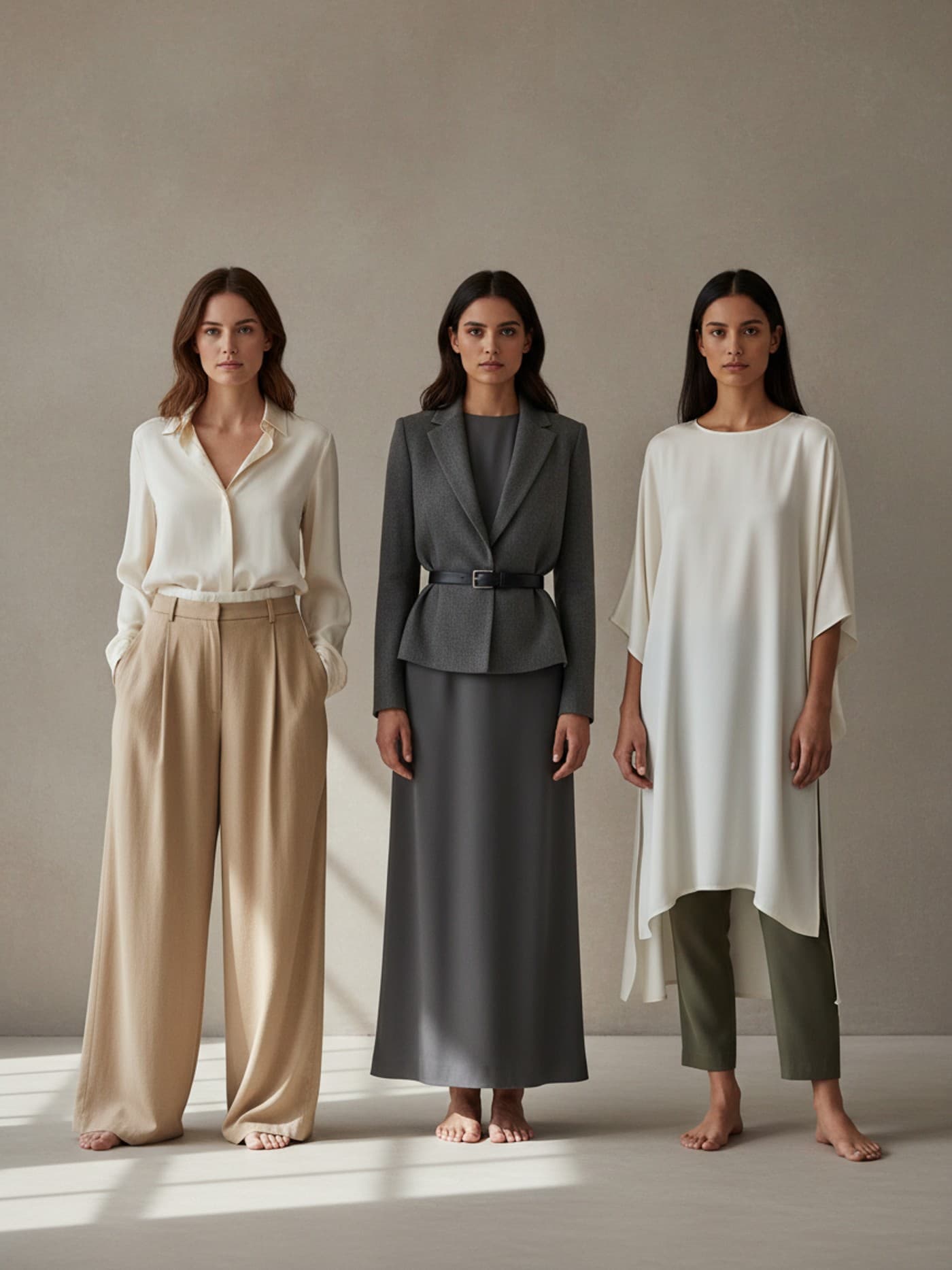
The Directional Power of Structural Lines
Beyond gross proportions, the specific lines created by seams, hems, patterns, and necklines act as the unspoken vocabulary of a garment. They silently dictate the exact path the observer's eye will take, radically altering the perceived shape and width of the wearer.5
Vertical Lines: Created by deep V-necklines, front-button closures, long pendant necklaces, tailored pleats, or by wearing a monochromatic "column of color," vertical lines force the eye to travel straight up and down.1 This swift vertical movement creates a powerful elongating and slimming effect, making the wearer appear taller and narrower.1
Horizontal Lines: Formed by boat necklines (bateau), wide belts, straight-across hemlines, and off-the-shoulder cuts, horizontal lines draw the eye side to side.9 This lateral movement creates a distinct illusion of width and volume.19 Consequently, horizontal lines are highly effective when placed on narrow areas of the body that require expansion (e.g., broad necklines on narrow shoulders), but are generally avoided on areas where the wearer wishes to minimize perceived width.9
Curved Lines: Soft, fluid, and circular lines suggest gentleness and organic movement.17 They are ideal for enhancing natural curves or artificially creating the illusion of a curve on a straight, rectangular body frame.17
Straight, Angular Lines: Sharp diagonals, crisp tailoring, and rigid seams impart a sense of structure, crispness, and authority.17 These are often used in corporate suiting to project power, or utilized to provide an architectural framework to bodies that lack strong skeletal definition.17
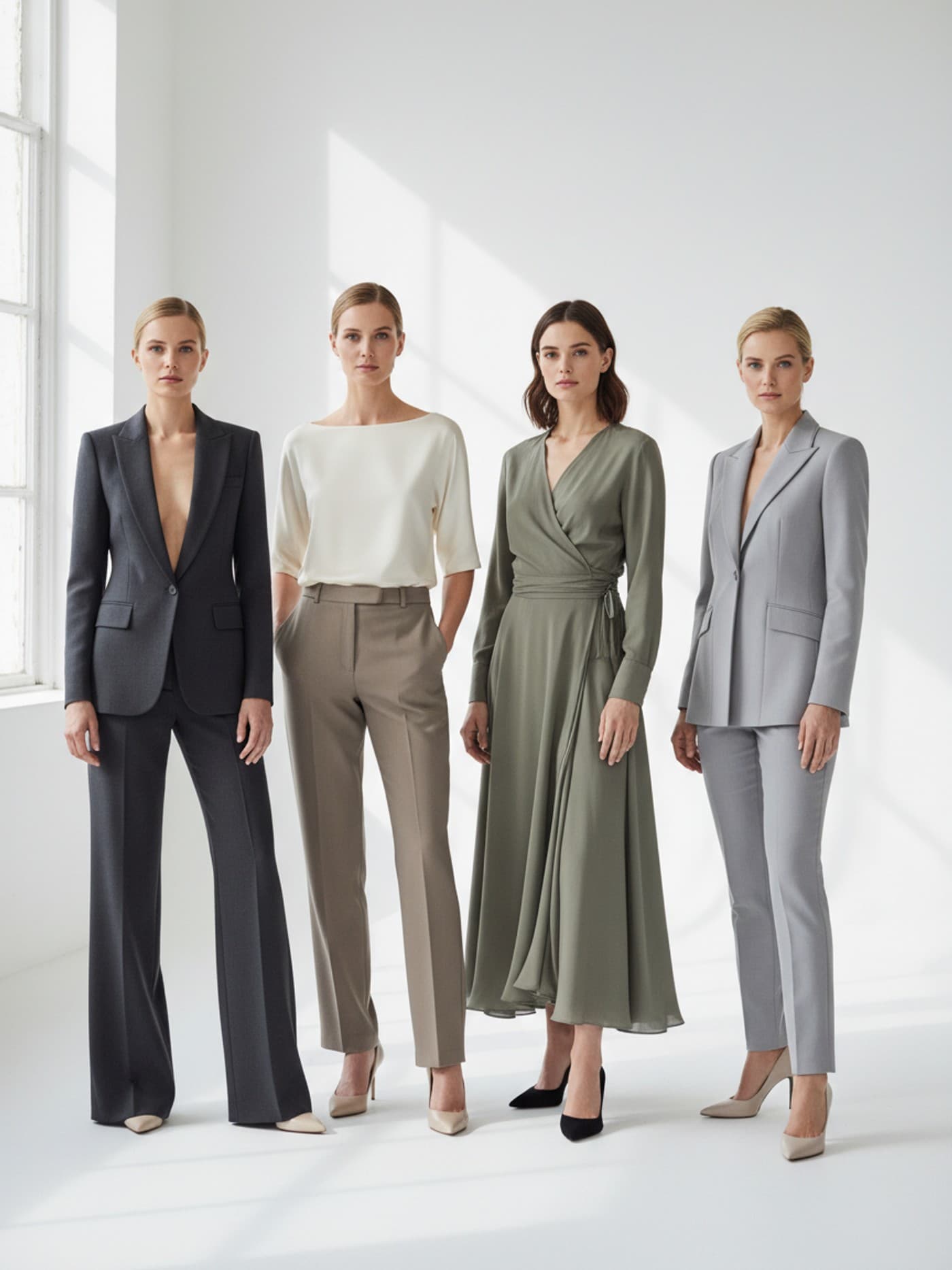
Textile Physics: The Architectural Role of Fabric
A garment's success relies equally on its two-dimensional silhouette and its three-dimensional material composition. Fabric acts as the vital physical interface between the body and the external environment. Its physical properties--specifically drape, weight, texture, and surface finish--dictate precisely how a design will behave in kinetic motion and how it will interact with the flesh beneath it.22 Choosing a silhouette that theoretically flatters a body shape, but executing it in the wrong fabric, will result in complete architectural failure.23
Drape vs. Weight Dynamics
It is crucial to distinguish between fabric weight and fabric drape, as they are related but entirely distinct properties.
Fabric Weight: This refers strictly to how heavy or thick a piece of textile feels physically. Weight determines how a fabric reacts to kinetic motion.22 Lighter fabrics (like chiffon) will swing outward away from the body as the wearer walks, creating visual motion and taking up more physical space in the air.22 Heavier fabrics (like dense wool or velvet) lag during movement, dropping straight down toward the floor due to gravity, providing visual stability and grounding the silhouette.22
Fabric Drape: Drape refers to the specific manner in which a fabric falls, folds, and conforms to a three-dimensional form.24
Fluid Drape: Materials like silk jersey, georgette, and lightweight crepe possess a fluid drape. They hug and conform closely to the body, revealing the underlying silhouette and moving harmoniously with the wearer's skin.9 These fabrics are highly effective for figures with natural curves (Hourglass, Pear), as they trace the body's geography without adding structural bulk.9
Moderate Drape: Fabrics like linen, lightweight cotton, and fine twill skim the body rather than hugging every curve, offering a versatile middle ground.24
Voluminous/Stiff Drape: Materials such as taffeta, heavy poplin, brocade, and organza stand away from the body.23 They do not conform to the flesh; instead, they create their own independent architectural structure.24 These fabrics are instrumental in building the illusion of volume or hiding irregularities, making them ideal for adding artificial curves to straight figures (Rectangle) or balancing top-heavy frames by building wide skirts (Inverted Triangle).23
Surface Texture and Light Reflection
The surface finish of a fabric drastically alters the optical perception of the body part it covers. The way a textile interacts with ambient light can visually expand or contract the wearer's proportions.
Shiny Finishes: Materials possessing a high sheen--such as satin, silk charmeuse, sequins, and metallic knits--actively reflect light outward.23 This reflection illuminates the body's silhouette and visually expands the surface area they cover, making the area appear larger and more prominent.23 Therefore, shiny fabrics are excellent strategic tools for highlighting specific assets or adding volume to narrower regions (e.g., a satin blouse on a Pear shape to broaden the chest).23 However, high-sheen fabrics relentlessly reveal every underlying contour and fold of flesh, which can be highly undesirable if the goal is concealment or smoothing.25
Matte Finishes: Fabrics with dull, matte surfaces--such as felt, wool crepe, brushed cotton, and heavy jersey--absorb light rather than reflecting it.25 This light absorption diffuses visual focus, creating a smoothing, minimizing effect that noticeably diminishes perceived volume.25 If a stylist wishes to minimize a specific area of the body (e.g., the hips on a Pear shape, or the midsection on an Apple shape), matte fabrics are absolutely essential.23
Textured Finishes: Rough, bulky, or highly tactile textures--such as boucle, faux fur, thick tweeds, and heavy corduroy--physically add undeniable weight and thickness to the frame.23 They create dimension and give the illusion of increased size.23
Consequently, an expert stylist manipulates texture with surgical precision: placing light-absorbing matte fabrics over areas meant to recede into the background, and light-reflecting or heavy textured fabrics over areas meant to advance to the foreground.26
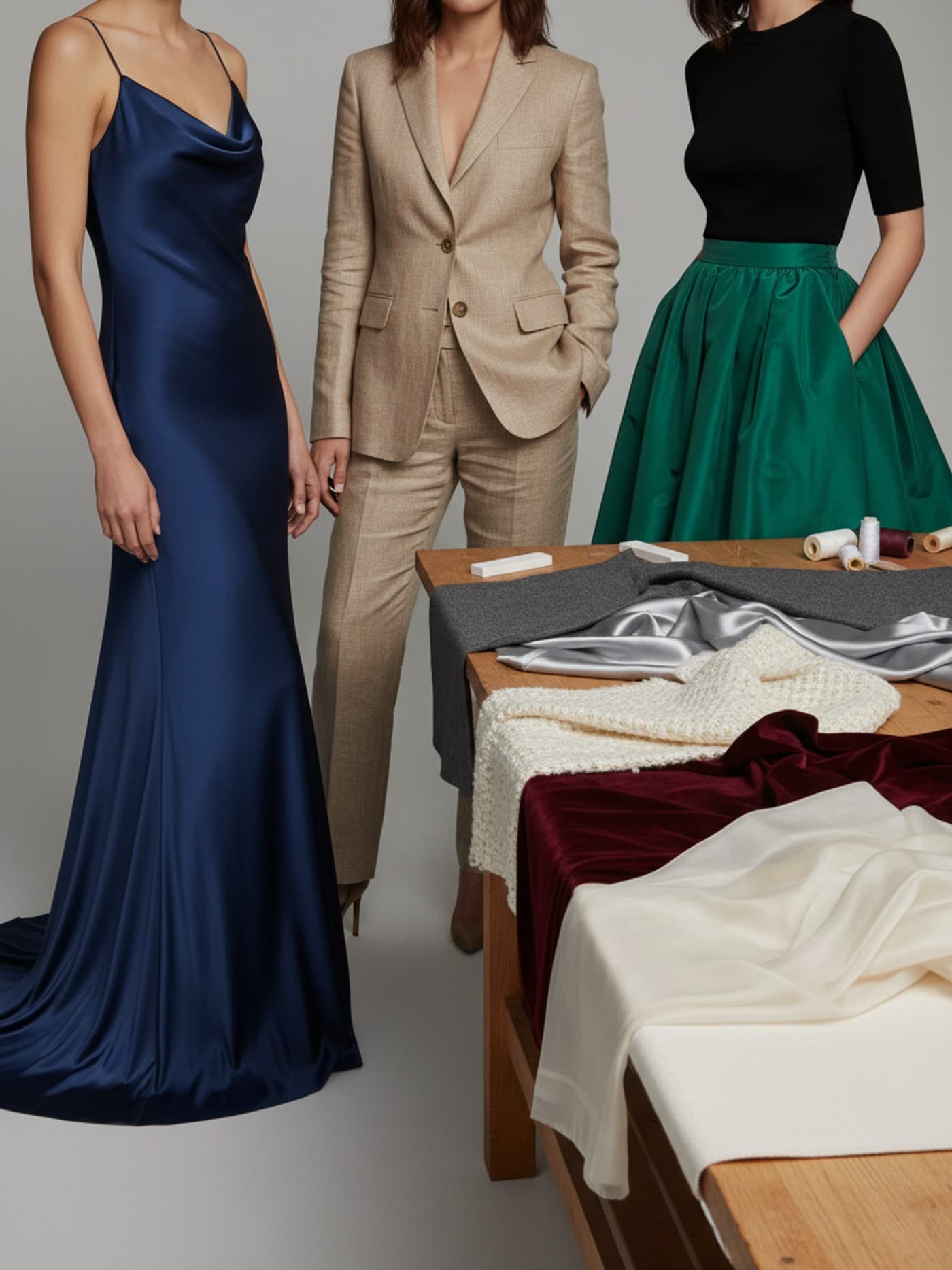
Comprehensive Anatomical Styling Analysis
By masterfully integrating the principles of geometric proportion, the Rule of Thirds, directional lines, and textile physics, we can rigorously dissect the optimal styling strategies for the eight distinct female body morphologies.
1. The Hourglass Morphology (X-Shape)
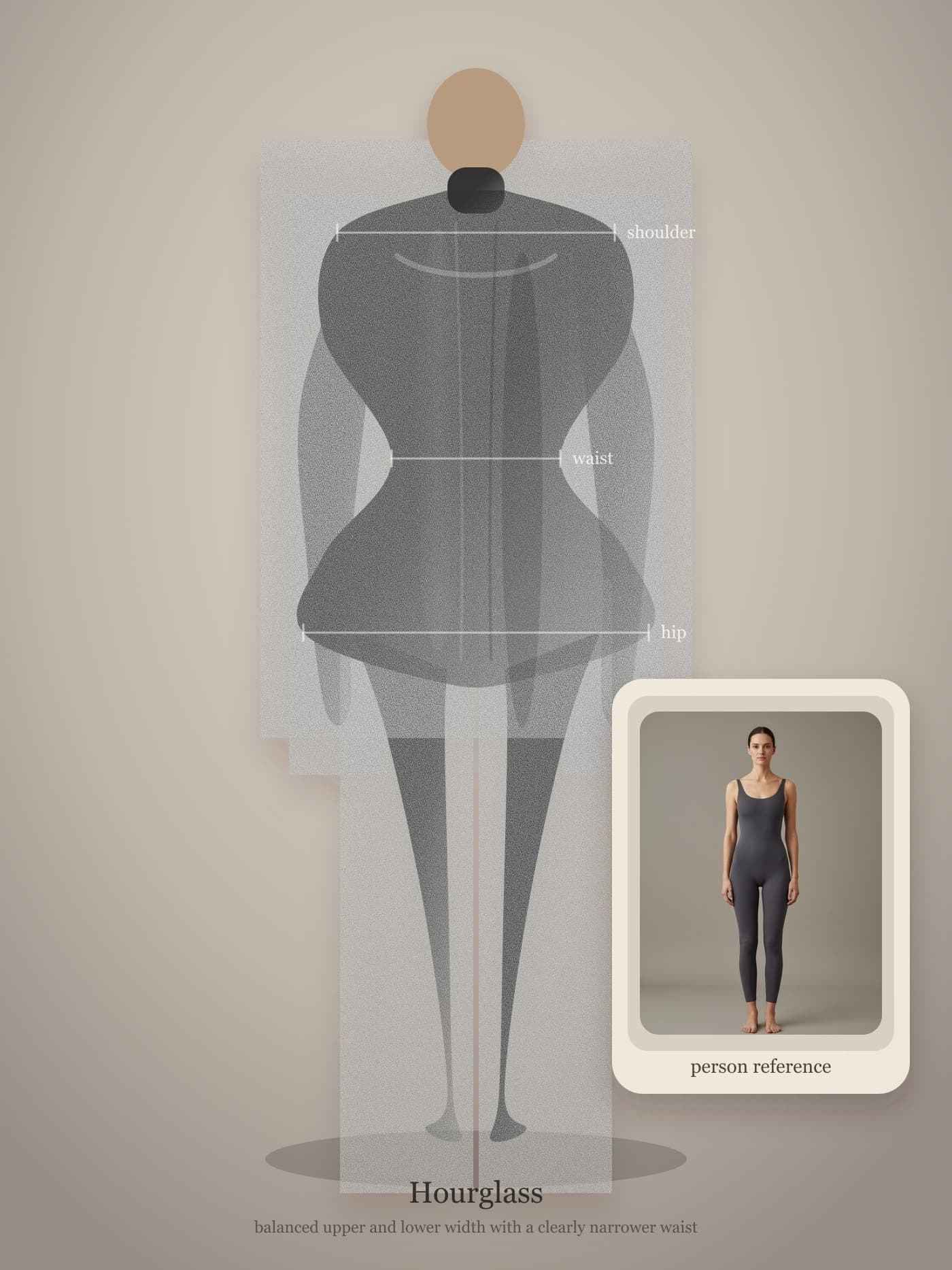
The Hourglass figure is widely considered the standard for natural, symmetrical geometric balance. Anatomically, the bust and hip measurements are nearly identical in width, intersected by a significantly narrower, sharply defined waistline.9 The shoulders are typically slightly rounded, and the legs are in perfect proportion with the upper torso.28 Because this body type already possesses the coveted mathematical equilibrium, the primary styling objective is not to correct proportions, but simply to follow the body's natural lines without disrupting the innate symmetry or obscuring the waist.3
Structural Strategy and Rationale
The absolute styling imperative for an hourglass figure is relentless waist definition. Garments must seamlessly bridge the transition from the broad bust, drastically taper inward to the narrow waist, and flare back out to accommodate the hips.9
Wrap dresses are universally celebrated as the quintessential garment for this shape.9 The architectural design of a wrap dress features a diagonal crossover bodice (creating an elongating V-neck) that physically ties and cinches exactly at the narrowest point of the waist, before draping softly over the hips.9 Similarly, tailored sheath dresses and bodycon silhouettes, designed with precise darts and seaming, encapsulate the natural curves with elegant structure.9 Necklines should organically follow the body's contours; sweetheart, scoop, and V-necks offer an open decolletage that highlights the bust without artificially widening the shoulders.20
Conversely, boxy, oversized, or straight-cut garments are highly detrimental to the Hourglass morphology.9 If a stiff fabric hangs straight down from the fullest point of the bust, it creates a vertical tent over the narrow waist.9 This optical illusion completely obscures the waistline, visually expanding the entire torso to the full width of the bust, thereby adding massive amounts of perceived, unwanted bulk to the frame.9 Visual examples of effective waist-cinching can be referenced in guides detailing Hourglass styling techniques.29
Textile Recommendations
Fabrics utilized for the Hourglass shape must possess either inherent stretch or a highly fluid drape to comfortably accommodate the drastic variations in circumference between the bust, waist, and hips. Stiff, unyielding fabrics (like heavy canvas or rigid brocade) will tent over the curves, creating rigidity and bulk.23 Spandex blends, soft jersey, bias-cut silks, fine crepe, and velvet are optimal, as they fluidly mold to the body's geography.23
| Garment Parameter | Flattering Choices for Hourglass | Unflattering Choices to Avoid | Recommended Textile Properties |
|---|---|---|---|
| Dresses | Wrap dresses, tailored sheath dresses, mermaid gowns, belted fit-and-flare.9 | Shapeless shift dresses, boxy tunics, empire waists that bypass the natural waist.1 | Spandex blends, velvet, silk, fine crepe, lightweight stretch jersey.23 |
| Tops | Belted tops, V-necks, scoop necks, fitted blouses with elastane.1 | Oversized tees, high rigid necklines, stiff boxy crop tops.9 | Stretch knits, soft cottons, modal blends. |
| Bottoms | High-waisted trousers, pencil skirts, bootcut jeans.29 | Low-rise pants, stiff pleating at the hips that adds artificial bulk.29 | Denim with high elastane content, soft wool blends. |
2. The Pear Morphology (Regular Triangle / A-Shape)
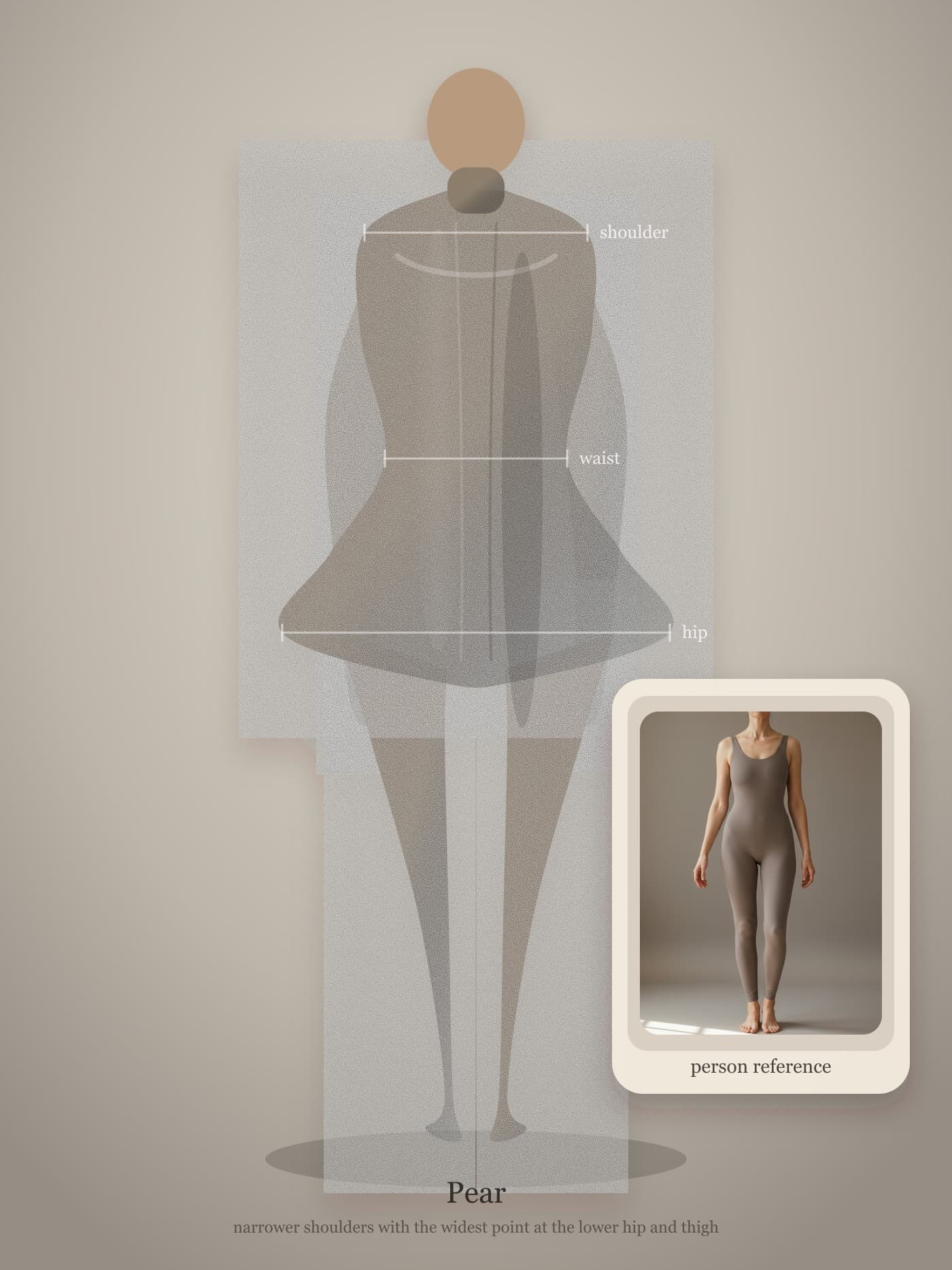
The Pear, or Triangle, body shape features a distinct bottom-heavy geometric proportion. The hips, thighs, and posterior are significantly wider than the bust and shoulders, accompanied by a slender, well-defined waist and a narrower upper torso.9 Weight distribution is heavily and disproportionately concentrated on the lower half of the body.31
Structural Strategy and Rationale
The architectural goal for the Pear shape is achieving visual equilibrium by counterbalancing the lower body. To mitigate the visual weight of the heavier lower half, significant physical volume, architectural structure, and visual interest must be added to the upper body, effectively expanding the shoulder line to match the width of the hip line.1
Necklines act as the primary tool for this expansion: boat necks (bateau), square necklines, and off-the-shoulder styles create a strong, horizontal line across the clavicle, which optically forces the observer's eye outward, widening the shoulders.9 Puffed sleeves, cap sleeves, prominent structural shoulder pads, and heavy bodice detailing (such as large ruffles, layered collars, or breast pockets) literally build physical volume on the narrow torso.9
For the lower half, the objective is to skim gracefully, rather than to cling tightly. Fit-and-flare dresses and A-line skirts are considered the absolute "holy grail" for this morphology.9 These garments are engineered to fit snugly at the narrow waist, anchoring the silhouette, and then utilize the fabric's inherent flare to cascade outward.9 This creates a conical void between the fabric and the lower body, effectively camouflaging the actual width of the hips and thighs while imposing a mathematically balanced shape.9 Trousers should feature a straight or bootcut leg to create a continuous, uninterrupted line to the floor, balancing the hip width.31 Tapered or skinny jeans anchor the visual weight at the hips and draw a sharp diagonal line inward toward the ankle, brutally exaggerating the lower body's width.29 Visual representation of these A-line silhouettes can be found in specialized Pear body shape guides.34
Textile Recommendations
Dressing a Pear shape requires a split-textile strategy. On the upper body, structured, slightly heavier, or light-reflecting fabrics (such as organza, crisp poplin, sequins, or shiny satin) can be utilized to aggressively build dimension and draw the eye.23 On the lower half, medium-weight fabrics with a strictly matte finish and a soft, fluid drape (matte crepe, fine twill, soft denim) are ideal, as they absorb light and recede visually.23 Clingy, thin materials like cheap spandex or high-shine satins on the lower body will highlight every contour of the hips and must be avoided.23
| Garment Parameter | Flattering Choices for Pear | Unflattering Choices to Avoid | Recommended Textile Properties |
|---|---|---|---|
| Dresses | A-line dresses, fit-and-flare, off-the-shoulder styles, structured blazer dresses.9 | Drop-waist dresses, tight bodycon dresses, bias-cut silk slips that cling.9 | Top: Poplin, organza. Bottom: Matte crepe, flowy chiffon.23 |
| Tops | Boat necks, puff sleeves, structured shoulders, bright eye-catching patterns.1 | Dropped shoulders, narrow spaghetti straps, long tight tunics that end at the widest part of the hip.1 | Boucle, tweed, light-reflecting satin to build volume. |
| Bottoms | Dark, straight-leg trousers, A-line skirts, bootcut jeans.31 | Clingy leggings, skirts with heavy hip embellishments, low-rise jeans, light-wash skinny jeans.29 | Matte finishes, soft worsted wool, medium-weight cotton blends. |
3. The Spoon Morphology
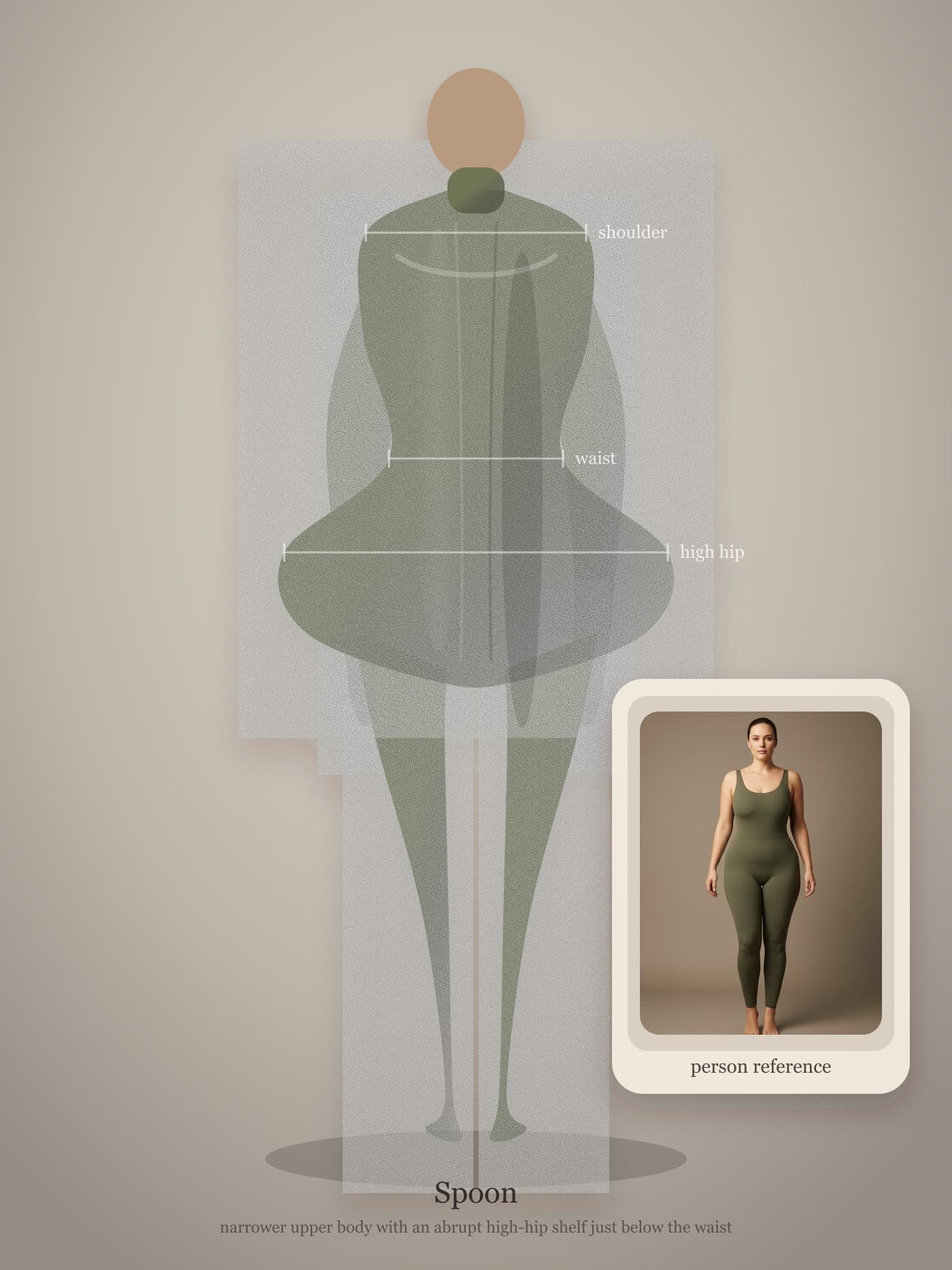
The Spoon shape is a highly nuanced, specific variation of the Pear shape. While both morphologies feature hips that are wider than the shoulders and bust, the Spoon is uniquely characterized by a distinct "shelf-like" hip appearance.31 The hip curve does not slope gently; rather, it is highly pronounced and juts out almost immediately below the waistline.31 The waist remains defined, but weight is often carried distinctly in the upper thighs and, notably, the upper arms--differentiating it from the pure Pear shape which carries weight lower in the thighs and posterior.31
Structural Strategy and Rationale
Similar to the Pear, the macro styling directive is to draw the eye upward and balance the pronounced lower curve by adding volume to the upper torso.33 Highlighting the decolletage through plunging necklines, strapless blouses, or wide boat necks shifts the focal point upward toward the face and shoulders.33
Because the hips possess a sharp, "shelf-like" protrusion, creating a smooth transition from the narrow waist to the leg is paramount. Garments that grip the hips will starkly outline this shelf, which can disrupt the fluidity of the silhouette. Therefore, A-line dresses and skirts that flare gently from the natural waist are critical; they glide over the hip shelf, camouflaging the sharp angle and creating a softer, sweeping line.33 Monochromatic dressing on the bottom half is highly recommended to create an unbroken vertical line that lengthens the leg and minimizes the shelf effect.33 For detailed inspiration, the cited source references provide excellent visual distinctions.36
Textile Recommendations
Flowing, unrestrictive textiles that do not catch or snag on the high hip shelf are required. Tencel, high-quality linen, and soft organic denim provide enough weight to fall smoothly toward the floor without clinging to the upper thigh or outlining the lower abdomen.33
| Garment Parameter | Flattering Choices for Spoon | Unflattering Choices to Avoid | Recommended Textile Properties |
|---|---|---|---|
| Dresses | Empire waists, A-line dresses with flared skirts, plunging necklines.33 | Extreme bodycon, dropped waists, horizontal stripes on the lower half.33 | Soft linen, medium-weight Tencel, matte crepe.33 |
| Tops | Embellished shoulders, bell sleeves, off-the-shoulder cuts, bright colors.33 | Tight, plain, dark-colored tops that shrink the upper body relative to the hips.33 | Light, textured cottons, visually interesting weaves. |
| Bottoms | High-rise straight cut pants, monotone dark trousers.33 | Skinny jeans, heavily pocketed cargo pants, low-rise cuts.33 | Matte, non-clingy woven fabrics with drape. |
4. The Inverted Triangle Morphology (Heart / V-Shape)
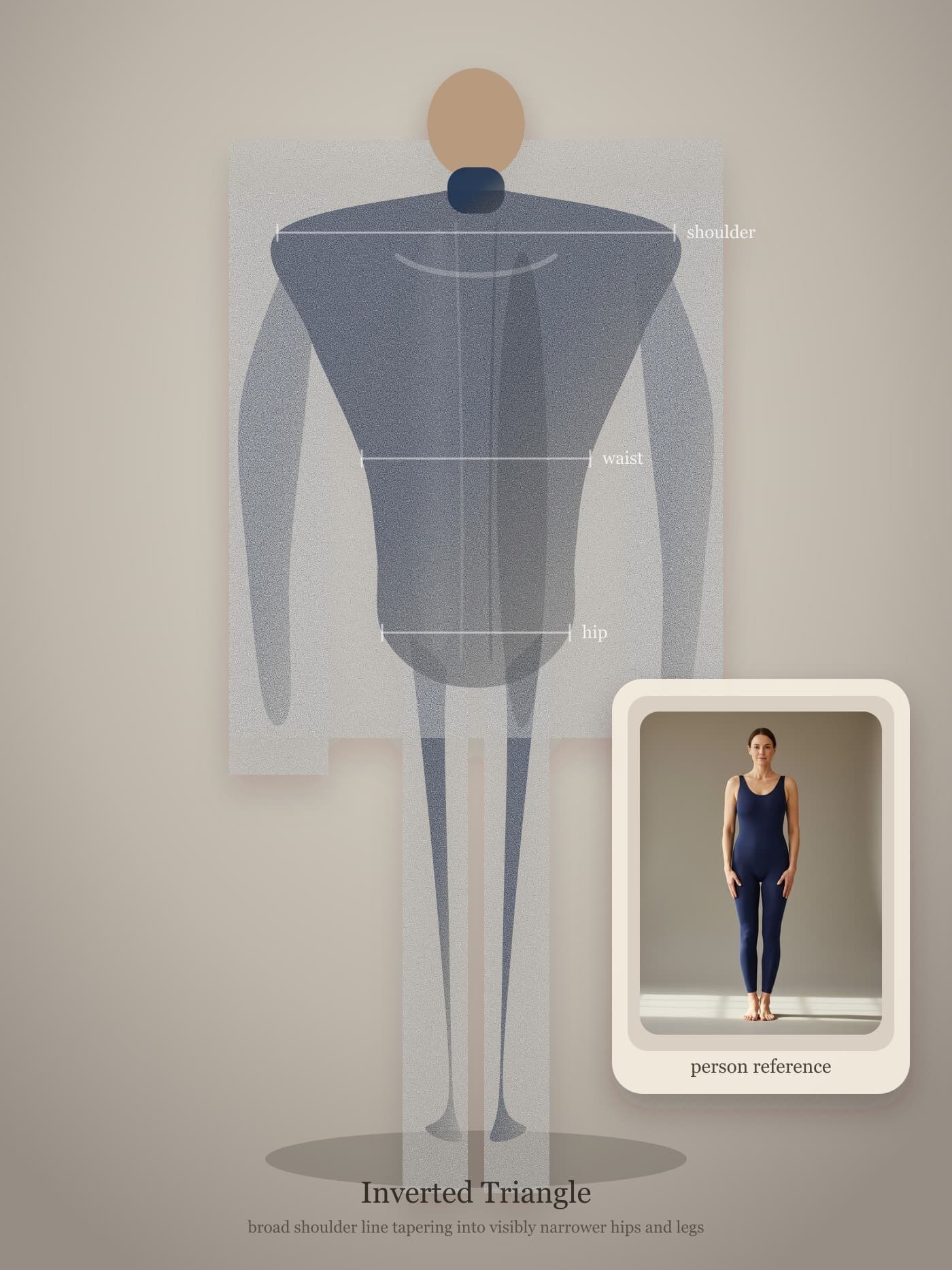
The Inverted Triangle, frequently referred to as the Heart shape, presents a decidedly top-heavy silhouette. The skeletal structure features broad, prominent shoulders and a wider, fuller chest, which then tapers sharply down to a narrower waist and slim, narrow hips.1 This body type is athletic in the upper body and often boasts excellent, slender legs, but the distinct lack of lower-body volume creates an inverted proportion that can appear top-heavy.1
Structural Strategy and Rationale
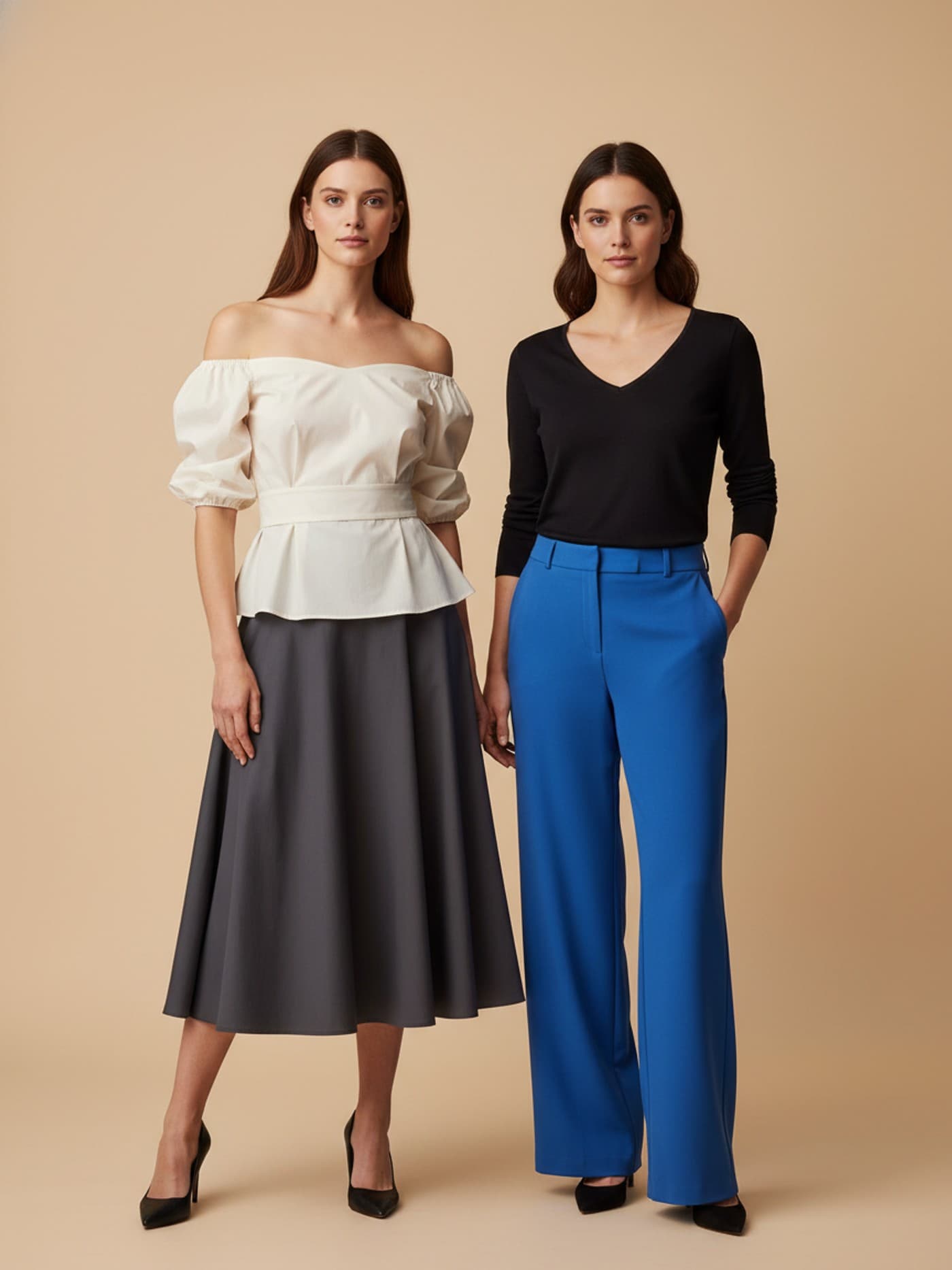
The architectural goal for the Inverted Triangle is the exact mathematical inverse of the Pear: to visually minimize the breadth of the shoulder width while aggressively adding substantial physical volume to the hips and lower body to create the illusion of an hourglass.9
To soften the expanse of the upper torso, deep, vertical necklines--such as plunging V-necks, deep scoops, and asymmetric cuts--are utilized.9 These necklines break up the broad horizontal expanse of the chest and shoulders, pulling the eye inward and downward.20 Wide necklines like boat necks, square cuts, or Bardot styles are strictly prohibited, as they draw a horizontal line across the already broad shoulders, exacerbating their width.1 Similarly, structured shoulder pads, epaulettes, and puff sleeves must be avoided.1
To build the architecture of the lower half, garments that physically flare from the waist outward are essential. Deeply pleated skirts, wide-leg trousers, flared ballgowns, boyfriend jeans, and rigid peplum details inject immense physical volume exactly at the hip line, balancing the broad shoulders above.1 Color-blocking is a highly effective optical tool here: employing dark, light-absorbing colors on the upper body causes the chest to recede, while wearing bright, advancing colors or bold, large-scale prints on the lower half visually advances and expands the hips, creating perfect optical balance.38 Additional styling strategies can be viewed in curated styling guides.38
Textile Recommendations
The upper body requires soft, fluid, and drapey fabrics (silk, soft jersey, fine knits, cashmere) that fall gently and softly over the broad shoulders without adding any architectural stiffness or bulk.23 The lower body, however, benefits immensely from stiffer, voluminous fabrics (taffeta, heavy duchess satin, rigid denim, stiff pleated cotton) that have the mechanical integrity to hold a flared shape independently, thereby building the hips.23
| Garment Parameter | Flattering Choices for Inverted Triangle | Unflattering Choices to Avoid | Recommended Textile Properties |
|---|---|---|---|
| Dresses | Flared dresses, deep V-neck wrap dresses, A-line ballgowns.9 | Boat neck dresses, strapless dresses, dresses with heavy shoulder embellishments.20 | Top: Soft jersey, silk crepe. Bottom: Taffeta, rigid cotton, structured pleats.23 |
| Tops | V-necks, wrap tops, dark muted colors, halter necks.1 | Shoulder pads, puff sleeves, wide horizontal stripes, stiff structured jackets.39 | Fluid, lightweight, non-bulky fabrics that hang softly. |
| Bottoms | Boyfriend jeans, wide-leg trousers, pleated full skirts, bright colors/prints.1 | Tight leggings, dark skinny jeans that emphasize narrow hips and slim legs.40 | Stiff fabrics, high-shine satin, heavy denim.23 |
5. The Rectangle Morphology (Athletic / H-Shape)
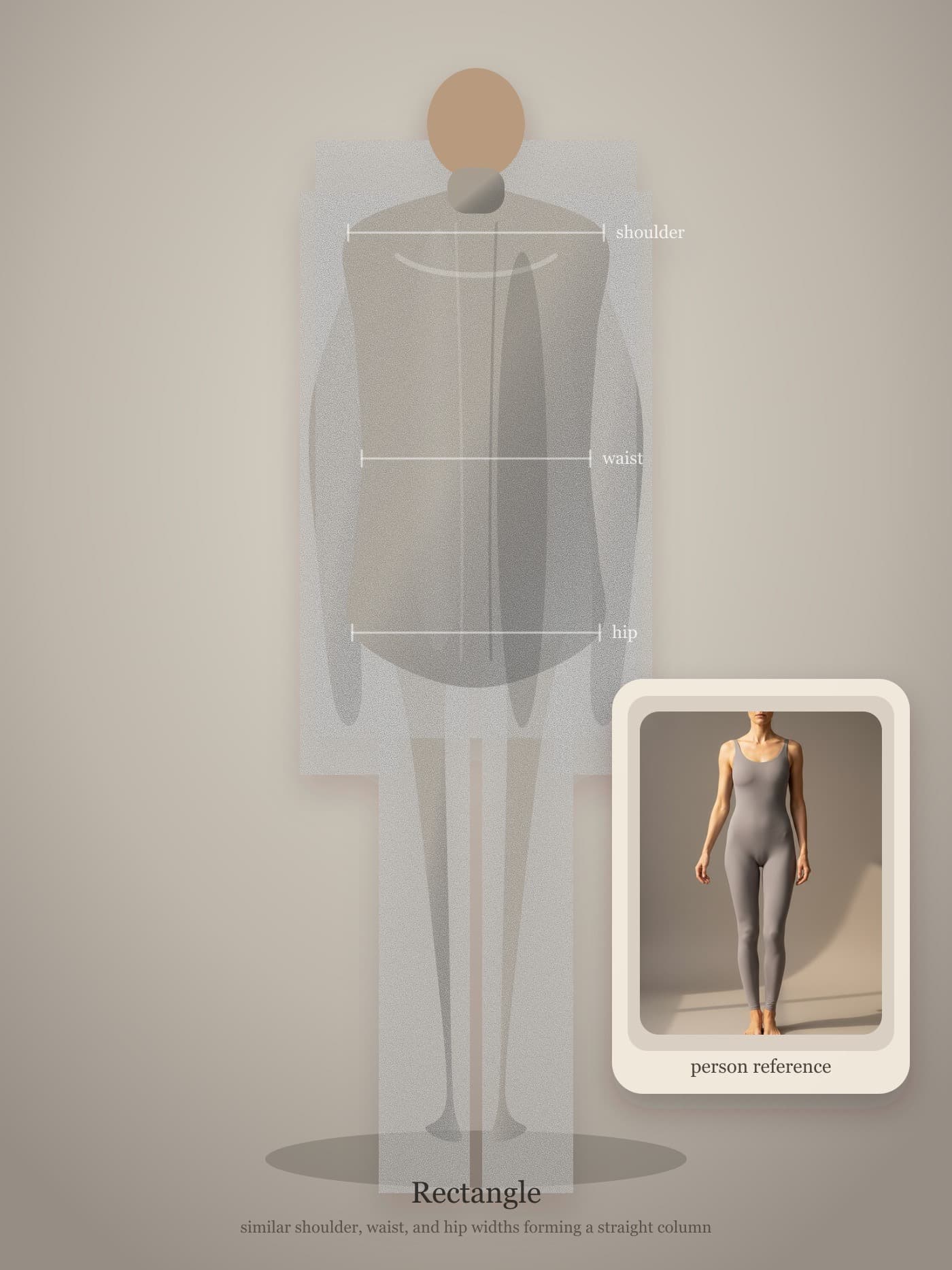
The Rectangle, frequently categorized as the Athletic, Straight, or H-shape, is defined by mathematically uniform measurements. The shoulders, bust, natural waist, and hips are all roughly the exact same width.9 This results in a straight, columnar silhouette with minimal to no natural flesh curves or waist indentation.9 While this shape benefits from being naturally well-proportioned and easy to fit off-the-rack, the stark lack of waist definition requires highly strategic structural intervention.42
Structural Strategy and Rationale
The stylistic mission for the Rectangle is purely illusionary: to artificially construct curves and forcefully define a waistline where one does not organically exist.42 This geometric manipulation is achieved by simultaneously adding significant volume to the upper body (bust/shoulders) and the lower body (hips) while physically cinching the middle, thereby creating a synthetic hourglass.42
Peplum tops and dresses are paramount in this endeavor; the bodice fits closely to the torso, while the flared ruffle at the waist instantly and sharply creates the geometric illusion of a curving hip.9 Strategic layering is another excellent architectural tool; a structured blazer worn open over a belted dress, or a belt worn over a cardigan, creates instant dimension and breaks up the columnar monotony.1 Tiered skirts, ruffles, heavy pleating, and hip pockets add necessary artificial volume to the lower half.9
Conversely, wearing boxy, shapeless shift dresses or straight columns of color will merely highlight and exacerbate the straightness of the figure.9 These should be approached with extreme caution unless a specific minimalist, androgynous aesthetic is the explicit goal.9 Detailed guidelines on constructing these artificial curves can be found in comprehensive rectangle-shape guides.42
Textile Recommendations
Because the body lacks natural, soft curves, the fabric itself must do the heavy architectural lifting. Stiff, heavily textured, or voluminous textiles are strictly required to hold artificial shapes away from the body. Materials like lace, heavy sequins, thick felt, brocade, and stiff heavy cotton can create architecture and dimension off the body.23 Thin, flat, or overly fluid fabrics (like thin jersey or limp silk) will simply hang flat and dead against the straight frame, doing nothing to enhance or create a silhouette.23
| Garment Parameter | Flattering Choices for Rectangle | Unflattering Choices to Avoid | Recommended Textile Properties |
|---|---|---|---|
| Dresses | Peplum dresses, belted fit-and-flare, dresses with tiered skirts or ruffles.9 | Straight shift dresses, unbelted tunics, shapeless maxi dresses.9 | Lace, sequins, thick felt, structured cotton, brocade.23 |
| Tops | Belted jackets, tops with breast pockets or ruffles, wrap tops with strong belts.1 | Straight, square-cut shirts that end bluntly at the waist.42 | Textured fabrics, dimensional weaves, stiff poplin. |
| Bottoms | Mid-rise jeans, pants with hip details/pockets, flared trousers.1 | Extremely low-rise pants without a belt, straight-cut plain skirts.42 | Heavier weight materials that maintain shape and structure. |
6. The Apple Morphology (Round / O-Shape)
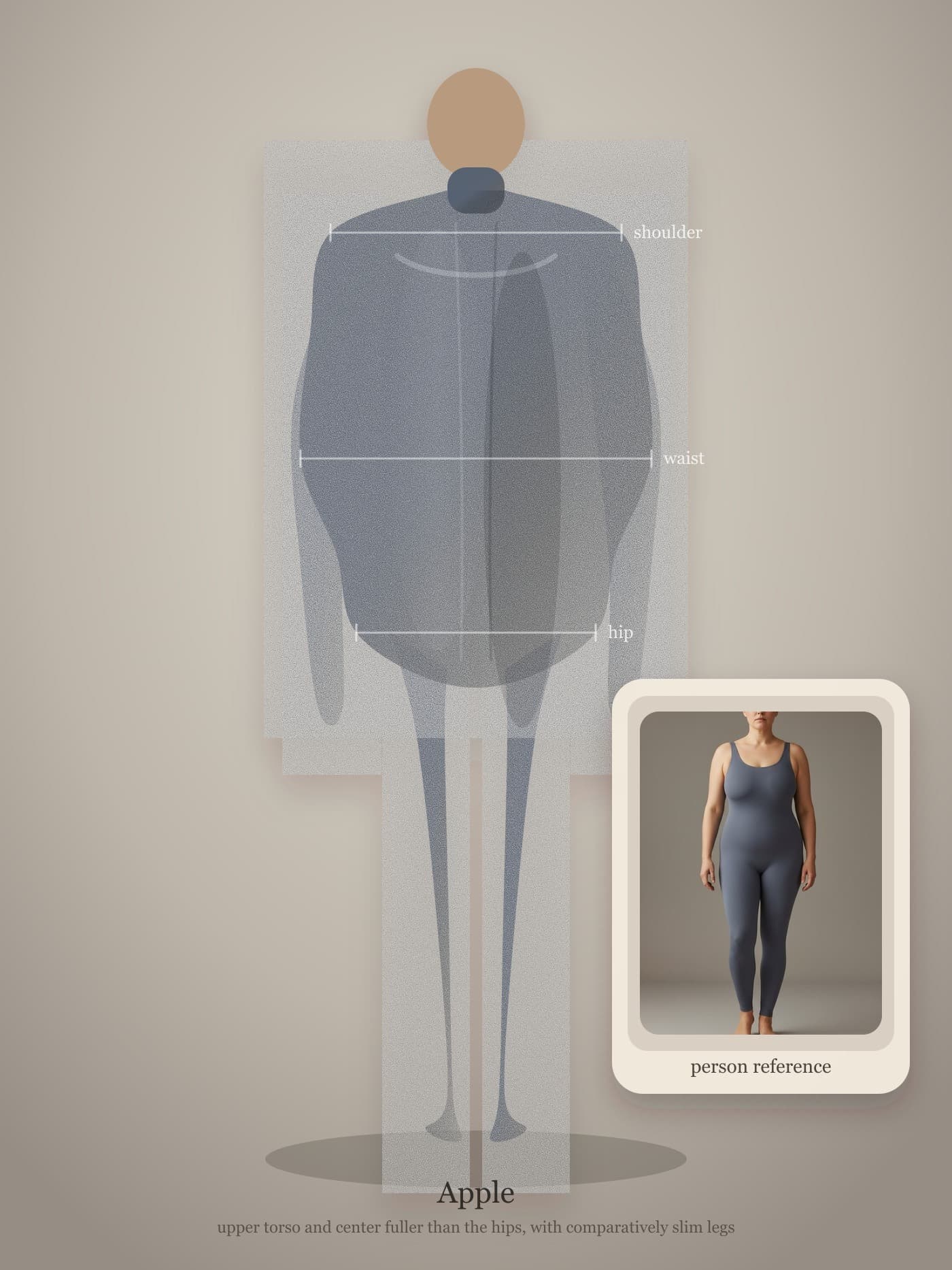
The Apple shape, or Round shape, features a fuller, broader upper body and a rounded midsection, typically paired with a fuller bust.9 The natural waistline is largely undefined or obscured, but the body tapers significantly to relatively slim, slender arms and excellent, narrow legs.9 Adipose weight is primarily carried centrally, in the torso and visceral area.9
Structural Strategy and Rationale
The primary objective when styling the Apple shape is redirection. The stylist must shift the visual focal point away from the fuller midsection, directing the eye upward to the face and decolletage, and downward to the slender legs.8
The most effective architectural tool for the Apple morphology is the Empire waistline.9 An empire cut places the narrowest cinched point of the garment directly beneath the bust--which is almost always the smallest, most defined part of the torso for this morphology.1 Below this high cinch, the remaining fabric is allowed to skim loosely and elegantly over the abdomen without clinging.9
Wrap dresses are also highly effective; the deep V-neck creates a powerful vertical line that elongates the chest, while the adjustable tie accommodates the varying dimensions of the midsection without painful restriction.9 Shift dresses, which hang straight down from the shoulders, provide ease of movement and bypass the midsection entirely.9 Necklines should remain aggressively open--plunging V-necks, deep scoops, and off-the-shoulder styles--to break up the solid, heavy mass of the upper torso and elongate the neck.9
Tight waistbands, thick belts placed indiscriminately over the stomach, and high, constricting necklines (like turtlenecks) are disastrous.9 They trap visual energy in the exact center of the body, creating a distinctly top-heavy and spherical appearance.9 Showing off the legs with knee-length hemlines or tailored shorts is highly recommended to anchor the look in the body's slimmest points.9
Textile Recommendations
Fabric choice for the Apple shape is paramount; errors here will result in severe proportional imbalance. The material must possess a gentle, fluid drape that falls softly over the midsection without gripping or clinging to the flesh. Heavy jersey, rayon, high-quality chiffon, and matte crepe are ideal.9 Stiff, heavy fabrics like thick brocade, heavy felt, or rigid cotton will stand away from the body, adding massive, boxy volume to the already full midsection.9 Shiny satins or tight spandex placed over the torso will reflect light and sharply magnify the stomach's curvature, so matte, light-absorbing finishes are highly preferred.23
| Garment Parameter | Flattering Choices for Apple | Unflattering Choices to Avoid | Recommended Textile Properties |
|---|---|---|---|
| Dresses | Empire waist, wrap dresses, straight shift dresses, gently flared A-line.9 | Bodycon, dresses with tight natural-waist belts, drop waists.9 | Soft jersey, rayon, matte crepe, flowy chiffon.9 |
| Tops | Deep V-necks, flowy tunics, unbuttoned structured blazers to create vertical lines.1 | High boat necks, tight crop tops, tops with midsection ruffles or horizontal stripes.9 | Fluid, medium-weight, matte fabrics.23 |
| Bottoms | Straight-leg jeans, shorter skirts to show legs, slim-fit trousers.1 | Bulky cargo pants, heavily pleated bulky skirts.9 | Stretchy denim, smooth, flat tailoring. |
7. The Oval Morphology
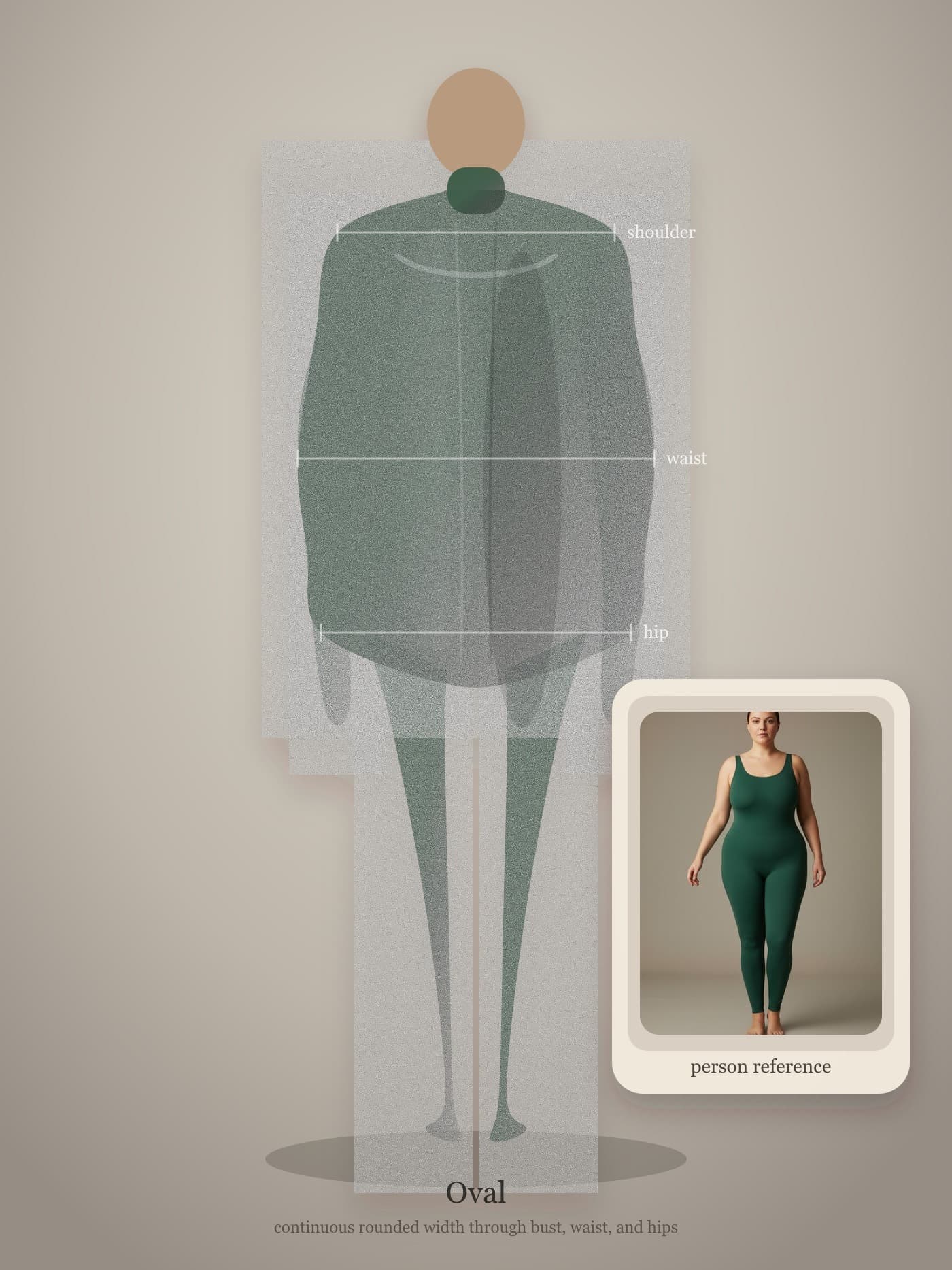
The Oval shape is very closely related to the Apple but features subtle, important distinctions in its overall geometry. An Oval body is generally rounder throughout the entire torso, with a fuller bust, and similar, continuous width across the bust, waist, and hips.9 It specifically lacks any waist definition, presenting as a continuous curve rather than a top-heavy frame.9
Structural Strategy and Rationale
Like the Apple, the styling goal is to elongate the frame, bypass the midsection, and create vertical visual pathways. Deep V-necklines and open collars are absolutely vital for extending the neck and creating a strong vertical axis that breaks up the roundness of the torso.9 Flowy A-line dresses that skim gently over the stomach provide a graceful, unrestrictive silhouette that implies a waist without forcing one.9
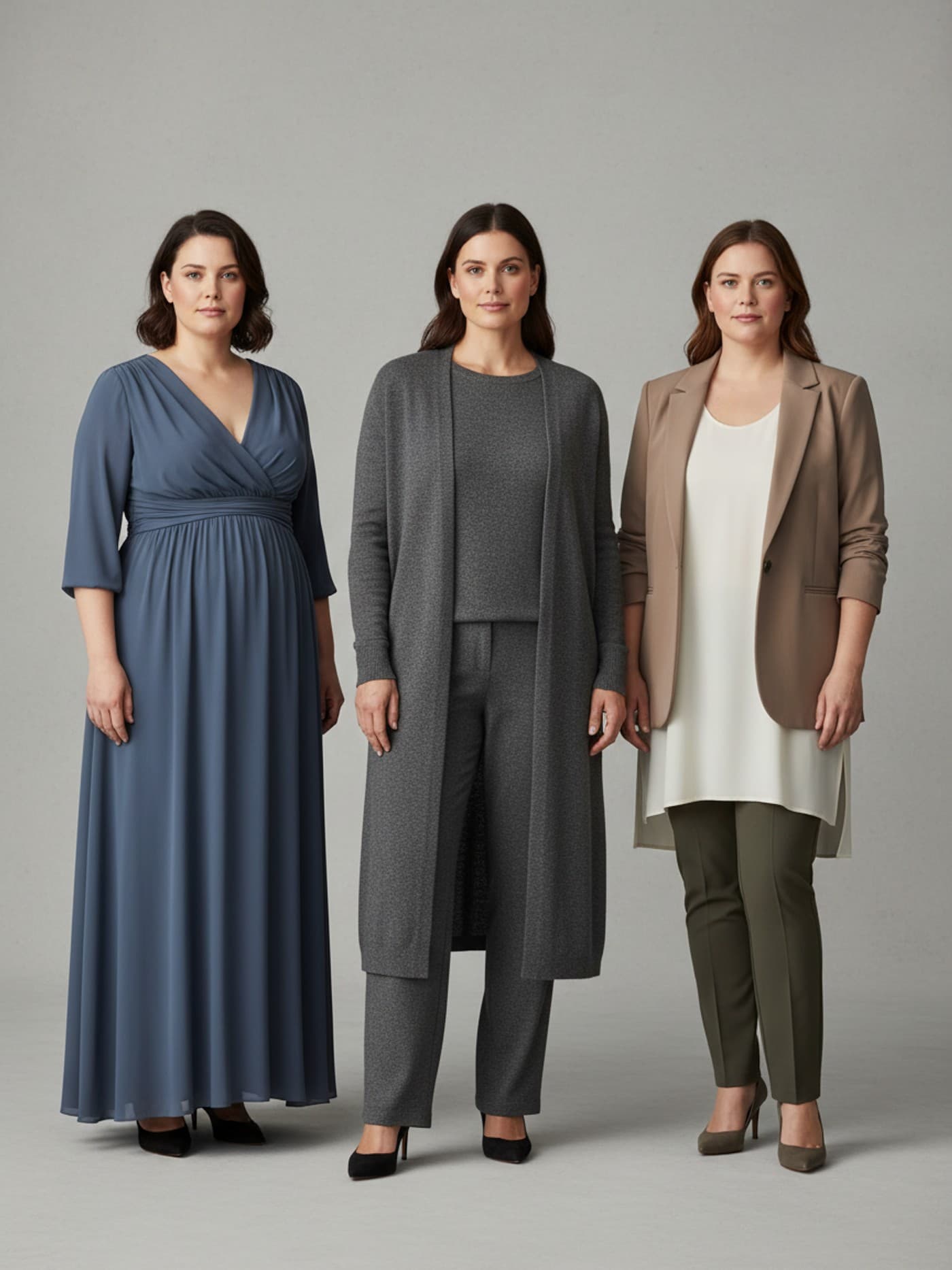
Monochromatic dressing--creating an unbroken column of color from head to toe--is a particularly potent tool for the Oval shape.15 By wearing a single color (or varying shades of the same color), the stylist prevents any horizontal visual breaks (such as a white shirt tucked into black pants), which would otherwise starkly emphasize width.18 Horizontal patterns, especially those placed anywhere near the waist or midsection, must be strictly avoided, as they will draw the eye side-to-side, expanding the torso.9 For further visual cues on monochromatic styling, Oval and Apple body shape resources provide excellent examples of the "column of color" technique.44
Textile Recommendations
Similar to the Apple, matte finishes are strictly required to absorb ambient light and reduce perceived spherical volume.26 Softly draping fabrics that do not cling to the flesh but possess enough intrinsic weight to hang straight down (rather than billowing out) are essential to creating a sleek silhouette.23
| Garment Parameter | Flattering Choices for Oval | Unflattering Choices to Avoid | Recommended Textile Properties |
|---|---|---|---|
| Dresses | Empire waists, flowy A-lines, deep V-neck maxis, monochromatic dresses.9 | Horizontally striped dresses, tight midsection banding, stiff fabrics.9 | Matte, soft-draping textiles, heavy jersey. |
| Tops | Open collars, longline cardigans, tunic lengths, deep scoops.9 | Tight crewnecks, high turtlenecks, cropped bulky sweaters.9 | Breathable, fluid knits, matte silk. |
| Bottoms | Straight or gently flared pants.11 | Clingy fabrics around the stomach, pleated waistbands.9 | Structured but comfortable, smooth weaves. |
8. The Diamond Morphology
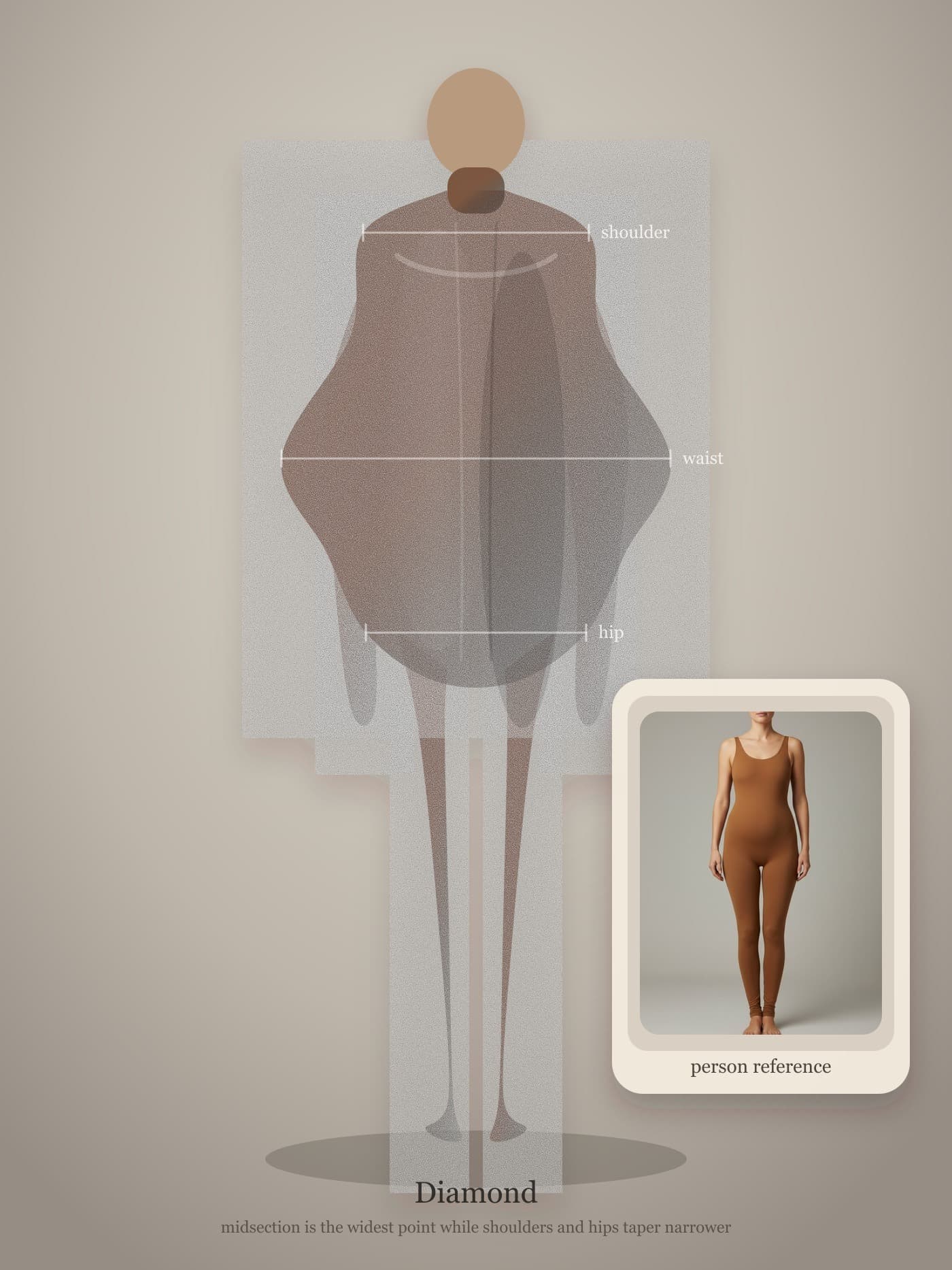
The Diamond shape is a unique morphology characterized by a midsection that is the absolute widest part of the entire body.11 Both the shoulders and the hips taper significantly, becoming much narrower than the waist.11 The waist is entirely undefined, but the lower body and legs are characteristically very slim, and the arms are often slender.11
Structural Strategy and Rationale
The Diamond shares heavy styling principles with both the Apple and the Oval, focusing aggressively on softening and camouflaging the waistline while drawing extreme focus to the slender extremities--specifically the neckline and the legs.11 V-necks and wide, open necklines elongate the upper torso and pull the focus upward to the face.11 Empire-waist garments are again the optimal choice, cinching under the bust and flowing seamlessly over the widest part of the torso.11
Because the shoulders are uncharacteristically narrow relative to the wide midsection, structured blazers, tops with slight shoulder padding, or flutter sleeves can be carefully introduced to build the upper framework.11 Expanding the shoulder line allows subsequent garments to hang more cleanly and vertically over the stomach, rather than stretching across it. To highlight the shape's best assets, slim or straight-leg trousers, or dresses with shorter hemlines, are utilized to showcase the slender legs.11
Textile Recommendations
Fabrics must be highly forgiving and non-clingy around the midsection. Dense, matte fabrics that offer a slight degree of structure without absolute stiffness (such as brushed cottons, lightweight worsted wools, or heavy crepe) help to smooth the silhouette and hide flesh rolls, while still allowing for fluid movement.11
| Garment Parameter | Flattering Choices for Diamond | Unflattering Choices to Avoid | Recommended Textile Properties |
|---|---|---|---|
| Dresses | Empire waists, A-line cuts, dresses with upper-body embellishments/shoulder details.11 | Clingy bodycon dresses, wide horizontal midsection belts, dropped waists.11 | Matte finishes, structured but soft blends, heavy crepe. |
| Tops | V-necks, structured shoulders, relaxed fits that skim the belly.11 | Tight, thin materials (like cheap spandex) that cling to the stomach.11 | Medium-weight, non-stretch wovens, thick knits. |
| Bottoms | Slim trousers, straight-leg cuts, shorter skirts to reveal legs.11 | Bulky, wide-leg pants that swallow the legs and make the whole body look wide.11 | Tailored, smooth fabrics, flat-front pants. |
Advanced Paradigm: The Kibbe Image Identity System
While the traditional geometric, fruit-based, and shape-based body typing systems provide an excellent, highly effective macro-level framework for proportion balancing, advanced sartorial styling often incorporates the Kibbe Image Identity System for micro-level, highly personalized refinement.46 Developed in the 1980s by David Kibbe, this holistic system moves far beyond simple tape measurements to analyze the body's overall skeletal structure and flesh composition along a spectrum of Yin and Yang.46
In this theoretical framework:
Yin represents curved, soft, rounded edges, delicate bone structure, and softer flesh (traditionally feminine elements).46
Yang represents angular, structured, sharp bone structure, broadness, and taut flesh (traditionally masculine structural elements).46
The Kibbe system categorizes bodies into five main families based on their unique balance of these energies: Dramatic (extreme Yang, sharp and long), Natural (blunt Yang, broad and muscular), Classic (perfect, symmetrical balance of Yin and Yang), Gamine (a juxtaposition of sharp Yang bone structure and soft Yin flesh/features), and Romantic (extreme Yin, soft, curved, and delicate).46
The profound advantage of integrating the Kibbe philosophy into styling is its intense emphasis on the way fabrics naturally drape over a unique combination of bone and flesh, rather than just treating the body as a 2D silhouette to be "corrected".46 For example, under a traditional measurement-based system, two women might both have a 36-26-36 measurement and be classified purely as an "Hourglass." However, the Kibbe system would differentiate them:
One woman might have her curves supported by a sharp, angular, prominent skeleton (a Yang-dominant hourglass, perhaps a Soft Dramatic). She requires more tailored, structured fabrics, bold large-scale prints, and deep V-necks to harmonize with her sharp bone structure.46
The other woman might have the exact same measurements but a delicate, rounded, barely-there skeleton (a Yin-dominant hourglass, a true Romantic). She requires lightweight, highly fluid, draping fabrics (like chiffon or silk), watercolor prints, and soft, rounded necklines.46 Putting stiff, tailored suits on her would look overwhelmingly harsh, despite her "Hourglass" measurements.47
Furthermore, the Kibbe system integrates "essence" and facial features into the styling equation, acknowledging that a person's face dictates the overall visual impact of an outfit just as much as their bodily proportions.46 It fundamentally argues that styling should not merely attempt to "correct" a perceived geometric imbalance--as traditional body typing sometimes implicitly suggests--but rather echo and harmonize with the body's innate geometric lines.46 If a frame is sharply angular (Yang), dressing the body in highly structured, stiff fabrics complements and honors that natural geometry, rather than attempting to artificially soften or hide it.46 Extensive Kibbe body type introductions provide deeper visual understanding of how flesh drapes over bone differently across the Yin/Yang spectrum.46
The Convergence of Fashion, Physics, and Physiology
The art of dressing the female form is fundamentally a multidisciplinary exercise requiring a profound, integrated understanding of anatomical geometry, visual proportion, and textile mechanics. As demonstrated throughout this analysis, there is no such thing as a universally flattering garment independent of the wearer's physical context. A heavy, voluminous taffeta skirt will brilliantly and architecturally construct necessary curves on a straight Rectangle morphology, providing life and dimension to a flat frame. Yet, placing that exact same garment on an Apple morphology will disastrously disrupt the balance of the silhouette, adding massive amounts of rigid weight to the midsection and destroying the body's natural lines.9
The core philosophy of modern, expert styling is not one of concealment, correction, or forcing a body into an unattainable mold. It is a philosophy of architectural harmonization.1 By accurately identifying one's underlying somatotype and the resulting geometric proportions--whether it be the broad-shouldered Heart, the bottom-heavy Pear, or the columnar Rectangle--individuals can masterfully manipulate the Rule of Thirds and deploy directional lines to actively guide visual perception.11
Furthermore, fabric selection must be recognized as the silent architect of style. The intricate interplay between a material's physical weight, its drape, and its light-reflecting properties dictates the final physical manifestation of the silhouette.23 Stiff, reflective materials build volume and attract the eye; soft, matte, fluid materials reduce volume and accommodate natural curves.23
Ultimately, mastering these anatomical and physical principles liberates the wearer from the arbitrary dictates of fleeting fashion trends. By consciously choosing silhouettes and fabrics that respond mathematically and physically to their specific anatomical framework, individuals can construct highly intentional wardrobes. This approach ensures that the clothing serves the body, rather than the body serving the clothing, resulting in profound aesthetic balance, uncompromised physical comfort, and an enduring sense of sartorial mastery.
Works cited
- How To Dress For Your Body Type and Female Body Shape Explained - Gabrielle Arruda, accessed May 7, 2026, https://gabriellearruda.com/how-to-dress-better-female-body-shape/
- Determine Your Body Shape(s) - the concept wardrobe, accessed May 7, 2026, https://theconceptwardrobe.com/build-a-wardrobe/determine-your-body-shapes
- How to Dress Your Body Shape: What Actually Looks Good, accessed May 7, 2026, https://thewelldressedlife.com/how-to-dress-your-body-shape/
- Classifying Body Types: A Complete Guide for Personal Stylists - QC Makeup Academy, accessed May 7, 2026, https://www.qcmakeupacademy.com/blog/2025/10/classifying-body-types-a-complete-guide-for-personal-stylists
- The Art of Dressing: A Deep Dive Into Design, Proportions, and the Power of Fashion, accessed May 7, 2026, https://gabriellearruda.com/the-art-of-dressing-style-pov/
- Body Shape Silhouette illustrations - Shutterstock, accessed May 7, 2026, https://www.shutterstock.com/search/body-shape-silhouette?image_type=illustration
- Body Types: Mesomorph, Ectomorph, & Endomorph Explained - NASM, accessed May 7, 2026, https://blog.nasm.org/body-types-mesomorph-ectomorphs-endomorphs-explained
- Body types women: what body shape do you have? - C&A, accessed May 7, 2026, https://www.c-and-a.com/eu/en/shop/body-types-women
- How to Dress for Your Body Shape: The Complete Style Guide - Adrianna Papell, accessed May 7, 2026, https://www.adriannapapell.com/blogs/style-guide/how-to-dress-for-your-body-shape
- Women's Body Shapes: 10 Types, Measurements, Changes, More - Healthline, accessed May 7, 2026, https://www.healthline.com/health/women-body-shapes
- What Body Shape Are You? Body Type Calculator - Sumissura, accessed May 7, 2026, https://www.sumissura.com/en-us/blog/what-is-my-body-shape
- How to Define Your Body Shape - Dia & Co, accessed May 7, 2026, https://www.dia.com/blog/know/how-to-define-your-body-shape/
- Female Body Types Chart: A Guide to Finding Your Shape - wikiHow, accessed May 7, 2026, https://www.wikihow.com/Female-Body-Types-Chart
- Keeping Things in Proportion: 3 Easy Outfit Formulas | EILEEN FISHER, accessed May 7, 2026, https://www.eileenfisher.com/a-sustainable-life/journal/a-simple-wardrobe/three-easy-proportions.html
- Body Proportions, Colour, look taller - Inside Out Style, accessed May 7, 2026, https://insideoutstyleblog.com/2011/10/how-to-use-the-golden-mean-ratio-to-dress.html
- The Divine Proportion: Origins and Usage in Plastic Surgery - PMC, accessed May 7, 2026, https://pmc.ncbi.nlm.nih.gov/articles/PMC7929632/
- Elements and Principles of Fashion Design, accessed May 7, 2026, https://www.fitnyc.edu/museum/documents/elements-and-principles-of-fashion-design.pdf
- Image Styling Guide for Body Types | PDF | Fashion | Clothing - Scribd, accessed May 7, 2026, https://www.scribd.com/document/915884054/Image-Styling-pdf-1
- How to Dress for the Spoon Body Shape: Flattering Styles and Fashion Tips - Substack, accessed May 7, 2026, https://substack.com/home/post/p-153613589
- Best Necklines for Different Body Shapes - Jovani, accessed May 7, 2026, https://www.jovani.com/blog/formal-events/best-necklines-for-different-body-shapes/
- How to Find the Best Silhouette for Your Body (And Your Style) - Seamwork, accessed May 7, 2026, https://www.seamwork.com/creativity-and-mindset/how-to-find-the-best-silhouette
- Why Fabric Weight Matters in Fashion Design, Drape, and Clothing Construction, accessed May 7, 2026, https://www.fashiontimes.com/why-fabric-weight-matters-fashion-design-drape-clothing-construction-13542
- How to Choose the Right Fabric for Your Body Type - Ice Fabrics, accessed May 7, 2026, https://icefabrics.com/blogs/news/how-to-choose-the-right-fabric-for-your-body-type
- The Ultimate Guide to Fabric Drape & Fit | Mood Sewciety, accessed May 7, 2026, https://blog.moodfabrics.com/the-ultimate-guide-to-fabric-drape-fit/
- Fashion Feasibility | New Mexico State University - BE BOLD. Shape the Future., accessed May 7, 2026, https://pubs.nmsu.edu/_c/C312/index.html
- What material according to your body shape and the drape of the garment: choose the right fabric to enhance the silhouette - Misciano, accessed May 7, 2026, https://misciano.com/en/blogs/newspaper/what-material-according-to-your-body-shape-and-the-drape-of-the-garment-choose-the-right-fabric-to-enhance-the-silhouette
- How to Select Fabric, Texture, Print & Patterns to Complement Your Body, accessed May 7, 2026, https://byferial.com/how-to-select-fabric-texture-print-patterns-to-complement-your-body/
- Hourglass Body Shape: A Comprehensive Guide - the concept wardrobe, accessed May 7, 2026, https://theconceptwardrobe.com/build-a-wardrobe/hourglass-body-shape
- BODY SHAPE STYLE GUIDE - Chic Over 50, accessed May 7, 2026, https://chicover50.com/body-shape-style-guide/
- Flattering Fabrics for Every Body Type | PDF | Textiles | Human Appearance - Scribd, accessed May 7, 2026, https://www.scribd.com/document/932523741/Fabric-Selection-for-Different-Body-Types-1
- Spoon Body Shape vs Pear: Key Differences and Styling Tips, accessed May 7, 2026, https://www.powersutra.co/blogs/news/spoon-body-shape-vs-pear-body-shape
- Pear Body Shape: A Comprehensive Guide | the concept wardrobe, accessed May 7, 2026, https://theconceptwardrobe.com/build-a-wardrobe/pear-body-shape
- How to Dress a Triangle or Spoon Body Shape - Velvety, accessed May 7, 2026, https://velvety.com.au/blogs/blog/how-to-dress-a-spoon-body-shape
- The Stitch Fix Guide to Dressing For Your Body Type, accessed May 7, 2026, https://www.stitchfix.com/women/blog/style-guide/find-fit-for-your-body-type/
- What is a diamond body type? - Lookiero blog, accessed May 7, 2026, https://lookiero.co.uk/blog/diamond-body-shape
- How to Dress for a Spoon Body Shape - Dressbarn, accessed May 7, 2026, https://dressbarn.com/blogs/blog-1/dressing-for-your-body-shape-how-to-dress-spoon-body-shape
- How to Dress for a Heart Body Shape | Stitch Fix, accessed May 7, 2026, https://www.stitchfix.com/women/blog/style-guide/how-to-dress-for-a-heart-body-shape/
- Dress Guide for Inverted Triangle Body Shape - Macy's, accessed May 7, 2026, https://www.macys.com/s/guides/best-dresses-inverted-triangle-body-type/
- Inverted Triangle Body Shape: A Comprehensive Guide | the concept wardrobe, accessed May 7, 2026, https://theconceptwardrobe.com/build-a-wardrobe/inverted-triangle-body-shape
- A Style Guide for Inverted Triangle Body Shapes - Lookiero, accessed May 7, 2026, https://lookiero.co.uk/blog/inverted-triangle-body-shape
- inverted triangle girls, what's in your wardrobe? : r/femalefashionadvice - Reddit, accessed May 7, 2026, https://www.reddit.com/r/femalefashionadvice/comments/1ggzcma/inverted_triangle_girls_whats_in_your_wardrobe/
- Rectangle Body Shape: A Comprehensive Guide | the concept wardrobe, accessed May 7, 2026, https://theconceptwardrobe.com/build-a-wardrobe/how-to-dress-the-rectangle-body-shape
- Figure Fashion: Styling Outfits for your Specific Body Type - Strike Magazines, accessed May 7, 2026, https://www.strikemagazines.com/blog-2-1/figure-fashion-styling-outfits-for-your-specific-body-type
- Body Shape Types: My Personal Guide to Measuring, Identifying, and Styling Your Silhouette | by Juliette Moreau | Medium, accessed May 7, 2026, https://medium.com/@juliette_moreau_fashion/body-shape-types-my-personal-guide-to-measuring-identifying-and-styling-your-silhouette-a52f15128c01
- Introducing Different Plus Size Body Shapes - Leather Skin Shop, accessed May 7, 2026, https://leatherskinshop.com/blogs/default-blog/different-plus-size-body-shapes
- An Introduction to the Kibbe Body Types {Image Identities} - Gabrielle Arruda, accessed May 7, 2026, https://gabriellearruda.com/kibbe-body-types-introduction/
- What does fabric draping vs hanging actually look like? Slash how do I know if my curves need accommodation? : r/Kibbe - Reddit, accessed May 7, 2026, https://www.reddit.com/r/Kibbe/comments/hy2ocj/what_does_fabric_draping_vs_hanging_actually_look/
- Kibbe: Flamboyant Natural Style Guide - Gabrielle Arruda, accessed May 7, 2026, https://gabriellearruda.com/kibbe-flamboyant-natural/
- Understanding the Impact of Fabric on Your Fashion Decisions - The Glass Magazine, accessed May 7, 2026, https://theglassmagazine.com/understanding-the-impact-of-fabric-on-your-fashion-decisions/